PUBLISHER: Mordor Intelligence | PRODUCT CODE: 2125446

PUBLISHER: Mordor Intelligence | PRODUCT CODE: 2125446
India Computed Tomography - Market Share Analysis, Industry Trends & Statistics, Growth Forecasts (2026 - 2031)
According to Mordor Intelligence, the India computed tomography (CT) market size was valued at USD 411.45 million in 2025 and estimated to grow from USD 438.81 million in 2026 to reach USD 605.14 million by 2031, at a CAGR of 6.65% during the forecast period (2026-2031).
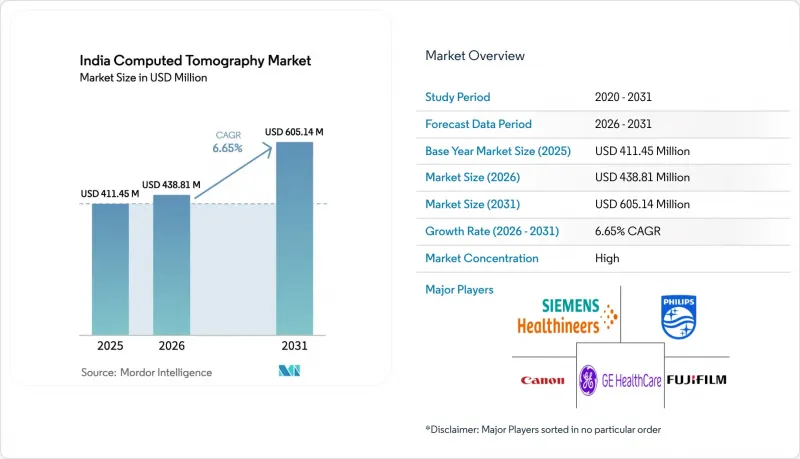
This report is Segmented by Technology (Low-Slice, Mid-Slice, High-Slice), Product Type (Stationary CT Scanners, Portable/Mobile CT Scanners), Application (Oncology, Cardiology, Neurology, and More), End-User (Hospitals, Diagnostic Imaging Centers, and More), Device Architecture (Spiral/Helical CT, Ring-Gantry CT, and More). The Market Forecasts are Provided in Terms of Value (USD).
India Computed Tomography Market Trends and Insights
Escalating Cancer Prevalence & Screening Programs
Nearly 2 million new cancer cases are expected annually by 2040, heightening the need for timely CT-based diagnosis. Standardized pathways from the National Cancer Grid are funneling more patients to imaging centers equipped with 64-slice or higher platforms. Government projects such as MegCan Care are removing cost barriers, lifting examination volume at public hospitals. AI-powered oncology suites introduced at AIIMS Delhi demonstrate how image-analysis algorithms can cut report turnaround time and improve tumor detection accuracy. With oncology already the largest clinical segment inside the India Computed Tomography (CT) market, broader screening protocols are reinforcing equipment replacement cycles in metropolitan hubs before diffusing to tier-2 cities.
Rising Public-Sector Hospital Capex (Ayushman Bharat, State Tenders)
The Pradhan Mantri Ayushman Bharat Health Infrastructure Mission allocates USD 7.7 billion for new and upgraded diagnostic suites across India. Procurement guidelines favor domestically manufactured scanners, accelerating order flow for vendors with PLI-certified plants. Recent installations of 128-slice units in government trauma centers are raising the benchmark for image quality in emergency medicine. Sixteen additional AIIMS campuses, each requiring multi-room imaging departments, promise recurring tenders through the decade. Reimbursement revisions under CGHS, with higher tariffs for accredited facilities, are cushioning operating margins for public hospitals that invest in dose-efficient CT platforms.
High Acquisition & Lifecycle Costs of >=64-Slice Systems
Premium systems can exceed total equipment budgets of mid-sized hospitals, especially where per-bed capital outlay is capped near USD 18,000. Service contracts, tube replacements and software updates often equal 40-60% of the original invoice across a decade. These economics constrain adoption beyond metropolitan centers despite rising clinical demand for cardiac CT angiography. Although domestic manufacturing trims list prices, financing innovations will remain critical for broader penetration of the India Computed Tomography (CT) market.
Other drivers and restraints analyzed in the detailed report include:
- Rapid AI/ML Integration for Dose-Optimized Scans & Workflow
- PLI-Led Domestic CT Manufacturing Push
- Shortage of Radiologists / Service Engineers
For complete list of drivers and restraints, kindly check the Table Of Contents.
Segment Analysis
Mid-slice scanners accounted for 42.78% of the India Computed Tomography (CT) market in 2025, confirming their sweet-spot balance between price and performance. Rising cardiology and trauma volumes are prompting tier-1 hospitals to upgrade to 128-slice platforms, which are advancing at 7.08% CAGR through 2031. The India Computed Tomography (CT) market size for 64-slice equipment remains substantial, but share is drifting toward higher arrays as procurement specifications tighten. Vendors are launching AI-ready mid-slice models with iterative reconstruction engines, preserving the segment's relevance in budget-sensitive districts. Over time, lower total cost of ownership and dual-energy add-ons are expected to accelerate the shift away from <64-slice machines.
Second-generation photon-counting prototypes showcased at AOCR 2025 spotlight long-term innovation pathways, yet commercial uptake will hinge on price curves suitable for the India Computed Tomography (CT) market. Government tenders are also specifying radiation dose caps, giving AI-assisted 128-slice units an edge. Consequently, the technology landscape will feature a gradual laddering effect, with mid-slice as entry point and high-slice as clinical aspiration.
Stationary platforms held 88.22% share of the India Computed Tomography (CT) market size in 2025. Their integration with PACS, power infrastructure and shielding makes them the backbone of multispecialty hospitals. Portable scanners, however, are registering the quickest 7.56% CAGR by delivering bedside neuro imaging in intensive-care units. Manufacturers are shrinking gantry footprints and using lithium-ion power packs to suit makeshift isolation wards. Policy efforts to equip disaster-response teams with mobile CT vans are opening a parallel growth track. As trauma protocols mature, dual-duty deployments that swing between emergency departments and operating suites are likely to lift mobility's contribution inside the India Computed Tomography (CT) market.
Financiers are experimenting with pay-per-day rental contracts for pop-up radiology camps, fostering first-time adoption in remote areas. Yet image-quality limitations and cooling requirements confine mobile units to targeted clinical scenarios. The stationary segment will thus preserve its structural dominance, aided by hospital-bed expansion programs that anchor volume stability.
Complete Report Scope:
- By Technology (Slice Count)
- Low-slice (<64)
- Mid-slice (64)
- High-slice (128-256)
- By Product Type
- Stationary CT Scanners
- Portable / Mobile CT Scanners
- By Application
- Oncology
- Lung Cancer Screening
- Head & Neck Oncology
- Colorectal Oncology
- Other Oncology
- Cardiology
- Coronary CT Angiography
- Calcium Scoring
- Structural Heart Disease
- Neurology
- Stroke Assessment
- Brain Trauma
- Vascular
- Peripheral Vascular Disease
- Pulmonary Angiography
- Musculoskeletal
- Orthopedic Trauma
- Sports Injuries
- Dental & Maxillofacial
- Trauma & Emergency
- Other Applications
- Oncology
- By End-User
- Hospitals
- Public Hospitals
- Private Hospitals
- Diagnostic Imaging Centers
- Dental Clinics
- Veterinary Clinics & Hospitals
- Academic & Research Institutes
- Hospitals
- By Device Architecture
- Spiral / Helical CT
- Ring-Gantry CT
- C-arm CT
- O-arm CT
- Flat-Panel Detector CT
List of Companies Covered in this Report:
- GE HealthCare Technologies Inc.
- Siemens Healthineers
- Koninklijke Philips
- Canon
- United Imaging Healthcare Co., Ltd.
- Hitachi
- FUJIFILM
- Trivitron Healthcare
- Allengers Medical Systems Ltd.
- Carestream Health
- Neusoft
- Shenzhen Anke High-tech Co., Ltd.
- Planmed
- Shimadzu
- Samsung Group
- Vatech Co., Ltd.
Additional Benefits:
- The market estimate (ME) sheet in Excel format
- 3 months of analyst support
TABLE OF CONTENTS
1 Introduction
- 1.1 Study Assumptions & Market Definition
- 1.2 Scope of the Study
2 Research Methodology
3 Executive Summary
4 Market Landscape
- 4.1 Market Overview
- 4.2 Market Drivers
- 4.2.1 Escalating cancer prevalence & screening programmes
- 4.2.2 Rising public-sector hospital capex (Ayushman Bharat, state tenders)
- 4.2.3 Rapid AI/ML integration for dose-optimized scans & workflow
- 4.2.4 PLI-led domestic CT manufacturing push
- 4.2.5 Teleradiology uptake in Tier-2/3 cities enabling scanner demand
- 4.2.6 Micro-leasing & NBFC financing models for stand-alone diagnostics
- 4.3 Market Restraints
- 4.3.1 High acquisition & lifecycle costs of >=64-slice systems
- 4.3.2 Shortage of radiologists / service engineers
- 4.3.3 Low reimbursement tariffs under CGHS & private insurers
- 4.3.4 Radiation-safety licensing delays (AERB)
- 4.4 Value / Supply-Chain Analysis
- 4.5 Regulatory Landscape
- 4.6 Technological Outlook
- 4.7 Porter's Five Forces
- 4.7.1 Threat of New Entrants
- 4.7.2 Bargaining Power of Suppliers
- 4.7.3 Bargaining Power of Buyers
- 4.7.4 Threat of Substitutes
- 4.7.5 Industry Rivalry
5 Market Size & Growth Forecasts (Value)
- 5.1 By Technology (Slice Count)
- 5.1.1 Low-slice (<64)
- 5.1.2 Mid-slice (64)
- 5.1.3 High-slice (128-256)
- 5.2 By Product Type
- 5.2.1 Stationary CT Scanners
- 5.2.2 Portable / Mobile CT Scanners
- 5.3 By Application
- 5.3.1 Oncology
- 5.3.1.1 Lung Cancer Screening
- 5.3.1.2 Head & Neck Oncology
- 5.3.1.3 Colorectal Oncology
- 5.3.1.4 Other Oncology
- 5.3.2 Cardiology
- 5.3.2.1 Coronary CT Angiography
- 5.3.2.2 Calcium Scoring
- 5.3.2.3 Structural Heart Disease
- 5.3.3 Neurology
- 5.3.3.1 Stroke Assessment
- 5.3.3.2 Brain Trauma
- 5.3.4 Vascular
- 5.3.4.1 Peripheral Vascular Disease
- 5.3.4.2 Pulmonary Angiography
- 5.3.5 Musculoskeletal
- 5.3.5.1 Orthopedic Trauma
- 5.3.5.2 Sports Injuries
- 5.3.6 Dental & Maxillofacial
- 5.3.7 Trauma & Emergency
- 5.3.8 Other Applications
- 5.3.1 Oncology
- 5.4 By End-User
- 5.4.1 Hospitals
- 5.4.1.1 Public Hospitals
- 5.4.1.2 Private Hospitals
- 5.4.2 Diagnostic Imaging Centers
- 5.4.3 Dental Clinics
- 5.4.4 Veterinary Clinics & Hospitals
- 5.4.5 Academic & Research Institutes
- 5.4.1 Hospitals
- 5.5 By Device Architecture
- 5.5.1 Spiral / Helical CT
- 5.5.2 Ring-Gantry CT
- 5.5.3 C-arm CT
- 5.5.4 O-arm CT
- 5.5.5 Flat-Panel Detector CT
6 Competitive Landscape
- 6.1 Market Concentration
- 6.2 Market Share Analysis
- 6.3 Company Profiles {(includes Global level Overview, Market level overview, Core Segments, Financials as available, Strategic Information, Market Rank/Share for key companies, Products & Services, and Recent Developments)}
- 6.3.1 GE HealthCare Technologies Inc.
- 6.3.2 Siemens Healthineers AG
- 6.3.3 Koninklijke Philips N.V.
- 6.3.4 Canon Medical Systems Corporation
- 6.3.5 United Imaging Healthcare Co., Ltd.
- 6.3.6 Hitachi, Ltd.
- 6.3.7 Fujifilm Holdings Corporation
- 6.3.8 Trivitron Healthcare Pvt. Ltd.
- 6.3.9 Allengers Medical Systems Ltd.
- 6.3.10 Carestream Health, Inc.
- 6.3.11 Neusoft Medical Systems Co., Ltd.
- 6.3.12 Shenzhen Anke High-tech Co., Ltd.
- 6.3.13 Planmed Oy
- 6.3.14 Shimadzu Corporation
- 6.3.15 Samsung Electronics Co., Ltd.
- 6.3.16 Vatech Co., Ltd.
7 Market Opportunities & Future Outlook
- 7.1 White-space & Unmet-need Assessment

