PUBLISHER: Mordor Intelligence | PRODUCT CODE: 2116709

PUBLISHER: Mordor Intelligence | PRODUCT CODE: 2116709
Spain Computed Tomography - Market Share Analysis, Industry Trends & Statistics, Growth Forecasts (2026 - 2031)
According to Mordor Intelligence, the Spain computed tomography market size is expected to grow from USD 252.68 million in 2025 to USD 267.97 million in 2026 and is forecast to reach USD 359.44 million by 2031 at 6.05% CAGR over 2026-2031.
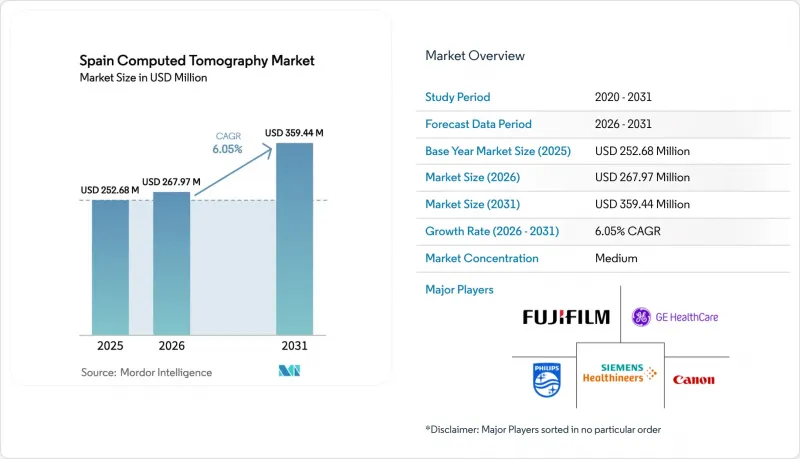
This report is Segmented by Product Type (Low Slice, Medium Slice, and High Slice), Application (Oncology, Neurology, and More), Mobility (Fixed Systems and Mobile Systems), and End User (Hospitals, Diagnostic Imaging Centers, and Others). The Market and Forecasts are Provided in Terms of Value (USD).
Spain Computed Tomography Market Trends and Insights
Government INVEAT Programme Accelerating Scanner Replacement
Spain's INVEAT plan allocates EUR 400 million for high-tech equipment, positioning the public sector to replace aging scanners and close regional gaps in diagnostic capacity. The Spanish Society of Medical Radiology reported that between 32% and 59% of imaging devices exceeded 10 years in service, underscoring the programme's urgency. Madrid is already linking all public hospitals to a unified imaging network scheduled for completion by end-2025, enabling shared protocols and bulk servicing economies . Standardized specifications under INVEAT are encouraging hospitals to favor 64-slice platforms that dovetail with AI upgrades. Training grants attached to the plan are also mitigating the learning curve for spectral imaging and dose-optimization tools.
Rising Geriatric Population & Chronic Disease Incidence
The share of Spaniards aged 65 and above is projected to climb from 20.4% in 2024 to 30.5% by 2055, driving long-run demand for CT-based cancer staging, stroke evaluation, and coronary assessment . New cancer diagnoses are expected to reach 296,103 in 2025, led by prostate, breast, and lung malignancies. Hypertension affects 47% of adult men and 39% of women, increasing CT angiography referrals for plaque characterization . Rural provinces with the steepest aging rates rely on mobile scanners that rotate among district hospitals, ensuring population coverage despite staffing shortages. Low-dose algorithms tailored for frail patients now form part of standard procurement criteria.
High Capital & Maintenance Cost of Multi-Slice Systems
Purchasing a 128-slice scanner can exceed EUR 1 million, with annual service contracts adding 8-12% of the purchase price. Smaller hospitals therefore favor refurbished 64-slice units even though diagnostic throughput is lower. One-third of Spain's CT inventory remains past recommended replacement cycles, raising downtime risk and repair bills. Public tenders attempt to counter cost pressures through group purchasing yet budget ceilings still cap the number of units awarded per region. Maintenance complexity is heightened for photon-counting scanners that require specialized calibration engineers and spare detector modules.
Other drivers and restraints analyzed in the detailed report include:
- Rapid Uptake of Spectral / Photon-Counting CT Upgrades
- Private Health-Insurance Expansion Boosting Scan Volumes
- Shortage of Radiologists Lengthening Scan-to-Report Times
For complete list of drivers and restraints, kindly check the Table Of Contents.
Segment Analysis
Medium-slice platforms are projected to register a 6.78% CAGR through 2031 as hospitals prioritize balanced performance and cost. High-slice models kept a 35.12% Spain computed tomography market share in 2025, cemented by academic centers that manage complex cardiac and oncology protocols. Hospitals use medium-slice units for emergency throughput, abdominal workups, and routine chest scans, stretching budgets without compromising core capability. The Spain computed tomography market size expansion for medium-slice equipment is further supported by standardized INVEAT specifications that list 64-slice minimums, effectively sidelining low-slice offerings. Photon-counting options slot into the high-end niche, attracting private facilities that differentiate on image clarity.
Budget pressures inside the public system tilt replacement cycles toward modular upgrades rather than full-chassis swaps, extending hardware life while adding AI-based dose management. Rural centers deploy refurbished systems sourced from large urban hospitals, yet still benefit from software enhancements covering metal artifact reduction. Vendor service contracts increasingly bundle remote monitoring that predicts tube wear, a feature that trims unplanned downtime.
Oncology held 31.05% share in 2025 as CT remains fundamental for tumor staging, radiation planning, and recurrence surveillance. The Spain computed tomography market size for oncology segments is forecast to keep pace with rising cancer incidence that tops 296,000 new cases in 2025. Neurology scans, driven by stroke codes and dementia workups, are set to grow at 6.85% CAGR, fastest among applications. Stroke prevalence is 2.02% nationally, and door-to-scan times are benchmarked at under 20 minutes for thrombectomy eligibility, stimulating neurology demand.
Cardiovascular studies gain traction on the back of 47% male hypertension prevalence, relying on CT angiography to guide statin therapy and invasive angiograms. Musculoskeletal indications pivot toward low-dose protocols for sports injuries, aligning with Spain's active aging demographic. AI decision support tools in oncology flag subtle lung nodules and bone metastases, decreasing false negatives and standardizing follow-up intervals.
Complete Report Scope:
- By Product Type
- Low Slice
- Medium Slice
- High Slice
- By Application
- Oncology
- Neurology
- Cardiovascular
- Musculoskeletal
- Other Applications
- By Mobility
- Fixed Systems
- Mobile Systems
- By End User
- Hospitals
- Diagnostic Imaging Centers
- Others
List of Companies Covered in this Report:
- Canon
- FUJIFILM
- GE Healthcare
- Koninklijke Philips
- Siemens Healthineers
- Carestream Health
- Planmed
- Samsung Electronics Co., Ltd. (Samsung Medison & NeuroLogica)
- Shimadzu
- United Imaging Healthcare Co., Ltd.
- Esaote
- Neusoft
- Stryker
- Mindray
- Sedecal SA
- GMV Innovating Solutions
- IberScanner SL
- Imascap
Additional Benefits:
- The market estimate (ME) sheet in Excel format
- 3 months of analyst support
TABLE OF CONTENTS
1 Introduction
- 1.1 Study Assumptions & Market Definition
- 1.2 Scope of the Study
2 Research Methodology
3 Executive Summary
4 Market Landscape
- 4.1 Market Overview
- 4.2 Market Drivers
- 4.2.1 Government INVEAT programme accelerating scanner replacement
- 4.2.2 Rising geriatric population & chronic disease incidence
- 4.2.3 Rapid uptake of spectral / photon-counting CT upgrades
- 4.2.4 Private health-insurance expansion boosting scan volumes
- 4.2.5 AI-ready DICOM standardisation mandates in public hospitals
- 4.2.6 Growing demand for ultra-low-dose paediatric protocols
- 4.3 Market Restraints
- 4.3.1 High capital & maintenance cost of multi-slice systems
- 4.3.2 Radiation-dose concerns and tightening EURATOM limits
- 4.3.3 Shortage of radiologists lengthening scan-to-report times
- 4.3.4 Regional procurement audits slowing equipment tenders
- 4.4 Regulatory Landscape
- 4.5 Technological Outlook
- 4.6 Porters Five Forces Analysis
- 4.6.1 Threat of New Entrants
- 4.6.2 Bargaining Power of Buyers
- 4.6.3 Bargaining Power of Suppliers
- 4.6.4 Threat of Substitute Products
- 4.6.5 Intensity of Competitive Rivalry
5 Market Size & Growth Forecasts (Value, USD)
- 5.1 By Product Type
- 5.1.1 Low Slice
- 5.1.2 Medium Slice
- 5.1.3 High Slice
- 5.2 By Application
- 5.2.1 Oncology
- 5.2.2 Neurology
- 5.2.3 Cardiovascular
- 5.2.4 Musculoskeletal
- 5.2.5 Other Applications
- 5.3 By Mobility
- 5.3.1 Fixed Systems
- 5.3.2 Mobile Systems
- 5.4 By End User
- 5.4.1 Hospitals
- 5.4.2 Diagnostic Imaging Centers
- 5.4.3 Others
6 Competitive Landscape
- 6.1 Market Concentration
- 6.2 Market Share Analysis
- 6.3 Company Profiles (includes Global level Overview, Market level overview, Core Segments, Financials as available, Strategic Information, Market Rank/Share for key companies, Products & Services, and Recent Developments)
- 6.3.1 Canon Medical Systems Corporation
- 6.3.2 Fujifilm Holdings Corporation
- 6.3.3 GE Healthcare
- 6.3.4 Koninklijke Philips N V
- 6.3.5 Siemens Healthineers
- 6.3.6 Carestream Health
- 6.3.7 Planmed Oy
- 6.3.8 Samsung Electronics Co., Ltd. (Samsung Medison & NeuroLogica)
- 6.3.9 Shimadzu Corporation
- 6.3.10 United Imaging Healthcare Co., Ltd.
- 6.3.11 Esaote SpA
- 6.3.12 Neusoft Medical Systems Co., Ltd.
- 6.3.13 Stryker Corp.
- 6.3.14 Mindray Medical International Ltd.
- 6.3.15 Sedecal SA
- 6.3.16 GMV Innovating Solutions
- 6.3.17 IberScanner SL
- 6.3.18 Imascap
7 Market Opportunities & Future Outlook
- 7.1 White-space & Unmet-Need Assessment

