PUBLISHER: Mordor Intelligence | PRODUCT CODE: 2125415

PUBLISHER: Mordor Intelligence | PRODUCT CODE: 2125415
United States Computed Tomography - Market Share Analysis, Industry Trends & Statistics, Growth Forecasts (2026 - 2031)
According to Mordor Intelligence, the United States computed tomography market size is expected to grow from USD 3.48 billion in 2025 to USD 3.71 billion in 2026 and is forecast to reach USD 5.13 billion by 2031 at 6.66% CAGR over 2026-2031.
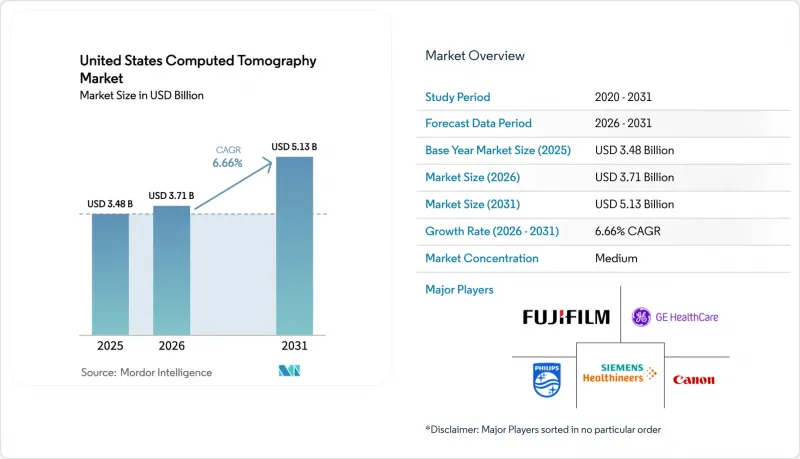
This report is Segmented by Product Type (Low Slice, Medium Slice, and High Slice), Application (Oncology, Neurology, and More), Mobility (Fixed Systems and Mobile Systems), and End User (Hospitals, Diagnostic Imaging Centers, and Others). The Market and Forecasts are Provided in Terms of Value (USD).
United States Computed Tomography Market Trends and Insights
Rising Prevalence of Chronic Diseases Drives Imaging Demand
Cardiovascular disease is projected to affect 45 million U.S. adults by 2050, and hypertension prevalence is forecast to climb from 51.2% in 2020 to 61.0% in 2050. Parallel increases in obesity, depression, and hyperlipidemia have lifted multimorbidity from 52.5% to 59.5% among younger adults between 2013 and 2023. Greater clinical complexity translates into higher examination volumes; CT utilization is expected to rise 25.1% through 2055 . Hospitals are expanding cardiac CT programs in anticipation of a 175% surge in procedures per site by 2030. Medicare's decision to cover virtual CT colonography is another signal that policymakers see preventive imaging as a cost-saving strategy.
Growing Geriatric Population Accelerates Advanced Imaging Adoption
Adults aged 65+ represent the fastest-growing cohort and prefer outpatient settings that offer faster appointments and easier parking. Hospital spending rose 10.4% in 2023 due in part to geriatric diagnostic complexity. Vizient projects a 13% advance in outpatient advanced imaging volumes over the next decade, led by CT and PET. The shift favors the computed tomography market because ambulatory centers often adopt mid-tier scanners that combine cardiac capability with lower capital cost. Workforce attrition complicates this growth: male radiologists face a 13.5% exit rate, intensifying staffing gaps.
High Equipment Acquisition Costs Constrain Market Penetration
Upfront scanner prices exceeding USD 1 million strain rural balance sheets; 20% of Americans live in counties now lacking local CT access after hospital closures. Managed service agreements and cash-flow-neutral financing have gained traction as providers seek to match payments with revenue cycles. Siemens' SOMATOM Pro.Pulse reduces energy draw by 20%, lowering total cost for small facilities.
Other drivers and restraints analyzed in the detailed report include:
- Continuous Technological Advancements Transform Clinical Workflows
- Expanded CMS Reimbursement Enhances Access to Preventive Screening
- Radiology Workforce Shortages Limit Scanner Utilization Potential
For complete list of drivers and restraints, kindly check the Table Of Contents.
Segment Analysis
High-slice platforms held 35.12% of the computed tomography market share in 2025, reflecting their dominance in cardiac, trauma, and oncology imaging where rapid temporal resolution is critical. Medium-slice systems are forecast to deliver a 7.53% CAGR and are increasingly selected by outpatient centers seeking cardiac capability without the cost of 256-slice flagships. GE Healthcare's Revolution Vibe offers single-heartbeat imaging at a mid-tier price, illustrating the market's pivot toward value-centric upgrades. Low-slice scanners remain relevant for pediatric follow-up and basic trauma studies when dose minimization is paramount. Constrained capital budgets, especially in non-urban facilities, favor mid-range replacements, encouraging suppliers to expand configurable options and AI bundles.
An installed-base shift is under way as providers retire 16-slice workhorses introduced in the early 2000s. Refurbishment programs target safety-net hospitals, whereas private equity-backed imaging chains prefer new installations to capture capacity incentives from payers. The computed tomography market benefits as medium configurations deliver robust ROI in outpatient corridors competing with hospital-owned centers. Vendor neutrality in post-processing has also reduced lock-in, further supporting mid-range adoption. Overall, budget alignment and throughput requirements make medium-slice technology the segment to watch through 2031.
Oncology captured 33.05% of the computed tomography market size in 2025, supported by expanding immunotherapy protocols that require serial monitoring. Neurology, however, will be the fastest climber at 7.44% CAGR because AI triage tools cut scan-to-treatment time for stroke. RapidAI's Lumina 3D slashes head-and-neck CTA reconstructions from hours to minutes, allowing technologists to move more patients per shift. Cardiovascular volumes also rise as CMS broadens coronary CTA reimbursement, prompting providers to install scanners with >=128 slices for plaque analytics.
Photon-counting detectors are opening new musculoskeletal horizons by resolving trabecular microarchitecture, valuable in osteoporosis management. Emergency departments still rely on whole-body trauma protocols, yet dose-optimized iterative reconstruction helps comply with ALARA guidelines in pediatric workups. The net effect is a demand mix that encourages vendors to ship multipurpose scanners configurable per clinical service line.
Complete Report Scope:
- By Product Type
- Low Slice
- Medium Slice
- High Slice
- By Application
- Oncology
- Neurology
- Cardiovascular
- Musculoskeletal
- Other Applications
- By Mobility
- Fixed Systems
- Mobile Systems
- By End User
- Hospitals
- Diagnostic Imaging Centers
- Others
List of Companies Covered in this Report:
- GE Healthcare
- Siemens Healthineers
- Koninklijke Philips
- Canon Medical Systems USA, Inc.
- FUJIFILM
- Carestream Health
- United Imaging Healthcare
- Samsung Neurologica Corp.
- Neusoft
- Planmeca Group (Planmed Oy)
- Koning
- Accuray
- Imris Deerfield Imaging
- Analogic
- CurveBeam
- Xoran Technologies
- Spectrum Dynamics Medical
- Epica Medical Innovations
- Animage
Additional Benefits:
- The market estimate (ME) sheet in Excel format
- 3 months of analyst support
TABLE OF CONTENTS
1 Introduction
- 1.1 Study Assumptions & Market Definition
- 1.2 Scope of the Study
2 Research Methodology
3 Executive Summary
4 Market Landscape
- 4.1 Market Overview
- 4.2 Market Drivers
- 4.2.1 Rising prevalence of chronic diseases
- 4.2.2 Growing geriatric population
- 4.2.3 Continuous technological advancements in CT
- 4.2.4 Expanded CMS reimbursement for low-dose lung cancer screening (LDCT)
- 4.2.5 Adoption of mobile CT in outpatient & trauma settings
- 4.2.6 Rapid AI-based workflow & image-quality upgrades
- 4.3 Market Restraints
- 4.3.1 High equipment acquisition & maintenance costs
- 4.3.2 Stringent FDA regulatory pathway & 510(k) backlog
- 4.3.3 Radiation-dose related patient safety concerns
- 4.3.4 Radiology workforce shortages constraining scanner utilization
- 4.4 Regulatory Landscape
- 4.5 Technological Outlook
- 4.6 Porters Five Forces Analysis
- 4.6.1 Threat of New Entrants
- 4.6.2 Bargaining Power of Buyers
- 4.6.3 Bargaining Power of Suppliers
- 4.6.4 Threat of Substitute Products
- 4.6.5 Intensity of Competitive Rivalry
5 Market Size & Growth Forecasts (Value, USD)
- 5.1 By Product Type
- 5.1.1 Low Slice
- 5.1.2 Medium Slice
- 5.1.3 High Slice
- 5.2 By Application
- 5.2.1 Oncology
- 5.2.2 Neurology
- 5.2.3 Cardiovascular
- 5.2.4 Musculoskeletal
- 5.2.5 Other Applications
- 5.3 By Mobility
- 5.3.1 Fixed Systems
- 5.3.2 Mobile Systems
- 5.4 By End User
- 5.4.1 Hospitals
- 5.4.2 Diagnostic Imaging Centers
- 5.4.3 Others
6 Competitive Landscape
- 6.1 Market Concentration
- 6.2 Market Share Analysis
- 6.3 Company Profiles (includes Global level Overview, Market level overview, Core Segments, Financials as available, Strategic Information, Market Rank/Share, Products & Services, Recent Developments)
- 6.3.1 GE Healthcare
- 6.3.2 Siemens Healthineers AG
- 6.3.3 Koninklijke Philips NV
- 6.3.4 Canon Medical Systems USA, Inc.
- 6.3.5 Fujifilm Holdings Corporation
- 6.3.6 Carestream Health
- 6.3.7 United Imaging Healthcare
- 6.3.8 Samsung Neurologica Corp.
- 6.3.9 Neusoft Medical Systems Co. Ltd
- 6.3.10 Planmeca Group (Planmed Oy)
- 6.3.11 Koning Corporation
- 6.3.12 Accuray Incorporated
- 6.3.13 Imris Deerfield Imaging
- 6.3.14 Analogic Corporation
- 6.3.15 CurveBeam
- 6.3.16 Xoran Technologies
- 6.3.17 Spectrum Dynamics Medical
- 6.3.18 Epica Medical Innovations
- 6.3.19 Animage LLC
7 Market Opportunities & Future Outlook
- 7.1 White-space & Unmet-Need Assessment

