PUBLISHER: Mordor Intelligence | PRODUCT CODE: 2116672

PUBLISHER: Mordor Intelligence | PRODUCT CODE: 2116672
Germany Mammography - Market Share Analysis, Industry Trends & Statistics, Growth Forecasts (2026 - 2031)
According to Mordor Intelligence, Germany mammography market size in 2026 is estimated at USD 149.94 million, growing from 2025 value of USD 137.87 million with 2031 projections showing USD 228.19 million, growing at 8.76% CAGR over 2026-2031.
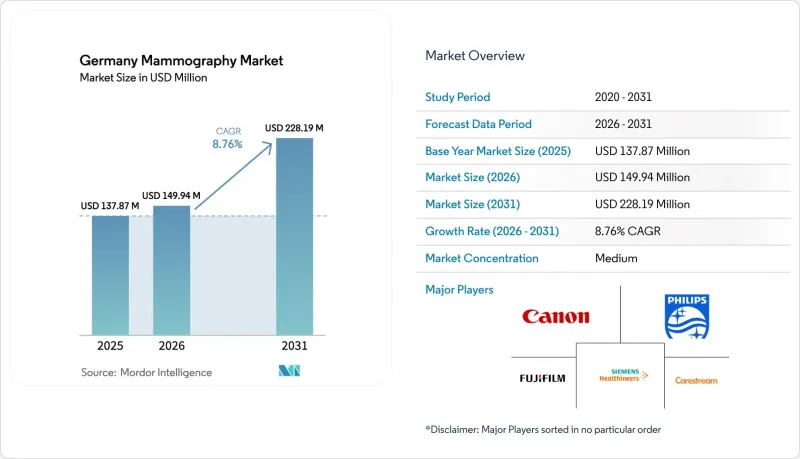
This report is Segmented by Product Type (Digital Systems, Breast Tomosynthesis, Analog Systems, Computer-Aided Detection Software), End User (Hospitals, Diagnostic Imaging Centres, Others), Technology (2-D Full-Field Digital, 3-D DBT, Others). The Market Forecasts are Provided in Terms of Value (USD).
Germany Mammography Market Trends and Insights
Growing Burden of Breast Cancer
Germany recorded 74,500 new breast cancer cases in 2022, making the disease the most common malignancy among German women . The 2024 extension of the national screening program to women aged 70-75 enlarges the eligible cohort by about 2 million, intensifying demand for mammography appointments across both urban and rural regions. Organized screening has already delivered up to a 40% mortality reduction among regularly screened participants. Yet participation still hovers at 51%, leaving a sizeable untapped market that vendors can address through outreach, mobile units, and AI-powered risk stratification tools. Hospitals and imaging centres that invest in patient-centric digital scheduling and educational campaigns are well positioned to capture this latent demand.
National Roll-Out of AI-Enabled Screening Programs
The PRAIM multicenter study covering 463,094 women demonstrated that AI support increased detection rates by 17.6% without inflating recall rates. As of 2025, at least a dozen screening sites nationwide have embedded AI triage into routine workflow, freeing radiologists to focus on complex reads while maintaining quality benchmarks. Berlin-based Vara now processes more than 80,000 studies each month, underscoring domestic capability to scale AI solutions quickly. Regulatory backing from the Federal Office for Radiation Protection further paves the way for AI applications in younger age brackets, suggesting that adoption curves could steepen beyond current forecasts. Vendors bundling AI with hardware upgrades are therefore able to offer a compelling total-solution narrative to both hospitals and outpatient centres.
Radiation-Dose Related Patient Apprehension
Despite modern devices lowering mean glandular dose to between 1-10 mGy, over-estimation of radiation risk keeps some women from attending screening exams. Younger, university-educated cohorts are especially cautious, demanding detailed dose disclosures and safety assurances. Vendors are responding with low-dose protocols and dose-tracking dashboards that clinicians can share during consultations. Educational campaigns anchored in transparent risk-benefit messaging have proven effective in closing the perception gap, but they require sustained funding from insurers and public-health agencies to maintain momentum.
Other drivers and restraints analyzed in the detailed report include:
- Increased Reimbursement for Digital Breast Tomosynthesis
- Rapid Hospital Digitization Through KHZG Funding
- Venture-Backed German Fem-Tech Start-Ups Promoting Self-Referral
- Declining Private Insurance Coverage for Opportunistic Screening
- Shortage of Sub-Specialised Breast Radiologists in Tier-2 Cities
For complete list of drivers and restraints, kindly check the Table Of Contents.
Segment Analysis
Digital systems contributed USD 62.21 million to revenue in 2025 and captured 45.12% of the Germany mammography market share, underscoring the wholesale transition away from film-screen and CR platforms. Breast tomosynthesis, while still a smaller category, is projected to clock a 9.02% CAGR through 2031 thanks to guidelines that place DBT on par with 2-D mammography for organized screening reimbursement. Analog systems continue to phase out as KHZG grants encourage IT-connected modalities that feed directly into electronic health records.
Manufacturers now bundle AI computer-aided detection (CAD) suites with hardware sales, increasing deal sizes and differentiating offerings in competitive tenders. Siemens Healthineers' MAMMOMAT B.brilliant, cleared by the FDA in 2024, showcases titanium contrast-enhanced mammography and wide-angle tomosynthesis for dense-breast visualization. As payers reward better sensitivity and specificity metrics, providers see stronger ROI in premium systems. The Germany mammography market continues to favor platforms that integrate seamlessly with hospital RIS-PACS environments, comply with MDR 2017/745, and deliver cybersecurity measures aligned with KHZG rules.
Complete Report Scope:
- By Product Type
- Digital Systems
- Breast Tomosynthesis
- Analog Systems
- Computer-Aided Detection (CAD) Software
- By End User
- Hospitals
- Diagnostic Imaging Centres
- Others
- By Technology
- 2-D Full-Field Digital
- 3-D DBT
- Others
List of Companies Covered in this Report:
- Siemens Healthineers
- Hologic
- GE Healthcare
- Koninklijke Philips
- Fujifilm Holdings Corp.
- Canon
- Carestream Health
- Planmed
- Metaltronica
- IMS Giotto S.p.A.
- Agfa-Gevaert
- Sectra
- Tridilogy GmbH (MammoCoach)
- ScreenPoint Medical B.V.
- iCAD Inc.
- NU MED GmbH
- SternMed
- SmartBreast (Germany) GmbH
- Micropos Medical AB
- Gamma Medic Systems GmbH
Additional Benefits:
- The market estimate (ME) sheet in Excel format
- 3 months of analyst support
TABLE OF CONTENTS
1 Introduction
- 1.1 Study Assumptions & Market Definition
- 1.2 Scope of the Study
2 Research Methodology
3 Executive Summary
4 Market Landscape
- 4.1 Market Overview
- 4.2 Market Drivers
- 4.2.1 Growing Burden Of Breast Cancer
- 4.2.2 National Roll-Out Of AI-Enabled Screening Programs
- 4.2.3 Increased Reimbursement For Digital Breast Tomosynthesis
- 4.2.4 Rapid Hospital Digitisation Through Krankenhauszukunftsgesetz Funding
- 4.2.5 Venture-Backed German Fem-Tech Start-Ups Promoting Self-Referral
- 4.2.6 Expansion Of Mobile Screening Vans In Rural Lander
- 4.3 Market Restraints
- 4.3.1 Radiation-Dose Related Patient Apprehension
- 4.3.2 Declining Private Insurance Coverage For Opportunistic Screening
- 4.3.3 Shortage Of Sub-Specialised Breast Radiologists In Tier-2 Cities
- 4.3.4 High Capital Cost Vs. DR-Capable General X-Ray Alternatives
- 4.4 Value / Supply-Chain Analysis
- 4.5 Regulatory Landscape
- 4.6 Technological Outlook
- 4.7 Porter's Five Forces
- 4.7.1 Threat of New Entrants
- 4.7.2 Bargaining Power of Buyers
- 4.7.3 Bargaining Power of Suppliers
- 4.7.4 Threat of Substitutes
- 4.7.5 Competitive Rivalry
5 Market Size & Growth Forecasts
- 5.1 By Product Type
- 5.1.1 Digital Systems
- 5.1.2 Breast Tomosynthesis
- 5.1.3 Analog Systems
- 5.1.4 Computer-Aided Detection (CAD) Software
- 5.2 By End User
- 5.2.1 Hospitals
- 5.2.2 Diagnostic Imaging Centres
- 5.2.3 Others
- 5.3 By Technology
- 5.3.1 2-D Full-Field Digital
- 5.3.2 3-D DBT
- 5.3.3 Others
6 Competitive Landscape
- 6.1 Market Concentration
- 6.2 Market Share Analysis
- 6.3 Company Profiles (includes Global level Overview, Market level overview, Core Segments, Financials as available, Strategic Information, Market Rank/Share for key companies, Products & Services, and Recent Developments)
- 6.3.1 Siemens Healthineers AG
- 6.3.2 Hologic Inc.
- 6.3.3 GE HealthCare
- 6.3.4 Koninklijke Philips N.V.
- 6.3.5 Fujifilm Holdings Corp.
- 6.3.6 Canon Medical Systems Corp.
- 6.3.7 Carestream Health Inc.
- 6.3.8 Planmed Oy
- 6.3.9 Metaltronica S.p.A.
- 6.3.10 IMS Giotto S.p.A.
- 6.3.11 Agfa-Gevaert N.V.
- 6.3.12 Sectra AB
- 6.3.13 Tridilogy GmbH (MammoCoach)
- 6.3.14 ScreenPoint Medical B.V.
- 6.3.15 iCAD Inc.
- 6.3.16 NU MED GmbH
- 6.3.17 SternMed GmbH
- 6.3.18 SmartBreast (Germany) GmbH
- 6.3.19 Micropos Medical AB
- 6.3.20 Gamma Medic Systems GmbH
7 Market Opportunities & Future Outlook
- 7.1 White-space & unmet-need assessment

