PUBLISHER: Mordor Intelligence | PRODUCT CODE: 2116744

PUBLISHER: Mordor Intelligence | PRODUCT CODE: 2116744
France Mammography - Market Share Analysis, Industry Trends & Statistics, Growth Forecasts (2026 - 2031)
According to Mordor Intelligence, the France mammography market size is expected to grow from USD 119.36 million in 2025 to USD 129.78 million in 2026 and is forecast to reach USD 197.16 million by 2031 at 8.73% CAGR over 2026-2031.
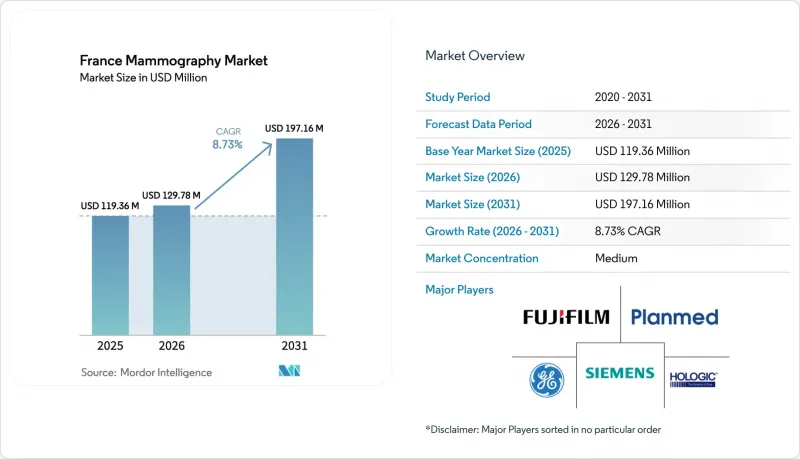
This report is Segmented by Product Type (Digital Systems, Analog Systems, Breast Tomosynthesis, Other Product Types), End User (Hospitals, Specialty Clinics, Diagnostic Centers), Technology (2-D Digital Mammography, 3-D Digital Mammography). The Market Forecasts are Provided in Terms of Value (USD).
France Mammography Market Trends and Insights
Growing Incidence of Breast Cancer in France
More than 61 000 women received a breast-cancer diagnosis in 2024, keeping the disease France's most common female malignancy . Eight out of ten cases arise after age 50, perfectly aligning with the target age bracket of the organized screening program. Policymakers are now evaluating an age-threshold reduction as nearly 5 000 women under 40 receive a diagnosis each year, signaling potential expansion in screening volumes. Regional disparities are stark, with participation ranging from 35% in Corsica to 57% in Centre-Val-de-Loire. These participation gaps translate into equipment-density imbalances that vendors can exploit by focusing sales efforts on low-uptake departments. The Institut National du Cancer reported 38 000 cancers detected via screening in 2023, underscoring how capacity additions directly influence early-detection outcomes. Rising incidence therefore sustains a baseline demand curve for the France Mammography Market that is immune to macroeconomic volatility.
Technological Shift Toward 3-D Breast Tomosynthesis
In March 2023 the Haute Autorite de Sante validated tomosynthesis for organized screening after clinical evidence demonstrated superior lesion detection without exceeding acceptable radiation limits. Large centers, such as Hopital d'Instruction des Armees Begin, quickly installed new-generation 3-D units in 2024. Yet national rollout faces bottlenecks-mainly limited PACS bandwidth and the need for radiologist re-training. Vendors that bundle 3-D hardware with robust archiving and AI-triage software capture a competitive edge. Over 2025-2027, procurement frameworks managed by regional health agencies are expected to prioritize tomosynthesis-ready systems, accelerating replacement cycles. As a result, the France Mammography Market anticipates double-digit annual installations of 3-D units through the medium term.
High Capital Cost of Advanced Systems
Acquiring a tomosynthesis platform plus PACS integration can exceed EUR 450 000 (USD 490 000) for a mid-size public hospital, a price tag that strains budgets set under the national Objective de Depenses d'Assurance Maladie framework. Smaller diagnostic centers often postpone upgrades or lease antiquated units, creating a technology gap. To mitigate sticker shock, Siemens Healthineers signed a 12-year, EUR 55 million value partnership with University Hospital Nantes that spreads costs across service years and guarantees technology refreshes. Such models are gaining traction, yet financing hurdles still slow overall adoption, dragging the France Mammography Market CAGR by an estimated 1.8 percentage points.
Other drivers and restraints analyzed in the detailed report include:
- Expansion of National Screening & Reimbursement Programs
- AI-Enabled CAD Tools Boosting Diagnostic Throughput
- Risk of Radiation Exposure & Patient Anxiety
For complete list of drivers and restraints, kindly check the Table Of Contents.
Segment Analysis
Digital Systems generated 67.12% of 2025 revenue, cementing their role as the backbone of organized screening because ANSM quality-control rules effectively disqualify analog units from program participation. Hospitals typically renew digital hardware every 7-8 years, so a sizable installed base is now entering a replacement cycle that will buoy the France Mammography Market through 2031. Breast Tomosynthesis, though currently smaller, is growing at a 9.03% CAGR as facilities pivot toward 3-D imaging for its higher cancer-detection yield. Analog Systems command single-digit revenue shares and face imminent retirement, while Other Product Types-such as contrast-enhanced mammography-remain niche but could gain relevance for high-risk populations.
Procurement behavior illustrates two tiers: university hospitals purchase fully loaded tomosynthesis suites with integrated AI, whereas community clinics favor entry-level digital machines with upgrade paths. GE Healthcare's Senographe Pristina and Hologic's 3Dimensions exemplify vendor strategies that pair ergonomic design with workflow-friendly features like zero-click positioning. Fujifilm and IMS Giotto differentiate on dose-sparing technology, appealing to facilities eager to address patient-radiation concerns. These competitive nuances will shape market-share shifts within the Digital and Tomosynthesis subsegments over the forecast horizon.
Complete Report Scope:
- By Product Type
- Digital Systems
- Analog Systems
- Breast Tomosynthesis
- Other Product Types
- By End User
- Hospitals
- Specialty Clinics
- Diagnostic Centers
- By Technology
- 2-D Digital Mammography
- 3-D Digital Mammography
List of Companies Covered in this Report:
- GE Healthcare
- Siemens Healthineers
- Hologic
- Fujifilm Holdings Corp.
- Koninklijke Philips
- Canon
- Carestream Health
- Planmed
- Samsung Group
- Agfa-Gevaert
- IMS Giotto S.p.A.
- Metaltronica
- Analogic
- Koning
- Olea Medical
- Esaote
- Shenzhen Mindray Bio-Medical
- United Imaging Healthcare
Additional Benefits:
- The market estimate (ME) sheet in Excel format
- 3 months of analyst support
TABLE OF CONTENTS
1 Introduction
- 1.1 Study Assumptions & Market Definition
- 1.2 Scope of the Study
2 Research Methodology
3 Executive Summary
4 Market Landscape
- 4.1 Market Overview
- 4.2 Market Drivers
- 4.2.1 Growing Incidence Of Breast Cancer In France
- 4.2.2 Technological Shift Toward 3-D Breast Tomosynthesis
- 4.2.3 Expansion Of National Screening & Reimbursement Programs
- 4.2.4 Rising Public-Private Awareness Campaigns
- 4.2.5 AI-Enabled Cad Tools Boosting Diagnostic Throughput
- 4.2.6 Deployment Of Mobile Mammography Units In Rural France
- 4.3 Market Restraints
- 4.3.1 Risk Of Radiation Exposure & Patient Anxiety
- 4.3.2 High Capital Cost Of Advanced Systems
- 4.3.3 Shortage Of Breast-Imaging Radiologists In Certain Departements
- 4.3.4 Legacy Analog Infrastructure Delaying Digital Adoption
- 4.4 Value / Supply-Chain Analysis
- 4.5 Regulatory Landscape
- 4.6 Technological Outlook
- 4.7 Porter's Five Forces
- 4.7.1 Threat of New Entrants
- 4.7.2 Bargaining Power of Buyers/Consumers
- 4.7.3 Bargaining Power of Suppliers
- 4.7.4 Threat of Substitute Products
- 4.7.5 Intensity of Competitive Rivalry
5 Market Size & Growth Forecasts (Value, USD mn)
- 5.1 By Product Type
- 5.1.1 Digital Systems
- 5.1.2 Analog Systems
- 5.1.3 Breast Tomosynthesis
- 5.1.4 Other Product Types
- 5.2 By End User
- 5.2.1 Hospitals
- 5.2.2 Specialty Clinics
- 5.2.3 Diagnostic Centers
- 5.3 By Technology
- 5.3.1 2-D Digital Mammography
- 5.3.2 3-D Digital Mammography
6 Competitive Landscape
- 6.1 Market Concentration
- 6.2 Market Share Analysis
- 6.3 Company Profiles (includes Global level Overview, Market level overview, Core Segments, Financials as available, Strategic Information, Market Rank/Share for key companies, Products & Services, and Recent Developments)
- 6.3.1 GE Healthcare
- 6.3.2 Siemens Healthineers
- 6.3.3 Hologic Inc.
- 6.3.4 Fujifilm Holdings Corp.
- 6.3.5 Koninklijke Philips N.V.
- 6.3.6 Canon Medical Systems Corp.
- 6.3.7 Carestream Health Inc.
- 6.3.8 Planmed Oy
- 6.3.9 Samsung Medison
- 6.3.10 Agfa-Gevaert Group
- 6.3.11 IMS Giotto S.p.A.
- 6.3.12 Metaltronica S.p.A.
- 6.3.13 Analogic Corporation
- 6.3.14 Koning Corporation
- 6.3.15 Olea Medical
- 6.3.16 Esaote SpA
- 6.3.17 Shenzhen Mindray Bio-Medical
- 6.3.18 United Imaging Healthcare
7 Market Opportunities & Future Outlook
- 7.1 White-space & Unmet-need Assessment

