PUBLISHER: Mordor Intelligence | PRODUCT CODE: 2116674

PUBLISHER: Mordor Intelligence | PRODUCT CODE: 2116674
India Mammography - Market Share Analysis, Industry Trends & Statistics, Growth Forecasts (2026 - 2031)
According to Mordor Intelligence, the India mammography market size is expected to grow from USD 74.48 million in 2025 to USD 82.2 million in 2026 and is forecast to reach USD 134.68 million by 2031 at 10.37% CAGR over 2026-2031.
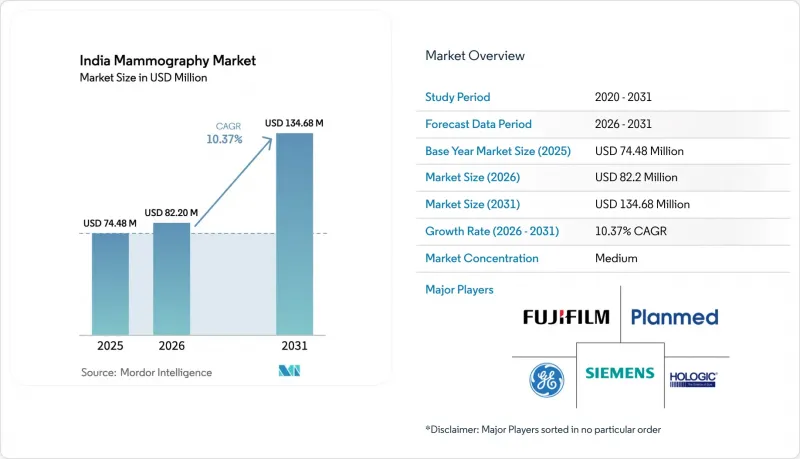
This report is Segmented by Product Type (Digital Systems, Analog Systems, Breast Tomosynthesis, and Other Product Types), End Users (Hospitals, Specialty Clinics, and Diagnostic Centers). The Market Provides the Value (in USD Million) for the Above-Mentioned Segments.
India Mammography Market Trends and Insights
Growing Breast-Cancer Burden in Urban & Semi-Urban India
Breast-cancer diagnoses in India are projected to climb from 806,218 in 2025, driven by delayed childbearing and lifestyle changes. Higher awareness campaigns, especially in metros, are prompting earlier self-referral. Economic modeling places the breast-cancer cost burden at USD 13.95 billion by 2030. These pressures drive sustained procurement of digital systems and mobile units, strengthening the India mammography market.
Government-Funded Population-Based Screening Roll-Outs
The NPCDCS now covers more than 400 districts and has screened over 34.39 crore individuals for common cancers. More than 1,72,148 Ayushman Arogya Mandirs perform routine clinical breast examinations, generating predictable equipment demand across public facilities. Duty exemptions on select oncology drugs and the National Cancer Grid's standardized protocols further reinforce volume certainty . The program's expansion into rural health sub-centers anchors the long-term trajectory of the India mammography market.
Uneven Reimbursement & Low Private Insurance Penetration
Only 41.2% of households have any insurance cover, and a mere 3.3% rely on private plans, stifling preventive screening uptake. State-level disparities are stark; Rajasthan reports 87.9% coverage while some island territories sit below 2%. Out-of-pocket mammography spending remains high because underwriting rules often treat screening as elective. Despite IRDAI guidance allowing coverage, real-world claims for mammograms stay low . These gaps defer elective imaging and weigh on the India mammography market.
Other drivers and restraints analyzed in the detailed report include:
- Expansion of Private Diagnostic Chains into Tier-2/Tier-3 Cities
- Rapid Hospital Adoption of 3-D/DBT Upgrades
- Radiation-Exposure Concerns Among Pre-Menopausal Women
For complete list of drivers and restraints, kindly check the Table Of Contents.
Segment Analysis
Digital Systems generated 69.78% of the India mammography market share in 2025 and underpin the nationwide shift toward image-rich, radiation-efficient diagnostics. Their cloud connectivity aligns with tele-radiology workflows, enabling remote reads from metro hubs. The India mammography market size for Digital Systems is expected to scale rapidly as state oncology programs mandate DICOM-compliant storage. Analog units are being phased out, often traded in for mobile vans targeting single-day screening camps. Other Product Types-biopsy-guided suites and van-mounted devices-show an 11.22% CAGR, buoyed by rural outreach under the National Health Mission.
Growing preference for base-hospital DBT plus satellite mobile units has widened vendor portfolios. Fujifilm alone has installed more than 50,000 medical devices across India, including FFDM scanners optimized for low-resource settings. Quality-assurance guidelines issued by the Breast Imaging Society of India push for uniform calibration and dose monitoring IJBI.IN. These standards reinforce digital predominance and help maintain consistent imaging quality across the India mammography market.
Complete Report Scope:
- By Product Type
- Digital Systems
- Analog Systems
- Other Product Types (Biopsy-guided, Mobile units)
- By End User
- Hospitals
- Specialty Clinics
- Others
- By Technology
- Full-Field Digital Mammography (FFDM)
- Digital Breast Tomosynthesis (DBT)
- Computer-Aided Detection (CAD)
List of Companies Covered in this Report:
- Hologic
- GE Healthcare
- Siemens Healthineers
- Fujifilm Holdings Corp.
- Koninklijke Philips
- Canon
- Carestream Health
- Allengers
- BPL
- Wipro GE Healthcare Pvt Ltd
- Trivitron Healthcare
- Planmed
- IMS Srl
- Metaltronica S.p.A
- Agfa-Gevaert
- Medion Healthcare Pvt Ltd
- Volpara Health Technologies
- KUBtec Medical Imaging
- Vatech Co. Ltd.
- Narang Medical
Additional Benefits:
- The market estimate (ME) sheet in Excel format
- 3 months of analyst support
TABLE OF CONTENTS
1 Introduction
- 1.1 Study Assumptions & Market Definition
- 1.2 Scope of the Study
2 Research Methodology
3 Executive Summary
4 Market Landscape
- 4.1 Market Overview
- 4.2 Market Drivers
- 4.2.1 Growing Burden Of Breast Cancer In Urban & Semi-Urban India
- 4.2.2 Government-Funded Population-Based Screening Roll-Outs
- 4.2.3 Expansion Of Large Private Diagnostic Chains Into Tier-2/Tier-3 Cities
- 4.2.4 Rapid Hospital Adoption Of 3-D/DBT Upgrades As Cap-Ex Costs Fall
- 4.2.5 AI-Enabled Triage Solutions Easing Radiologist Shortage
- 4.2.6 Corporate Wellness Programs Boosting Opportunistic Screening
- 4.3 Market Restraints
- 4.3.1 Uneven Reimbursement & Low Private Insurance Penetration
- 4.3.2 Radiation-Exposure Concerns Among Pre-Menopausal Women
- 4.3.3 Scarcity Of Mammography Technicians In Tier-3 Towns
- 4.3.4 Import-Duty & GST Structure Inflating Device Asps
- 4.4 Value / Supply-Chain Analysis
- 4.5 Regulatory Landscape
- 4.6 Technological Outlook
- 4.7 Porter's Five Forces
- 4.7.1 Threat of New Entrants
- 4.7.2 Bargaining Power of Buyers
- 4.7.3 Bargaining Power of Suppliers
- 4.7.4 Threat of Substitutes
- 4.7.5 Intensity of Competitive Rivalry
5 Market Size & Growth Forecasts (Value)
- 5.1 By Product Type
- 5.1.1 Digital Systems
- 5.1.2 Analog Systems
- 5.1.3 Other Product Types (Biopsy-guided, Mobile units)
- 5.2 By End User
- 5.2.1 Hospitals
- 5.2.2 Specialty Clinics
- 5.2.3 Others
- 5.3 By Technology
- 5.3.1 Full-Field Digital Mammography (FFDM)
- 5.3.2 Digital Breast Tomosynthesis (DBT)
- 5.3.3 Computer-Aided Detection (CAD)
6 Competitive Landscape
- 6.1 Market Concentration
- 6.2 Market Share Analysis
- 6.3 Company Profiles (includes Global level Overview, Market level overview, Core Segments, Financials as available, Strategic Information, Market Rank/Share for key companies, Products & Services, and Recent Developments)
- 6.3.1 Hologic Inc.
- 6.3.2 GE HealthCare
- 6.3.3 Siemens Healthineers
- 6.3.4 Fujifilm Holdings Corp.
- 6.3.5 Koninklijke Philips N.V.
- 6.3.6 Canon Medical Systems Corp.
- 6.3.7 Carestream Health Inc.
- 6.3.8 Allengers Medical Systems Ltd
- 6.3.9 BPL Medical Technologies
- 6.3.10 Wipro GE Healthcare Pvt Ltd
- 6.3.11 Trivitron Healthcare
- 6.3.12 Planmed Oy
- 6.3.13 IMS Srl
- 6.3.14 Metaltronica S.p.A
- 6.3.15 Agfa-Gevaert Group
- 6.3.16 Medion Healthcare Pvt Ltd
- 6.3.17 Volpara Health Technologies
- 6.3.18 KUBtec Medical Imaging
- 6.3.19 Vatech Co. Ltd.
- 6.3.20 Narang Medical Ltd
7 Market Opportunities & Future Outlook
- 7.1 White-space & Unmet-Need Assessment

