PUBLISHER: Mordor Intelligence | PRODUCT CODE: 2116675

PUBLISHER: Mordor Intelligence | PRODUCT CODE: 2116675
Italy Mammography - Market Share Analysis, Industry Trends & Statistics, Growth Forecasts (2026 - 2031)
According to Mordor Intelligence, the Italy mammography market size was valued at USD 106.59 million in 2025 and estimated to grow from USD 115.7 million in 2026 to reach USD 174.39 million by 2031, at a CAGR of 8.55% during the forecast period (2026-2031).
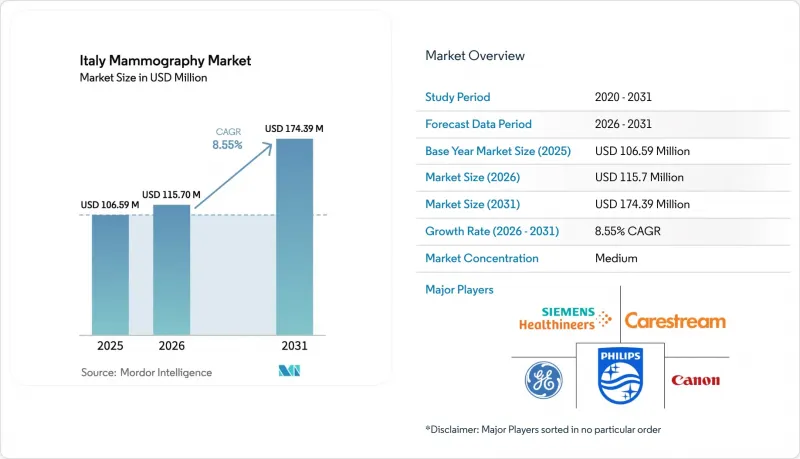
This report is Segmented by Product Type (Digital Systems, Analog Systems, Breast Tomosynthesis, Other Product Types), End User (Hospitals, Specialty Clinics, Diagnostic Centers, Mobile Screening Units), and Geography (Italy). The Market Forecasts are Provided in Terms of Value (USD).
Italy Mammography Market Trends and Insights
Growing Burden of Breast Cancer Cases
Italy records 55,900 new breast-cancer diagnoses each year, and lifetime risk now stands at 1 in 8 women . Early-stage detection offers 88% five-year survival, driving sustained utilization of the Italy mammography market. Incidence is higher in the North, yet better screening adherence keeps metastatic presentation at 5.1% versus 7.8% in the South. Ageing demographics intensify demand, as risk rises sharply after 50. Regional cancer registries underscore the urgency of structured screening to curb late presentation and trim treatment costs. The demographic and epidemiological realities translate into predictable equipment replacement cycles and consistent scan volumes across public and private sectors.
Technological Advancements
Digital breast tomosynthesis paired with synthetic 2-D reconstructions doubles detection rates versus conventional 2-D systems-8.1/1,000 versus 4.5/1,000 in the Verona Pilot Study. AI algorithms now surpass 90% sensitivity compared with 70-80% for manual reads. Hologic's Genius AI Detection and GE HealthCare's SmartMammo rolled out nationwide during 2024, while Campania's Synergy-Net couples AI with 3-D tomosynthesis to enhance dense-breast assessment. Equipment vendors embed algorithms on-board, reducing latency and easing compliance with EU Medical Device Regulation (MDR) quality standards. These advances catalyze the transition from analog fleets and underpin the Italy mammography market's digital premium.
Radiation-Exposure Concerns Limiting Repeat Screening
Educated women in Turin show lower adherence due to heightened radiation worries despite superior awareness. Tomosynthesis delivers higher doses than 2-D imaging but remains within EU safety thresholds. AIRC emphasizes that benefits outweigh risks, yet communication gaps persist. Providers increasingly offer contrast-enhanced or low-dose protocols and deploy decision aids to reassure patients. Mitigating this restraint is pivotal for sustaining participation rates central to Italy mammography market growth.
Other drivers and restraints analyzed in the detailed report include:
- Increasing Funding in Hospitals
- Government-Funded National Screening Programs
- Expansion of Mobile Mammography Units in Rural Italy
- Fast-Track Reimbursement for Genomic Screening Tests
- Regional Workforce Shortages in Breast Imaging
For complete list of drivers and restraints, kindly check the Table Of Contents.
Segment Analysis
Digital Systems held 61.84% of Italy mammography market share in 2025, benefitting from PNRR-funded upgrades and embedded AI capabilities. Users cite sharper image resolution, lower repeat rates, and seamless integration with RIS/PACS. Analog fleets persist in cash-constrained rural settings but face accelerated obsolescence. EU MDR deadlines intensify digital adoption, shaping procurement preferences through 2031.
Breast Tomosynthesis contributes a 8.98% CAGR, buoyed by compelling evidence of superior detection in dense tissue. Hospitals spearhead uptake to enhance clinical accuracy, while diagnostic centers leverage tomosynthesis for competitive differentiation. Vendors integrate AI to automate lesion characterization, thereby expanding use cases and unlocking premium service tariffs tied to Italy mammography market size for advanced modalities. Multimodal innovations, such as Metaltronica's Cybele platform that adds ultrasound and densitometry, illustrate convergence trends influencing future demand curves.
Complete Report Scope:
- By Product Type
- Digital Systems
- Analog Systems
- Breast Tomosynthesis
- Other Product Types
- By End User
- Hospitals
- Specialty Clinics
- Diagnostic Centers
- Mobile Screening Units
List of Companies Covered in this Report:
- Hologic
- GE Healthcare
- Siemens Healthineers
- Fujifilm Holdings Corp.
- Canon Inc. (Canon Medical Systems)
- Carestream Health
- Planmed
- IMS Giotto SpA
- Esaote
- Metaltronica
- Sectra
- Agfa-Gevaert
- Hitachi
- General Medical Merate
- ScreenPoint Medical
- Volpara Health Technologies
- iCAD Inc.
- Lunit
Additional Benefits:
- The market estimate (ME) sheet in Excel format
- 3 months of analyst support
TABLE OF CONTENTS
1 Introduction
- 1.1 Study Assumptions & Market Definition
- 1.2 Scope of the Study
2 Research Methodology
3 Executive Summary
4 Market Landscape
- 4.1 Market Overview
- 4.2 Market Drivers
- 4.2.1 Growing Burden Of Breast Cancer Cases
- 4.2.2 Technological Advancements
- 4.2.3 Increasing Funding In Hospitals
- 4.2.4 Government-Funded National Screening Programs
- 4.2.5 Expansion Of Mobile Mammography Units In Rural Italy
- 4.2.6 Fast-Track Reimbursement For Genomic Screening Tests
- 4.3 Market Restraints
- 4.3.1 Radiation-Exposure Concerns Limiting Repeat Screening
- 4.3.2 Declining Reimbursement Tariffs For Mammography
- 4.3.3 Regional Workforce Shortages In Breast Imaging
- 4.3.4 EU Green-Equipment Mandates Raising Capex
- 4.4 Regulatory Landscape
- 4.5 Technological Outlook
- 4.6 Porter's Five Forces
- 4.6.1 Threat of New Entrants
- 4.6.2 Bargaining Power of Buyers
- 4.6.3 Bargaining Power of Suppliers
- 4.6.4 Threat of Substitutes
- 4.6.5 Intensity of Competitive Rivalry
- 4.7 Value / Supply-Chain Analysis
5 Market Size & Growth Forecasts (Value)
- 5.1 By Product Type
- 5.1.1 Digital Systems
- 5.1.2 Analog Systems
- 5.1.3 Breast Tomosynthesis
- 5.1.4 Other Product Types
- 5.2 By End User
- 5.2.1 Hospitals
- 5.2.2 Specialty Clinics
- 5.2.3 Diagnostic Centers
- 5.2.4 Mobile Screening Units
6 Competitive Landscape
- 6.1 Market Concentration
- 6.2 Market Share Analysis
- 6.3 Company Profiles {(includes Global level Overview, Market level Overview, Core Segments, Financials, Strategic Information, Market Rank/Share, Products & Services, Recent Developments)}
- 6.3.1 Hologic Inc.
- 6.3.2 GE HealthCare
- 6.3.3 Siemens Healthineers AG
- 6.3.4 Fujifilm Holdings Corp.
- 6.3.5 Canon Inc. (Canon Medical Systems)
- 6.3.6 Carestream Health Inc.
- 6.3.7 Planmed Oy
- 6.3.8 IMS Giotto SpA
- 6.3.9 Esaote SpA
- 6.3.10 Metaltronica SpA
- 6.3.11 Sectra AB
- 6.3.12 Agfa-Gevaert NV
- 6.3.13 Hitachi Medical Systems
- 6.3.14 General Medical Merate SpA
- 6.3.15 ScreenPoint Medical
- 6.3.16 Volpara Health Technologies
- 6.3.17 iCAD Inc.
- 6.3.18 Lunit Inc.
7 Market Opportunities & Future Outlook
- 7.1 White-space & Unmet-need Assessment

