PUBLISHER: Mordor Intelligence | PRODUCT CODE: 2116676

PUBLISHER: Mordor Intelligence | PRODUCT CODE: 2116676
China Mammography - Market Share Analysis, Industry Trends & Statistics, Growth Forecasts (2026 - 2031)
According to Mordor Intelligence, China mammography market size in 2026 is estimated at USD 149.76 million, growing from 2025 value of USD 134.88 million with 2031 projections showing USD 252.55 million, growing at 11.03% CAGR over 2026-2031.
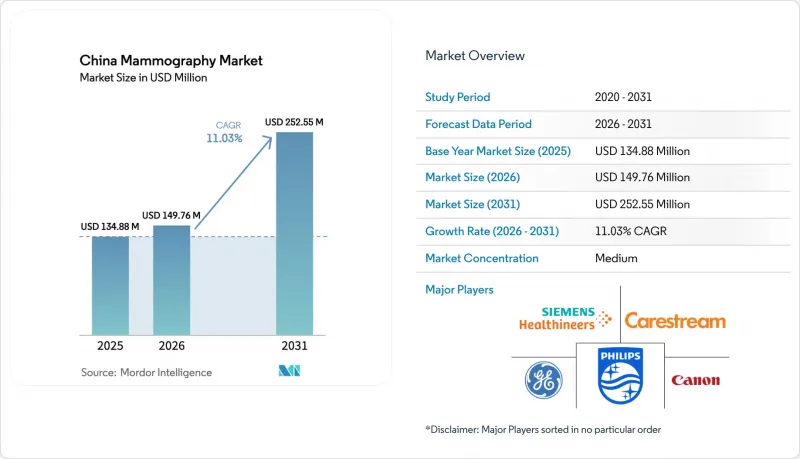
This report is Segmented by Product Type (Digital Systems, Analog Systems, Breast Tomosynthesis (3D), Others) and End-User (Hospitals, Specialty Breast Clinics, Diagnostic Imaging Centers, Mobile Screening Units). The Market Forecasts are Provided in Terms of Value (USD).
China Mammography Market Trends and Insights
Growing Burden of Breast Cancer
China recorded 357,200 new breast-cancer cases and 75,000 deaths in 2022, the highest incidence in Asia, prompting aggressive screening investments. Incidence peaks among women aged 50-54, aligning with global guidelines and underpinning equipment demand across all province tiers. Urban-rural gaps persist, with incidence rates of 35.45 versus 29.38 per 100,000, respectively, motivating resource allocation toward underserved regions. Long-term demographic shifts and lifestyle changes sustain the upward trajectory of breast-cancer burden, reinforcing a durable need for mammography capacity. Consequently, the China mammography market continues to align public-health imperatives with robust commercial opportunities.
Technological Shift to Full-Field Digital & 3-D Tomosynthesis
Digital breast tomosynthesis (DBT) achieves a sensitivity of 86%, compared to 80% for conventional digital systems, resulting in a significant reduction in false-positive callbacks.Dense breast tissue, present in roughly 70% of Asian women, benefits most, accelerating DBT installations in Class III hospitals. Economic models show incremental cost-effectiveness ratios of USD 5,971.58 per QALY, validating capital outlays. Synthetic 2-D reconstruction further reduces patient radiation exposure without compromising accuracy. AI algorithms integrated into DBT platforms achieve area-under-the-curve scores exceeding 0.93, enhancing lesion detection and positioning high-end systems as the benchmark for the China mammography market.
Radiation-Exposure Risk Perception
Studies reveal radiation fear remains a leading deterrent to screening participation, especially where health literacy is limited. Misinformation on social media amplifies skepticism, necessitating structured educational campaigns that explain low-dose protocols and highlight cumulative safety records. Manufacturers mitigate concerns by promoting synthetic 2-D imaging that halves radiation relative to legacy systems. Continuous professional training for primary-care providers and collaboration with local women's organizations help normalize mammography in apprehensive communities, steadily improving uptake within the China mammography market.
Other drivers and restraints analyzed in the detailed report include:
- Nation-Wide "Two-Cancer" Screening Expansion
- AI-Powered CAD Adoption in Class III Hospitals
- Inadequate Reimbursement Outside Urban Megacities
For complete list of drivers and restraints, kindly check the Table Of Contents.
Segment Analysis
Digital systems accounted for 70.68% of the China mammography market share in 2025, underscoring the dominance of full-field digital and DBT technology in tertiary and secondary hospitals. Rapid image acquisition, cloud archiving, and seamless integration with AI-based CAD workflows underpin their appeal. Analog units persist only in budget-constrained rural centers but face declining procurement as VBP narrows price differences. Breast tomosynthesis leads growth, posting an 11.73% CAGR projected through 2031, propelled by superior sensitivity in dense-breast populations and favorable cost-effectiveness profiles.
Beyond screening, stereotactic biopsy attachments and contrast-enhanced modules extend platform utility, offering incremental revenue via procedure-based reimbursements. Manufacturers bundle software upgrades as software-as-a-service, ensuring recurring income while customers maintain updated diagnostic functionality. These trends cement digital systems as the cornerstone of the China mammography market size for the foreseeable future.
Complete Report Scope:
- By Product Type
- Digital Systems
- Analog Systems
- Breast Tomosynthesis (3-D)
- Others (e.g., stereotactic biopsy units)
- By End-User
- Hospitals
- Specialty Breast Clinics
- Diagnostic Imaging Centers
- Mobile Screening Units
List of Companies Covered in this Report:
- Hologic
- Siemens Healthineers
- GE Healthcare
- Canon Inc. (Canon Medical)
- Fujifilm Holdings Corp.
- Konica Minolta
- Mindray Bio-Medical Electronics Co.
- United Imaging Healthcare Co.
- Neusoft Medical Systems
- Carestream Health
- General Medical Merate
- Planmed
- Trivitron Healthcare
- Agfa-Gevaert
- Shimadzu
- Toshiba (Alphatec) Medical Systems
- Anke High-Tech Co.
- Perlove Medical
- Shenzhen Xiaolung Medical Tech
- Guangzhou Maya Medical Equipment
Additional Benefits:
- The market estimate (ME) sheet in Excel format
- 3 months of analyst support
TABLE OF CONTENTS
1 Introduction
- 1.1 Study Assumptions & Market Definition
- 1.2 Scope of the Study
2 Research Methodology
3 Executive Summary
4 Market Landscape
- 4.1 Market Overview
- 4.2 Market Drivers
- 4.2.1 Growing Burden of Breast Cancer
- 4.2.2 Technological Shift to Full-Field Digital & 3-D Tomosynthesis
- 4.2.3 Nation-Wide "Two-Cancer" (Breast & Cervical) Screening Expansion
- 4.2.4 AI-Powered CAD Adoption in Class III Hospitals
- 4.2.5 Provincial Volume-Based Procurement Slashing System Prices
- 4.2.6 Mobile Screening Vans Reaching Tier-3/4 Counties
- 4.3 Market Restraints
- 4.3.1 Radiation-Exposure Risk Perception
- 4.3.2 Inadequate Reimbursement Outside Urban Megacities
- 4.3.3 High Capex Versus Ultrasound Alternatives
- 4.3.4 Stringent NMPA Domestic-Content Localisation Quotas
- 4.4 Value / Supply-Chain Analysis
- 4.5 Regulatory Landscape
- 4.6 Technological Outlook
- 4.7 Porter's Five Forces Analysis
- 4.7.1 Threat of New Entrants
- 4.7.2 Bargaining Power of Buyers/Consumers
- 4.7.3 Bargaining Power of Suppliers
- 4.7.4 Threat of Substitute Products
- 4.7.5 Intensity of Competitive Rivalry
5 Market Size & Growth Forecasts
- 5.1 By Product Type
- 5.1.1 Digital Systems
- 5.1.2 Analog Systems
- 5.1.3 Breast Tomosynthesis (3-D)
- 5.1.4 Others (e.g., stereotactic biopsy units)
- 5.2 By End-User
- 5.2.1 Hospitals
- 5.2.2 Specialty Breast Clinics
- 5.2.3 Diagnostic Imaging Centers
- 5.2.4 Mobile Screening Units
6 Competitive Landscape
- 6.1 Market Concentration
- 6.2 Market Share Analysis
- 6.3 Company Profiles (includes Global Level Overview, Market Level Overview, Core Segments, Financials as Available, Strategic Information, Market Rank/Share, Products & Services, Recent Developments)
- 6.3.1 Hologic Inc.
- 6.3.2 Siemens Healthineers AG
- 6.3.3 GE HealthCare
- 6.3.4 Canon Inc. (Canon Medical)
- 6.3.5 Fujifilm Holdings Corp.
- 6.3.6 Konica Minolta Inc.
- 6.3.7 Mindray Bio-Medical Electronics Co.
- 6.3.8 United Imaging Healthcare Co.
- 6.3.9 Neusoft Medical Systems
- 6.3.10 Carestream Health Inc.
- 6.3.11 General Medical Merate SpA
- 6.3.12 Planmed Oy
- 6.3.13 Trivitron Healthcare
- 6.3.14 Agfa-Gevaert N.V.
- 6.3.15 Shimadzu Corporation
- 6.3.16 Toshiba (Alphatec) Medical Systems
- 6.3.17 Anke High-Tech Co.
- 6.3.18 Perlove Medical
- 6.3.19 Shenzhen Xiaolung Medical Tech
- 6.3.20 Guangzhou Maya Medical Equipment
7 Market Opportunities & Future Outlook

