PUBLISHER: Mordor Intelligence | PRODUCT CODE: 2116928

PUBLISHER: Mordor Intelligence | PRODUCT CODE: 2116928
Hard Facility Management - Market Share Analysis, Industry Trends & Statistics, Growth Forecasts (2026 - 2031)
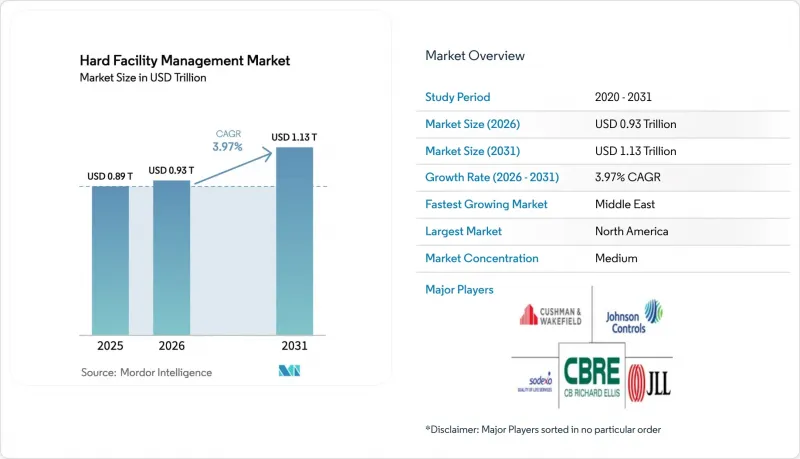
According to Mordor Intelligence, the hard facility management market size is expected to increase from USD 890 billion in 2025 to USD 930 billion in 2026 and reach USD 1.13 trillion by 2031, growing at a CAGR of 3.97% over 2026-2031.
This report is Segmented by Service Type (Asset Management, MEP and HVAC Services, Fire Systems and Safety, and More), Offering Type (In-House FM, and Outsourced FM [Single FM, Bundled FM, and More]), End-User Industry (Commercial, Hospitality, Institutional and Public Infrastructure, Industrial and Process Sector, and More), and Geography. The Market Forecasts are Provided in Terms of Value (USD).
Global Hard Facility Management Market Trends and Insights
AI-Enabled Predictive Maintenance Platforms Drive Operational Transformation
Machine-learning models now analyze vibration, temperature, and power-draw data from HVAC chillers, boilers, and switchgear to flag anomalies weeks before a failure occurs, converting unplanned downtime into scheduled interventions. ABM Industries deployed the approach at an Ingredion site in 2025, avoiding compressor outages and saving USD 1.2 million annually. Building owners are embedding uptime clauses in service agreements, pushing providers to invest in sensor networks and data scientists. The shift favors large, capital-rich operators that can absorb upfront digital costs, accelerating consolidation. Predictive contracts also tighten supplier relationships because analytics platforms benchmark asset health against manufacturer data, compelling joint optimization of parts inventory and warranty coverage. As a result, the hard facility management market is moving toward outcome-based pricing tied to mean-time-between-failure metrics.
Decarbonization Mandates Accelerate HVAC and Energy Retrofit Investments
California's 2025 code now requires heat pumps in new commercial builds, and the EU's revised directive mandates zero-emission status for new structures by 2030, forcing rapid electrification of heating and ventilation. Demand has spiked for variable-refrigerant-flow systems, ground-source heat pumps, and high-performance facades that cut thermal bridging. Facility managers wrestle with securing retrofit capital that may exceed traditional contract horizons, amplifying interest in energy-service-company style agreements that spread repayment over savings. Procurement teams face lengthy lead times for compressors and inverters, a bottleneck that expands the role of integrated FM providers with sourcing leverage. Compliance frameworks such as ISO 50001 are now prerequisites for public tenders, raising entry barriers for smaller contractors and increasing the strategic importance of decarbonization credentials within the hard facility management market.
Skilled-Trades Labor Shortages Constrain Service Delivery Capacity
The Associated General Contractors of America revealed a 439,000-worker shortfall in the United States for 2025 projects, with 68% of technicians aged 45 plus and retirement outpacing apprenticeship intake. Wage inflation passed 6% annually, eroding fixed-price margins. Specialized roles in building-automation programming and fire-alarm integration face the steepest gaps because certification pathways are lengthy and vendor-specific. Immigration curbs intensify the squeeze in North America and Europe. Higher pay alone has not resolved the scarcity, prompting providers to invest in augmented-reality training and remote expert support to stretch scarce talent. Persistent shortages limit the capacity of the hard facility management market to absorb surging retrofit demand.
Other drivers and restraints analyzed in the detailed report include:
- Integrated Hard-Soft FM Outsourcing Reduces Lifecycle Costs
- Data-Driven FM Procurement Enables Cost-Inflation Hedging Strategies
- Volatile Input Prices for Critical MEP Spare Parts Increase Operational Costs
For complete list of drivers and restraints, kindly check the Table Of Contents.
Segment Analysis
MEP and HVAC services claimed 44.63% of 2025 revenue, underscoring their role as the backbone of the hard facility management market size at facility level. Data-center power densities jumping toward 100 kW per rack accelerate demand for liquid cooling, redundant feeds, and precision controls. Quarterly inspections mandated by Joint Commission in healthcare sustain fire-safety work, while facade and structural repair volumes are event-driven, rising after climate events.
The rise of computerized maintenance management systems is elevating asset management, the fastest-growing service line at 4.32% CAGR. Platforms capture run-time data from chillers, pumps, and emergency power systems, calculate remaining useful life, and auto-schedule tasks. This convergence blurs distinctions between trades because analytics pull MEP telemetry into strategic planning. Smaller HVAC-only shops face consolidation pressure as owners pursue integrated bundles that cut administrative effort. Wireless smoke detectors and cloud alarms, recognized in NFPA 72-2025, further digitize inspection routines. Overall, the segment's transition from break-fix to outcome-oriented service is a defining current for the hard facility management market.
Complete Report Scope:
- By Service Type
- Asset Management
- MEP and HVAC Services
- Fire Systems and Safety
- Other Hard FM Services
- By Offering Type
- In-House FM
- Outsourced FM
- Single Facility Management
- Bundled Facility Management
- Integrated Facility Management
- By End-User Industry
- Commercial
- Hospitality
- Institutional and Public Infrastructure
- Healthcare
- Industrial and Process Sector
- Other End-User Industries
- By Geography
- North America
- United States
- Canada
- Mexico
- Europe
- United Kingdom
- Germany
- France
- Italy
- Rest of Europe
- Asia-Pacific
- China
- Japan
- India
- South Korea
- Rest of Asia
- Middle East
- Israel
- Saudi Arabia
- United Arab Emirates
- Turkey
- Rest of Middle East
- Africa
- South Africa
- Egypt
- Rest of Africa
- South America
- Brazil
- Argentina
- Rest of South America
- North America
Geography Analysis
North America retained 37.28% of 2025 revenue because of vast legacy building stock and regulatory momentum around electrification. Federal incentives and state codes encourage retrofit cycles, especially in California where compulsory heat pumps now set design baselines. U.S. data-center clusters in Virginia and Texas amplify demand for high-density power and water-efficient cooling. Canada's infrastructure renewals concur with P3 models that embed FM guarantees, binding long-term revenue.
Europe's trajectory is dominated by the revised directive setting zero-emission goals for new buildings by 2030, which channels capital into HVAC electrification and envelope upgrades. Germany earmarked EUR 14 billion (USD 15.9 billion) for energy efficiency, subsidizing FM-led retrofits. Compliance with EPC classes A and B is reshaping procurement criteria, shunting preference toward providers with decarbonization roadmaps verified under ISO 50001.
The Middle East carries the fastest CAGR at 5.81% as Saudi Vision 2030 mega projects including NEOM and the Red Sea resort city demand climate-adapted HVAC and energy management. UAE directives under the Dubai 2040 master plan push smart-building integration and LEED Gold certifications. High ambient temperatures necessitate chiller plants with thermal storage and materials rated for 50 °C summers, intensifying per-square-foot spend. Asia-Pacific growth is propelled by China's automation mandate for large commercial builds and India's Smart Cities Mission, while South America and Africa progress in pockets as urbanization lures multinational occupiers. Across regions, regulatory energy targets, climatic extremes, and smart-city programs expand addressable volumes within the hard facility management market.
- CBRE Group, Inc.
- ISS A/S
- Sodexo S.A.
- EMCOR Group, Inc.
- Mitie Group plc
- ABM Industries Incorporated
- Aramark Corporation
- Apleona GmbH
- GDI Integrated Facility Services Inc.
- OCS Group Limited
- Atalian Holding Development and Strategy
- Compass Group PLC
- Cushman and Wakefield plc
- Jones Lang LaSalle Incorporated
- Bouygues Energies and Services S.A.S.
- Dussmann Stiftung and Co. KGaA
- SBFM Limited
- BGIS Global Integrated Solutions, Inc.
- Al Shafar United for Facilities Management LLC
- Serco Group plc
Additional Benefits:
- The market estimate (ME) sheet in Excel format
- 3 months of analyst support
TABLE OF CONTENTS
1 INTRODUCTION
- 1.1 Study Assumptions and Market Definition
- 1.2 Scope of the Study
2 RESEARCH METHODOLOGY
3 EXECUTIVE SUMMARY
4 MARKET LANDSCAPE
- 4.1 Market Overview
- 4.2 Market Drivers
- 4.2.1 AI-Enabled Predictive Maintenance Platforms
- 4.2.2 Decarbonization Mandates Driving HVAC and Energy Retrofits
- 4.2.3 Integrated Hard-Soft FM Outsourcing to Reduce Lifecycle Cost
- 4.2.4 Data-Driven FM Procurement and Cost-Inflation Hedging
- 4.2.5 Resilience Upgrades for Climate-Related Extreme Weather Events
- 4.2.6 Private-Equity Roll-Ups Accelerating Hard-FM Tech Adoption
- 4.3 Market Restraints
- 4.3.1 Skilled-Trades Labor Shortages and Aging Workforce
- 4.3.2 Volatile Input Prices for Critical MEP Spare Parts
- 4.3.3 Cyber-Security Vulnerabilities in Connected BMS
- 4.3.4 Short Contract Tenures Limiting ROI on Hard-FM Capex
- 4.4 Industry Value Chain Analysis
- 4.5 Regulatory Landscape
- 4.6 Impact of Macroeconomic Factors
- 4.7 Porter's Five Forces Analysis
- 4.7.1 Threat of New Entrants
- 4.7.2 Bargaining Power of Suppliers
- 4.7.3 Bargaining Power of Buyers
- 4.7.4 Threat of Substitutes
- 4.7.5 Industry Rivalry
5 MARKET SIZE AND GROWTH FORECASTS (VALUE)
- 5.1 By Service Type
- 5.1.1 Asset Management
- 5.1.2 MEP and HVAC Services
- 5.1.3 Fire Systems and Safety
- 5.1.4 Other Hard FM Services
- 5.2 By Offering Type
- 5.2.1 In-House FM
- 5.2.2 Outsourced FM
- 5.2.2.1 Single Facility Management
- 5.2.2.2 Bundled Facility Management
- 5.2.2.3 Integrated Facility Management
- 5.3 By End-User Industry
- 5.3.1 Commercial
- 5.3.2 Hospitality
- 5.3.3 Institutional and Public Infrastructure
- 5.3.4 Healthcare
- 5.3.5 Industrial and Process Sector
- 5.3.6 Other End-User Industries
- 5.4 By Geography
- 5.4.1 North America
- 5.4.1.1 United States
- 5.4.1.2 Canada
- 5.4.1.3 Mexico
- 5.4.2 Europe
- 5.4.2.1 United Kingdom
- 5.4.2.2 Germany
- 5.4.2.3 France
- 5.4.2.4 Italy
- 5.4.2.5 Rest of Europe
- 5.4.3 Asia-Pacific
- 5.4.3.1 China
- 5.4.3.2 Japan
- 5.4.3.3 India
- 5.4.3.4 South Korea
- 5.4.3.5 Rest of Asia
- 5.4.4 Middle East
- 5.4.4.1 Israel
- 5.4.4.2 Saudi Arabia
- 5.4.4.3 United Arab Emirates
- 5.4.4.4 Turkey
- 5.4.4.5 Rest of Middle East
- 5.4.5 Africa
- 5.4.5.1 South Africa
- 5.4.5.2 Egypt
- 5.4.5.3 Rest of Africa
- 5.4.6 South America
- 5.4.6.1 Brazil
- 5.4.6.2 Argentina
- 5.4.6.3 Rest of South America
- 5.4.1 North America
6 COMPETITIVE LANDSCAPE
- 6.1 Market Concentration
- 6.2 Strategic Moves
- 6.3 Market Share Analysis
- 6.4 Company Profiles (includes Global Level Overview, Market Level Overview, Core Segments, Financials as available, Strategic Information, Market Rank/Share, Products and Services, Recent Developments)
- 6.4.1 CBRE Group, Inc.
- 6.4.2 ISS A/S
- 6.4.3 Sodexo S.A.
- 6.4.4 EMCOR Group, Inc.
- 6.4.5 Mitie Group plc
- 6.4.6 ABM Industries Incorporated
- 6.4.7 Aramark Corporation
- 6.4.8 Apleona GmbH
- 6.4.9 GDI Integrated Facility Services Inc.
- 6.4.10 OCS Group Limited
- 6.4.11 Atalian Holding Development and Strategy
- 6.4.12 Compass Group PLC
- 6.4.13 Cushman and Wakefield plc
- 6.4.14 Jones Lang LaSalle Incorporated
- 6.4.15 Bouygues Energies and Services S.A.S.
- 6.4.16 Dussmann Stiftung and Co. KGaA
- 6.4.17 SBFM Limited
- 6.4.18 BGIS Global Integrated Solutions, Inc.
- 6.4.19 Al Shafar United for Facilities Management LLC
- 6.4.20 Serco Group plc
7 MARKET OPPORTUNITIES AND FUTURE OUTLOOK
- 7.1 White-space and Unmet-Need Assessment

