PUBLISHER: Mordor Intelligence | PRODUCT CODE: 2116929

PUBLISHER: Mordor Intelligence | PRODUCT CODE: 2116929
Asia-Pacific Hard Facility Management - Market Share Analysis, Industry Trends & Statistics, Growth Forecasts (2026 - 2031)
According to Mordor Intelligence, the asia-Pacific hard facility management market size is expected to grow from USD 250.46 billion in 2025 to USD 258.17 billion in 2026 and is forecast to reach USD 300.41 billion by 2031 at 3.08% CAGR over 2026-2031.
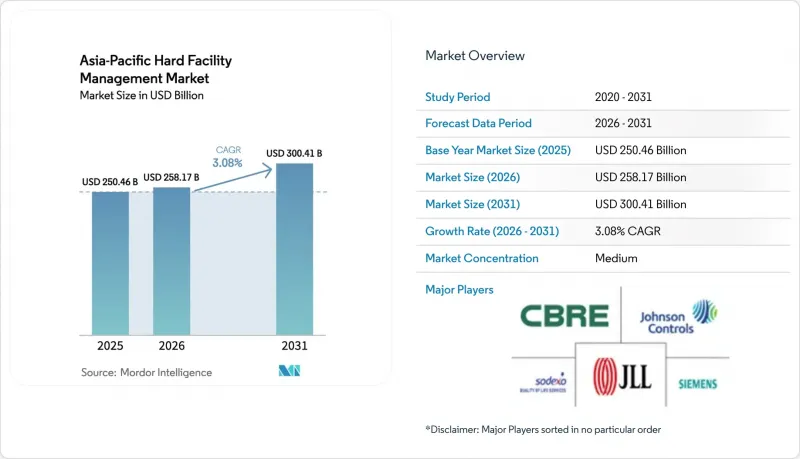
This report is Segmented by Service Type (Electrical Services Maintenance, HVAC Maintenance Services, and More), End User (Commercial, Institutional, and More), Service Delivery Model (In-House, Outsourced Single-Service, and More), Facility Type (Healthcare Facilities, Hospitality and Leisure Properties, and More), and Country. The Market Forecasts are Provided in Terms of Value (USD).
Asia-Pacific Hard Facility Management Market Trends and Insights
Expansion of Commercial and Industrial Construction Activity
Emerging industrial corridors are reshaping the Asia-Pacific hard facility management market. Commercial square footage in China's tier-2 cities increased 18% in 2024, and Vietnam, Indonesia, and Thailand attracted USD 42 billion of manufacturing FDI the same year. Developers often bundle three-year mechanical and electrical maintenance into turnkey packages, shortening the bid cycle and favoring integrators with pre-negotiated supplier networks. Providers are opening satellite depots in Chengdu, Pune, and Hanoi so they can meet service-level agreements within four hours. The result is a geographic realignment that rewards firms with regional logistics planning and local permitting expertise. Those unable to migrate beyond legacy urban cores risk missing a wave of opportunity that could define revenue pools for the rest of the decade.
Rising Demand for HVAC and MEP Maintenance Services
HVAC upkeep remains a key driver of the Asia-Pacific hard facility management market, as tropical humidity and dense urbanization increase cooling loads. Yet demand is becoming more technical than routine. Singapore's district-cooling systems now require continuous refrigerant-leak detection and remote telemetry, which legacy preventive schedules cannot address. Malaysia's chiller retrofits come with energy-savings guarantees that shift risk to service vendors. IoT-enabled diagnostics are normalizing forty-eight-hour fault remediation windows, so providers must invest in analytics talent and spare-parts inventory. Without that capability, mid-tier contractors lose premium accounts to firms that can underwrite performance.
Skilled Technical-Labor Shortage
Labor scarcity is the most immediate brake on the Asia-Pacific hard facility management market. Singapore reported a 12% deficit of certified HVAC engineers in 2024. Australian electricians experienced 15% wage inflation, while Malaysia's construction sector faced a 15% headcount shortfall. Large integrators responded by opening training academies; ISS targets 500 graduates a year through its newly launched Southeast Asia center. Smaller companies lack the scale to replicate that model, so staff attrition funnels talent toward higher-paying data-center posts. The skills gap raises service costs and threatens SLA compliance, pushing buyers to favor vendors with formal workforce pipelines.
Other drivers and restraints analyzed in the detailed report include:
- Outsourcing Shift Toward Integrated FM Contracts
- Energy-Efficiency and Green-Building Regulation Push
- Grid-Capacity Shortfalls Delaying Facility Handovers
For complete list of drivers and restraints, kindly check the Table Of Contents.
Segment Analysis
Asia-Pacific hard facility management market size for energy management and power systems is poised to reach a significant value, advancing at a 3.83% CAGR, well ahead of legacy HVAC services. Energy-management contracts increasingly include on-site renewables, battery storage, and digital twins that predict load variance. Buyers value verified savings, so vendors who can bundle metering, analytics, and performance guarantees command premium prices. In contrast, HVAC maintenance, although still holding 38.12% of the Asia-Pacific hard facility management market share in 2025, faces slower growth because much of the installed base is aging equipment awaiting phased replacement. Mechanical and electrical maintenance will remain foundational, yet commoditization is likely as IoT sensors reduce the need for routine inspections. Fire and life-safety system upkeep is gaining regulatory tailwinds, while plumbing services climb the agenda in water-stressed geographies..
Routine tasks, such as filter changes, are migrating toward outcome-based pricing, rewarding firms that invest in remote-monitoring hardware. Johnson Controls recorded a 25% jump in Asia-Pacific bookings for performance-guaranteed contracts in 2024, illustrating the link between financial innovation and market capture. Providers that cannot underwrite energy savings will cede ground to platforms with stronger balance sheets. The battle lines are therefore drawn between scale-driven integrators and niche experts who master high-value micro-segments like liquid cooling or greywater recycling.
Industrial and manufacturing customers are poised to add notable value through incremental spending, growing at a 4.18% CAGR as supply-chain diversification prompts factories to relocate to Vietnam, Indonesia, and India. Semiconductor fabs and pharma plants require cleanroom HVAC, ultra-pure water, and redundant power, lifting per-square-meter revenue well above that of office towers. In 2025, commercial buildings still accounted for 46.05% of outlays; however, their expansion rate lags behind because saturated CBDs and hybrid work arrangements temper new space demand. Healthcare and education budgets are rising as governments fund hospital refurbishments and research campuses, a trend that insulates cash flows from economic cycles.
Residential complexes remain largely in-house managed, though luxury towers in Singapore and Sydney are trialing predictive-maintenance outsourcing to differentiate amenities. For FM providers, industrial diversification creates a need for regional dispatch hubs, spare parts logistics, and specialized certifications. Those who invested early in local technician training and OEM partnerships are winning multi-year contracts at higher margins. Late movers face a steep learning curve and risk being locked out of complex industrial niches.
Complete Report Scope:
- By Service Type
- Mechanical Services Maintenance
- Electrical Services Maintenance
- HVAC Maintenance Services
- Fire and Life-Safety Systems Maintenance
- Plumbing and Water Management
- Building Fabric and Structural Maintenance
- Energy Management and Power Systems
- By End User
- Commercial
- Institutional (Education and Healthcare)
- Public / Infrastructure
- Industrial and Manufacturing
- Residential and Mixed-Use
- By Service Delivery Model
- In-House (Self-Performed)
- Outsourced Single-Service
- Integrated Facilities Management (IFM)
- Hybrid Models
- By Facility Type
- Office and Corporate Campuses
- Industrial and Logistics Facilities
- Data Centres and Critical Environments
- Healthcare Facilities
- Hospitality and Leisure Properties
- Transportation Hubs and Infrastructure
- By Country
- Australia
- China
- India
- Japan
- Indonesia
- Malaysia
- Singapore
- South Korea
- Taiwan
- Thailand
- Rest of Asia-Pacific
List of Companies Covered in this Report:
- Jones Lang LaSalle Incorporated
- CBRE Group, Inc.
- Sodexo S.A.
- ISS A/S
- Cushman and Wakefield plc
- Johnson Controls International plc
- Siemens AG
- Honeywell International Inc.
- Aden Group Limited
- Aeon Delight Co., Ltd.
- Ventia Services Group Limited
- OCS Group Limited
- Nippon Kanzai Co., Ltd.
- Brookfield Global Integrated Solutions Canada LP
- Downer Edi Limited (Facilities Management)
- Serco Group plc
- GDI Integrated Facility Services Inc.
- EMCOR Group, Inc.
- Atalian Global Services SAS
- Knight Facilities Management Ltd.
- BVG India Limited
- Sembcorp Facilities Management Pte Ltd.
- Mapletree Facilities Services Pte Ltd.
Additional Benefits:
- The market estimate (ME) sheet in Excel format
- 3 months of analyst support
TABLE OF CONTENTS
1 INTRODUCTION
- 1.1 Study Assumptions and Market Definition
- 1.2 Scope of the Study
2 RESEARCH METHODOLOGY
3 EXECUTIVE SUMMARY
4 MARKET LANDSCAPE
- 4.1 Market Overview
- 4.2 Market Drivers
- 4.2.1 Expansion Of Commercial And Industrial Construction Activity
- 4.2.2 Rising Demand For HVAC And MEP Maintenance Services
- 4.2.3 Outsourcing Shift Toward Integrated FM Contracts
- 4.2.4 Energy-Efficiency And Green-Building Regulation Push
- 4.2.5 Hyperscale Data-Centre Build-Out Driving Critical FM Needs
- 4.2.6 Corporate On-Site Renewable Targets And Micro-Grid Upkeep
- 4.3 Market Restraints
- 4.3.1 Skilled Technical-Labour Shortage
- 4.3.2 Volatile Energy And Materials Costs Squeezing Margins
- 4.3.3 Fragmented Asia-Pacific Compliance And Certification Landscape
- 4.3.4 Grid-Capacity Shortfalls Delaying Facility Handovers
- 4.4 Industry Value Chain Analysis
- 4.5 Regulatory Landscape
- 4.6 Technological Outlook
- 4.7 Porter's Five Forces Analysis
- 4.7.1 Bargaining Power of Suppliers
- 4.7.2 Bargaining Power of Buyers
- 4.7.3 Threat of New Entrants
- 4.7.4 Threat of Substitutes
- 4.7.5 Intensity of Competitive Rivalry
5 MARKET SIZE AND GROWTH FORECASTS (VALUE)
- 5.1 By Service Type
- 5.1.1 Mechanical Services Maintenance
- 5.1.2 Electrical Services Maintenance
- 5.1.3 HVAC Maintenance Services
- 5.1.4 Fire and Life-Safety Systems Maintenance
- 5.1.5 Plumbing and Water Management
- 5.1.6 Building Fabric and Structural Maintenance
- 5.1.7 Energy Management and Power Systems
- 5.2 By End User
- 5.2.1 Commercial
- 5.2.2 Institutional (Education and Healthcare)
- 5.2.3 Public / Infrastructure
- 5.2.4 Industrial and Manufacturing
- 5.2.5 Residential and Mixed-Use
- 5.3 By Service Delivery Model
- 5.3.1 In-House (Self-Performed)
- 5.3.2 Outsourced Single-Service
- 5.3.3 Integrated Facilities Management (IFM)
- 5.3.4 Hybrid Models
- 5.4 By Facility Type
- 5.4.1 Office and Corporate Campuses
- 5.4.2 Industrial and Logistics Facilities
- 5.4.3 Data Centres and Critical Environments
- 5.4.4 Healthcare Facilities
- 5.4.5 Hospitality and Leisure Properties
- 5.4.6 Transportation Hubs and Infrastructure
- 5.5 By Country
- 5.5.1 Australia
- 5.5.2 China
- 5.5.3 India
- 5.5.4 Japan
- 5.5.5 Indonesia
- 5.5.6 Malaysia
- 5.5.7 Singapore
- 5.5.8 South Korea
- 5.5.9 Taiwan
- 5.5.10 Thailand
- 5.5.11 Rest of Asia-Pacific
6 COMPETITIVE LANDSCAPE
- 6.1 Market Concentration Analysis
- 6.2 Strategic Moves
- 6.3 Market Share Analysis
- 6.4 Company Profiles (includes Global level Overview, Market level overview, Core Segments, Financials as available, Strategic Information, Market Rank/Share for key companies, Products and Services, and Recent Developments)
- 6.4.1 Jones Lang LaSalle Incorporated
- 6.4.2 CBRE Group, Inc.
- 6.4.3 Sodexo S.A.
- 6.4.4 ISS A/S
- 6.4.5 Cushman and Wakefield plc
- 6.4.6 Johnson Controls International plc
- 6.4.7 Siemens AG
- 6.4.8 Honeywell International Inc.
- 6.4.9 Aden Group Limited
- 6.4.10 Aeon Delight Co., Ltd.
- 6.4.11 Ventia Services Group Limited
- 6.4.12 OCS Group Limited
- 6.4.13 Nippon Kanzai Co., Ltd.
- 6.4.14 Brookfield Global Integrated Solutions Canada LP
- 6.4.15 Downer Edi Limited (Facilities Management)
- 6.4.16 Serco Group plc
- 6.4.17 GDI Integrated Facility Services Inc.
- 6.4.18 EMCOR Group, Inc.
- 6.4.19 Atalian Global Services SAS
- 6.4.20 Knight Facilities Management Ltd.
- 6.4.21 BVG India Limited
- 6.4.22 Sembcorp Facilities Management Pte Ltd.
- 6.4.23 Mapletree Facilities Services Pte Ltd.
7 MARKET OPPORTUNITIES AND FUTURE OUTLOOK
- 7.1 White-space and Unmet-need Assessment

