PUBLISHER: Mordor Intelligence | PRODUCT CODE: 2119648

PUBLISHER: Mordor Intelligence | PRODUCT CODE: 2119648
North America Facility Management - Market Share Analysis, Industry Trends & Statistics, Growth Forecasts (2026 - 2031)
According to Mordor Intelligence, the North America facility management market size was valued at USD 455.95 billion in 2025 and estimated to grow from USD 470.04 billion in 2026 to reach USD 547.29 billion by 2031, at a CAGR of 3.09% during the forecast period (2026-2031).
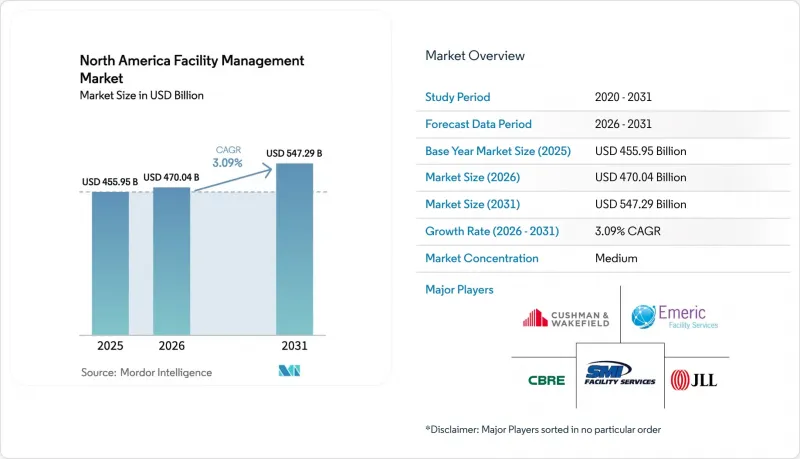
This report is Segmented by Service Type (Hard Services, and Soft Services), Offering Type (In-House, and Outsourced), End-User Industry (Commercial, Hospitality, Institutional and Public Infrastructure, Healthcare, Industrial and Process, and Other End-User Industries), and Geography (United States, Canada, and Mexico). The Market Forecasts are Provided in Terms of Value (USD).
North America Facility Management Market Trends and Insights
Increasing Infrastructure Development
Federal, state, and provincial mandates across the region elevate building performance thresholds, pushing asset owners to retrofit outdated HVAC, life-safety, and electrical systems. The U.S. General Services Administration's 2024 P100 standards strengthen sustainability and resiliency criteria for federal properties, setting a template for private portfolios. Mexico's push to accommodate nearshoring-driven industrial expansion offsets political budget constraints yet sustains demand for high-spec logistics and assembly space. In Canada, harmonized construction codes aimed at meeting climate targets are amplifying energy-efficiency retrofits. Hard-service contractors with deep MEP expertise are consequently seeing stable recurring revenue streams, while technology-enabled monitoring platforms reinforce compliance and extend asset life cycles within the North America facility management market.
Rising Outsourcing in Building Management
Corporate boards increasingly frame FM as a strategic lever rather than a commodity cost center. ABM Industries secured more than USD 1 billion in new contracts during 2024 as clients prioritized integrated offerings that limit vendor sprawl and guarantee single-point accountability. Bundled hard-plus-soft contracts improve economies of scale and often embed outcome-based KPIs tied to safety, uptime, and energy targets. For healthcare, vendor-neutral strategies such as Medxcel's generated USD 104 million savings over three years by fine-tuning in-house resources and third-party spend. As a result, the outsourced slice of the North America facility management market is widening, with providers that can demonstrate transparent performance reporting and digital toolsets attracting multi-year, multi-site deals.
Security Concerns Over Device and Network Vulnerabilities
Cyberattacks on BMS and IoT endpoints expose life-safety, HVAC, and access-control layers to potential sabotage, with 27% of facility managers reporting incidents over the past year. Insurance premiums for cyber coverage in critical infrastructure have spiked, further delaying large-scale rollouts. Healthcare and government campuses, sitting on sensitive data and mission-critical systems, demand end-to-end encryption, zero-trust frameworks, and 24/7 threat monitoring, raising barriers for smaller FM providers and elongating sales cycles across the North America facility management market.
Other drivers and restraints analyzed in the detailed report include:
- Heightened Safety and Security Needs
- Technological Advancements in Facility Management
- High Costs of Advanced Tech and Skilled Labor
For complete list of drivers and restraints, kindly check the Table Of Contents.
Segment Analysis
Hard services account for 58.72% of the North America facility management market in 2025 and progress in lock-step with overall expansion at a 3.09% CAGR to 2031. This branch anchors operational continuity through disciplined MEP upkeep, fire-safety compliance, and structural asset preservation. Widespread building-system obsolescence and code updates around energy and life-safety create predictable demand for retrofit programs, condition-based monitoring, and asset-lifecycle planning.
Soft services, although smaller, rise faster at a 4.08% CAGR driven by wellness, security, and concierge expectations. Elevated indoor-air-quality protocols and health-security certifications fuel premium cleaning packages. Office support and front-of-house roles increasingly integrate smart-locker and visitor-management technologies, broadening scope. This divergence positions integrated suppliers to cross-sell soft-service innovations while defending recurring hard-service annuities, thereby enhancing wallet share inside the North America facility management market.
Complete Report Scope:
- By Service Type
- Hard Services
- Asset Management
- MEP and HVAC Services
- Fire Systems and Safety
- Other Hard FM Services
- Soft Services
- Office Support and Security
- Cleaning Services
- Catering Services
- Other Soft FM Services
- Hard Services
- By Offering Type
- In-house
- Outsourced
- Single FM
- Bundled FM
- Integrated FM
- By End-user Industry
- Commercial (IT and Telecom, Retail and Warehouses)
- Hospitality (Hotels, Eateries, Large-scale Restaurants)
- Institutional and Public Infrastructure (Govt, Education, Transportation)
- Healthcare (Public and Private Facilities)
- Industrial and Process (Manufacturing, Energy, Mining)
- Other End-user Industries (Multi-housing, Entertainment, Sports and Leisure)
- By Country
- United States
- Canada
- Mexico
List of Companies Covered in this Report:
- ABM Industries Inc.
- ISS A/S
- Sodexo Inc.
- Aramark
- CBRE Group Inc.
- EMCOR Group Inc.
- GDI Integrated Facility Services
- JLL (Jones Lang LaSalle IP, Inc.)
- Cushman and Wakefield PLC
- Compass Group PLC
- Kellermeyer Bergensons Services, LLC
- Guardian Service Industries Inc.
- SMS Assist, LLC
- AHI Facility Services Inc.
- Emeric Facility Services LLC
- SMI Facility Services
- Shine Facility Services
- Brookfield Global Integrated Solutions
- Honeywell Building Technologies (FM Division)
Additional Benefits:
- The market estimate (ME) sheet in Excel format
- 3 months of analyst support
TABLE OF CONTENTS
1 INTRODUCTION
- 1.1 Study Assumptions and Market Definition
- 1.2 Scope of the Study
2 RESEARCH METHODOLOGY
3 EXECUTIVE SUMMARY
4 MARKET LANDSCAPE
- 4.1 Market Overview
- 4.1.1 Current Occupancy Rates in North American Commercial Real Estate
- 4.1.2 Profitability Benchmarks of Major FM Providers
- 4.1.3 Workforce Indicators - Skilled and Unskilled Labor Participation
- 4.1.4 Facility Management Market Share (%) by Service Type
- 4.1.5 Facility Management Market Share (%) by Hard Services
- 4.1.6 Facility Management Market Share (%) by Soft Services
- 4.1.7 Urbanization and Population Growth in Top Metro Areas
- 4.1.8 Sector Investment Priorities in United States, Canada, and Mexico Infrastructure Pipeline
- 4.1.9 Regulatory Drivers Specific to Labour and Safety Standards
- 4.2 Market Driver
- 4.2.1 Increasing Infrastructure Development
- 4.2.2 Rising Outsourcing in Building Management
- 4.2.3 Heightened Safety and Security Needs
- 4.2.4 Technological Advancements in Facility Management
- 4.2.5 Sustainability & ESG Compliance Pressures on Building Operations
- 4.2.6 Hybrid-Work Models Driving Demand for Flexible FM Solutions
- 4.3 Market Restraint
- 4.3.1 Security concerns over device and network vulnerabilities
- 4.3.2 High costs of advanced tech and skilled labor
- 4.3.3 Fragmented State-Level Labor Regulations Increasing Compliance Burden
- 4.3.4 Limited Digital Maturity among Small & Mid-Sized FM Providers
- 4.4 Value Chain Analysis
- 4.5 PESTEL Analysis
- 4.6 Regulatory and Legislative Framework for Market Entrants
- 4.7 Impact of Macroeconomic Indicators on FM Demand
- 4.8 Porter's Five Forces Analysis
- 4.8.1 Bargaining Power of Suppliers
- 4.8.2 Bargaining Power of Buyers
- 4.8.3 Threat of New Entrants
- 4.8.4 Threat of Substitute Services
- 4.8.5 Intensity of Competitive Rivalry
- 4.9 Investment and Funding Analysis
5 MARKET SIZE AND GROWTH FORECASTS (VALUES)
- 5.1 By Service Type
- 5.1.1 Hard Services
- 5.1.1.1 Asset Management
- 5.1.1.2 MEP and HVAC Services
- 5.1.1.3 Fire Systems and Safety
- 5.1.1.4 Other Hard FM Services
- 5.1.2 Soft Services
- 5.1.2.1 Office Support and Security
- 5.1.2.2 Cleaning Services
- 5.1.2.3 Catering Services
- 5.1.2.4 Other Soft FM Services
- 5.1.1 Hard Services
- 5.2 By Offering Type
- 5.2.1 In-house
- 5.2.2 Outsourced
- 5.2.2.1 Single FM
- 5.2.2.2 Bundled FM
- 5.2.2.3 Integrated FM
- 5.3 By End-user Industry
- 5.3.1 Commercial (IT and Telecom, Retail and Warehouses)
- 5.3.2 Hospitality (Hotels, Eateries, Large-scale Restaurants)
- 5.3.3 Institutional and Public Infrastructure (Govt, Education, Transportation)
- 5.3.4 Healthcare (Public and Private Facilities)
- 5.3.5 Industrial and Process (Manufacturing, Energy, Mining)
- 5.3.6 Other End-user Industries (Multi-housing, Entertainment, Sports and Leisure)
- 5.4 By Country
- 5.4.1 United States
- 5.4.2 Canada
- 5.4.3 Mexico
6 COMPETITIVE LANDSCAPE
- 6.1 Market Concentration
- 6.2 Strategic Moves and Partnerships
- 6.3 Market Share Analysis
- 6.4 Company Profiles (includes Global level Overview, Market level overview, Core Segments, Financials as available, Strategic Information, Market Rank/Share for key companies, Products and Services, and Recent Developments)
- 6.4.1 ABM Industries Inc.
- 6.4.2 ISS A/S
- 6.4.3 Sodexo Inc.
- 6.4.4 Aramark
- 6.4.5 CBRE Group Inc.
- 6.4.6 EMCOR Group Inc.
- 6.4.7 GDI Integrated Facility Services
- 6.4.8 JLL (Jones Lang LaSalle IP, Inc.)
- 6.4.9 Cushman and Wakefield PLC
- 6.4.10 Compass Group PLC
- 6.4.11 Kellermeyer Bergensons Services, LLC
- 6.4.12 Guardian Service Industries Inc.
- 6.4.13 SMS Assist, LLC
- 6.4.14 AHI Facility Services Inc.
- 6.4.15 Emeric Facility Services LLC
- 6.4.16 SMI Facility Services
- 6.4.17 Shine Facility Services
- 6.4.18 Brookfield Global Integrated Solutions
- 6.4.19 Honeywell Building Technologies (FM Division)
7 MARKET OPPORTUNITIES AND FUTURE OUTLOOK
- 7.1 White-space and Unmet-Need Assessment
- 7.2 Technology-led Integrated FM (IoT, BMS, AI-based Predictive Maintenance)
- 7.3 ESG-Compliant FM Solutions Demand
- 7.4 Future Service-Model Shifts (Outcome-Based Contracts)

