PUBLISHER: Mordor Intelligence | PRODUCT CODE: 2116937

PUBLISHER: Mordor Intelligence | PRODUCT CODE: 2116937
China ICT - Market Share Analysis, Industry Trends & Statistics, Growth Forecasts (2026 - 2031)
According to Mordor Intelligence, the china iCT market size is expected to grow from USD 0.89 trillion in 2025 to USD 0.95 trillion in 2026 and is forecast to reach USD 1.35 trillion by 2031 at 7.14% CAGR over 2026-2031.
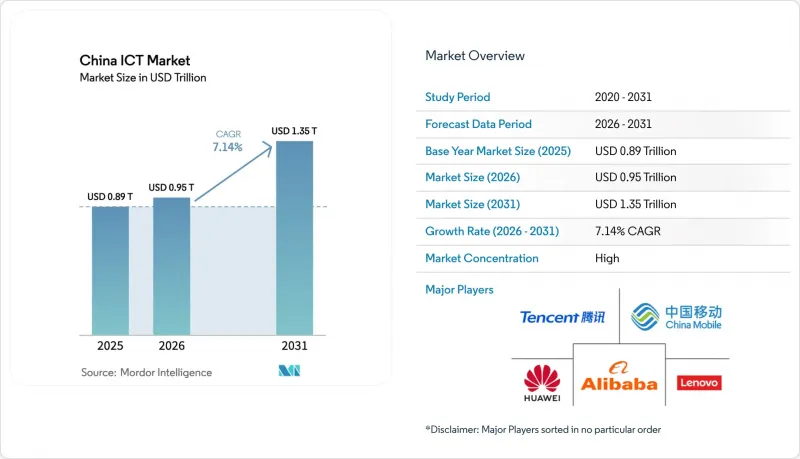
This report is Segmented by Type (Hardware, Software, and More), Enterprise Size (Small and Medium Enterprises and Large Enterprises), Industry Vertical (BFSI, IT and Telecom, Government and Public, and More), Technology Domain (Cloud Computing, Artificial Intelligence, Cybersecurity, and More), and Region. The Market Forecasts are Provided in Terms of Value (USD).
China ICT Market Trends and Insights
Rising Internet and 5G Penetration
Nationwide 5G rollout exceeded 101.4 million subscribers in 2024, lifting mobile internet usage to 78.6%. Industrial parks adopt private 5G networks to enable real-time quality control and autonomous guided vehicles. Each additional base station multiplies data traffic, increasing the addressable workload for edge servers and IoT gateways. Pricing models evolve from bandwidth metering toward outcome-based arrangements that link service fees to measured productivity uplifts. The China ICT market, therefore, captures both subscription revenues and high-margin integration services as enterprises redesign processes around low-latency connectivity.
Government "Digital China" and 14th Five-Year ICT Plan
Central planning sets explicit digital-economy targets, including a 45% GDP contribution by 2030. Unified technical standards lower integration costs for smart-city, telemedicine, and e-government platforms. Provincial grants funnel workloads westward under the "Eastern Data, Western Computing" program, cutting energy expenses and balancing regional capacity. Mandatory preference for local suppliers expands market access for domestic chip, server, and middleware vendors. The China ICT market thus gains both volume and value as policy support creates predictable demand cycles.
Legacy IT Complexity in State-Owned Enterprises
Many state actors still depend on proprietary mainframe environments installed over decades. Integrating cloud applications with these systems requires middleware and custom connectors that increase project timelines and costs. Procurement frameworks emphasize vendor track record, restricting market entry for emerging software firms. Workforce retraining adds an organizational challenge because digital workflows often conflict with established operating procedures. This inertia slows the overall pace at which the Chinese ICT market can penetrate heavy-industry value chains.
Other drivers and restraints analyzed in the detailed report include:
- Accelerated Enterprise Cloud Migration
- AI-Driven Productivity Gains Across Sectors
- Escalating Cybersecurity and Data-Sovereignty Risk
For complete list of drivers and restraints, kindly check the Table Of Contents.
Segment Analysis
The hardware segment accounted for 42.65% of China's ICT market revenue in 2025. Investments in 5G base stations, high-density servers, and edge gateways form the indispensable substrate for nationwide digitalization. Procurement linked to smart-city, transportation, and manufacturing projects guarantees a steady equipment refresh cycle. Datacenter operators prioritize domestic chips and switch gear to mitigate export risk, anchoring value locally.
Software, though smaller today, is forecast to post a 10.09% CAGR, making it the fastest-growing component of the China ICT market. Platform-as-a-Service offerings accelerate code deployment, while low-code tools let non-technical staff prototype customer-facing applications. System-infrastructure software rides the cloud wave as enterprises modernize legacy workloads. The convergence of hardware and software yields integrated stacks, allowing vendors such as Huawei to monetize silicon, operating systems, and cloud services in a single contract.
Large organizations retained 63.55% of the China ICT market share in 2025 due to sizable ERP, SCM, and CRM deployments that require bespoke integration. Their digital-transformation roadmaps span core production, finance, and distribution functions, locking in high consulting demand. Procurement cycles are lengthy yet produce multi-year recurring revenue streams once relationships mature.
SMEs log the fastest expansion at 10.32% CAGR, adding fresh addressable volume to the China ICT market size. Fiscal incentives, including tax rebates on qualifying software purchases, lower adoption barriers. Subscription-based cloud suites grant access to AI analytics, cybersecurity, and e-commerce modules without up-front hardware spend. Peer-to-peer knowledge sharing boosts confidence, and local service partners offer affordable customization. As SME digital intensity rises, overall productivity gains per USD invested often exceed those of larger rivals, reinforcing the structural importance of this customer layer.
Complete Report Scope:
- By Type
- Hardware
- Computing Devices
- Network Equipment
- Datacentre Infrastructure
- Software
- System Infrastructure
- Enterprise Applications
- IT Services
- Consulting and Integration
- Managed Services
- Telecommunication Services
- Mobile Services
- Fixed-Line and Broadband
- Hardware
- By Enterprise Size
- Small and Medium Enterprises (SMEs)
- Large Enterprises
- By Industry Vertical
- BFSI
- IT and Telecom
- Government and Public
- Retail and E-commerce
- Manufacturing
- Energy and Utilities
- Healthcare
- Education
- Transportation and Logistics
- Other Industry Verticals
- By Technology Domain
- Cloud Computing
- Artificial Intelligence
- Cybersecurity
- Digital Services (SaaS, PaaS)
- Edge Computing
- Internet of Things
- Blockchain
- By Region
- East China
- South China
- North and Northeast China
- Central China
- West and North-west China
List of Companies Covered in this Report:
- Alibaba Group Holding Ltd.
- Huawei Technologies Co Ltd.
- Tencent Holdings Ltd.
- China Mobile Communications Group Co. Ltd.
- Lenovo Group Ltd.
- Baidu Inc.
- JD.com Inc.
- Xiaomi Corporation
- ZTE Corporation
- Inspur Group Co Ltd.
- Hikvision Digital Technology Co Ltd.
- Dahua Technology Co Ltd.
- Sangfor Technologies Inc.
- Venustech Group Inc.
- H3C Technologies Co Ltd.
- Kingsoft Cloud Holdings Ltd.
- UCloud Technology Co Ltd.
- Kingdee International Software Group Co Ltd.
- Neusoft Corporation
- iFlytek Co Ltd.
- SenseTime Group Inc.
- Cambricon Technologies Corp Ltd.
- GDS Holdings Ltd.
- FiberHome Telecom Technologies Co Ltd.
- China Unicom
- China Telecom
Additional Benefits:
- The market estimate (ME) sheet in Excel format
- 3 months of analyst support
TABLE OF CONTENTS
1 INTRODUCTION
- 1.1 Study Assumptions and Market Definition
- 1.2 Scope of the Study
2 RESEARCH METHODOLOGY
3 EXECUTIVE SUMMARY
4 MARKET LANDSCAPE
- 4.1 Market Overview
- 4.2 Market Drivers
- 4.2.1 Rising internet and 5G penetration
- 4.2.2 Government "Digital China" and 14th Five-Year ICT plan
- 4.2.3 Accelerated enterprise cloud migration
- 4.2.4 AI?driven productivity gains across sectors
- 4.2.5 "XInc.huang" localisation push fuelling domestic demand
- 4.2.6 Carbon-informatisation mandates driving green ICT
- 4.3 Market Restraints
- 4.3.1 Legacy IT complexity in state-owned enterprises
- 4.3.2 Escalating cybersecurity/data-sovereignty risk
- 4.3.3 US export controls on advanced semiconductors
- 4.3.4 Fragmented provIncial procurement processes
- 4.4 Industry Value Chain Analysis
- 4.5 Regulatory Landscape
- 4.6 Technological Outlook
- 4.7 Industry Attractiveness - Porter's Five Forces Analysis
- 4.7.1 Bargaining Power of Suppliers
- 4.7.2 Bargaining Power of Consumers
- 4.7.3 Threat of New Entrants
- 4.7.4 Threat of Substitute Products
- 4.7.5 Intensity of Competitive Rivalry
- 4.8 Impact of Macroeconomic Factors on the Market
5 MARKET SIZE AND GROWTH FORECASTS (VALUES)
- 5.1 By Type
- 5.1.1 Hardware
- 5.1.1.1 Computing Devices
- 5.1.1.2 Network Equipment
- 5.1.1.3 Datacentre Infrastructure
- 5.1.2 Software
- 5.1.2.1 System Infrastructure
- 5.1.2.2 Enterprise Applications
- 5.1.3 IT Services
- 5.1.3.1 Consulting and Integration
- 5.1.3.2 Managed Services
- 5.1.4 Telecommunication Services
- 5.1.4.1 Mobile Services
- 5.1.4.2 Fixed-Line and Broadband
- 5.1.1 Hardware
- 5.2 By Enterprise Size
- 5.2.1 Small and Medium Enterprises (SMEs)
- 5.2.2 Large Enterprises
- 5.3 By Industry Vertical
- 5.3.1 BFSI
- 5.3.2 IT and Telecom
- 5.3.3 Government and Public
- 5.3.4 Retail and E-commerce
- 5.3.5 Manufacturing
- 5.3.6 Energy and Utilities
- 5.3.7 Healthcare
- 5.3.8 Education
- 5.3.9 Transportation and Logistics
- 5.3.10 Other Industry Verticals
- 5.4 By Technology Domain
- 5.4.1 Cloud Computing
- 5.4.2 Artificial Intelligence
- 5.4.3 Cybersecurity
- 5.4.4 Digital Services (SaaS, PaaS)
- 5.4.5 Edge Computing
- 5.4.6 Internet of Things
- 5.4.7 Blockchain
- 5.5 By Region
- 5.5.1 East China
- 5.5.2 South China
- 5.5.3 North and Northeast China
- 5.5.4 Central China
- 5.5.5 West and North-west China
6 COMPETITIVE LANDSCAPE
- 6.1 Market Concentration
- 6.2 Strategic Moves
- 6.3 Market Share Analysis
- 6.4 Company Profiles (includes Global level Overview, Market level overview, Core Segments, Financials as available, Strategic Information, Market Rank/Share for key companies, Products and Services, and Recent Developments)
- 6.4.1 Alibaba Group Holding Ltd.
- 6.4.2 Huawei Technologies Co Ltd.
- 6.4.3 Tencent Holdings Ltd.
- 6.4.4 China Mobile Communications Group Co. Ltd.
- 6.4.5 Lenovo Group Ltd.
- 6.4.6 Baidu Inc.
- 6.4.7 JD.com Inc.
- 6.4.8 Xiaomi Corporation
- 6.4.9 ZTE Corporation
- 6.4.10 Inspur Group Co Ltd.
- 6.4.11 Hikvision Digital Technology Co Ltd.
- 6.4.12 Dahua Technology Co Ltd.
- 6.4.13 Sangfor Technologies Inc.
- 6.4.14 Venustech Group Inc.
- 6.4.15 H3C Technologies Co Ltd.
- 6.4.16 Kingsoft Cloud Holdings Ltd.
- 6.4.17 UCloud Technology Co Ltd.
- 6.4.18 Kingdee International Software Group Co Ltd.
- 6.4.19 Neusoft Corporation
- 6.4.20 iFlytek Co Ltd.
- 6.4.21 SenseTime Group Inc.
- 6.4.22 Cambricon Technologies Corp Ltd.
- 6.4.23 GDS Holdings Ltd.
- 6.4.24 FiberHome Telecom Technologies Co Ltd.
- 6.4.25 China Unicom
- 6.4.26 China Telecom
7 MARKET OPPORTUNITIES AND FUTURE TRENDS
- 7.1 White-Space and Unmet-Need Assessment

