PUBLISHER: Mordor Intelligence | PRODUCT CODE: 2117267

PUBLISHER: Mordor Intelligence | PRODUCT CODE: 2117267
Spain ICT - Market Share Analysis, Industry Trends & Statistics, Growth Forecasts (2026 - 2031)
According to Mordor Intelligence, the Spain ICT market size is expected to increase from USD 62.33 billion in 2025 to USD 67.69 billion in 2026 and reach USD 97.72 billion by 2031, growing at a CAGR of 7.62% over 2026-2031.
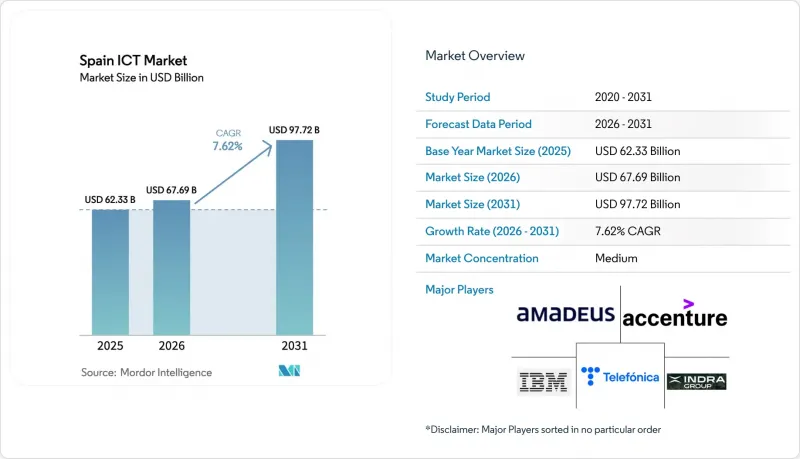
This report is Segmented by Product Type (IT Hardware, IT Software, IT Services, IT Infrastructure, and More), Enterprise Size (Small and Medium-Sized Enterprises, and Large Enterprises), and Industry Vertical (Government and Public Administration, BFSI, IT and Telecom, Energy and Utilities, Retail E-Commerce and Logistics, and More). The Market Forecasts are Provided in Terms of Value (USD).
Spain ICT Market Trends and Insights
Accelerated Cloud Adoption Among Spanish SMEs
More than 710,000 vouchers worth EUR 2.9 billion (USD 3.44 billion) lowered the payback period on SaaS investments from three years to under 18 months, lifting the SME cloud-utilization rate to 34% in late 2025. Software vendors now chase monthly recurring revenue, embedding GDPR modules that lock firms into multi-year contracts. Madrid and Catalonia captured nearly half of all vouchers, while rural Extremadura trailed because of limited broadband. As subsidies sunset in late 2026, churn metrics will reveal whether SMEs internalize cloud workflows or retreat to on-premise stacks. For the Spain ICT market, retention, not acquisition, will determine post-subsidy momentum.
EU-Funded Digitalization Surge Post-2026
Spain received the EU's highest per-capita digital allocation, exceeding EUR 800 (USD 949.24) per inhabitant through 2025. The PERTE Chip initiative injects EUR 12.25 billion (USD 14.54 billion) into semiconductor R&D, while Spain Digital 2026 targets nationwide fiber coverage and online availability of all public services by end-2026. Systems integrators with framework agreements stand to book back-to-back projects as ministries race to hit EU milestones. Municipalities lacking project-management bandwidth risk missing funds, widening the urban-rural digital divide. From 2027 onward, grants morph into blended finance, favoring partners able to absorb balance-sheet risk, a dynamic that reshapes the Spain ICT market's competitive landscape.
Persistent Shortage of Senior Cloud Architects
Spain had up to 200,000 unfilled ICT roles in 2025, with senior cloud architects commanding 20-30% salary premiums. Only 9.2% of graduates emerge with STEM degrees, and women fill just 1.4% of ICT posts, dampening diversity and supply lines. Project queues lengthen 6-12 months, inflating migration costs by up to 25%. Although a government-backed Digital Talent program subsidizes bootcamps, the first cohort enters the labor market in late 2026, leaving a critical talent gap that slows the Spain ICT market's velocity.
Other drivers and restraints analyzed in the detailed report include:
- Rapid 5G Roll-Out Catalyzing Edge Demand
- Rising Cyber-Attack Sophistication Driving Security Spend
- High Electricity Prices and Grid Saturation
For complete list of drivers and restraints, kindly check the Table Of Contents.
Segment Analysis
IT services contributed 38.23% of 2025 revenue, giving the segment the largest Spain ICT market share across product lines. Managed services, application modernization, and integration workstreams drive this dominance as enterprises transition to hybrid architectures. Meanwhile, IT security revenue is set to grow at an 8.18% CAGR to 2031, the fastest among all categories, driven by ransomware escalation and NIS2 compliance deadlines. Hardware faces margin compression as clients prolong refresh cycles, though network equipment enjoys a bump from 5G rollouts.
Spending patterns demonstrate overlap: cloud vendors now embed automated patching, while managed security providers supply compliance dashboards, blurring classic product boundaries. Hyperscale data-center builds in Aragon illustrate this convergence, pairing infrastructure investment with high-margin professional services. These shifts reinforce the Spain ICT market size at the intersection of services and security, redirecting vendor innovation toward outcome-based pricing.
Complete Report Scope:
- By Product Type
- IT Hardware
- Computer Hardware
- Networking Equipment
- Peripherals
- IT Software
- IT Services
- IT Consulting and Implementation
- IT Outsourcing (ITO)
- Business Process Outsourcing (BPO)
- Managed Security Services
- Cloud and Platform Services
- IT Infrastructure
- IT Security/Cybersecurity
- Communication Services
- IT Hardware
- By Enterprise Size
- Small and Medium-sized Enterprises
- Large Enterprises
- By Industry Vertical
- Government and Public Administration
- BFSI
- IT and Telecom
- Energy and Utilities
- Retail, E-commerce, and Logistics
- Manufacturing and Industry 4.0
- Healthcare and Life Sciences
- Oil and Gas
- Other Industry Verticals
List of Companies Covered in this Report:
- Telefonica S.A.
- Indra Sistemas S.A.
- Amadeus IT Group S.A.
- IBM Corporation
- Accenture plc
- Atos SE
- NTT DATA Espana, S.L.U. (Everis)
- Capgemini SE
- Vodafone Group Plc
- Orange S.A.
- Hewlett Packard Enterprise Company
- Cisco Systems Inc.
- Microsoft Corporation
- Amazon Web Services Inc.
- Google LLC
- DXC Technology Company
- Fujitsu Limited
- SAP SE
- Oracle Corporation
- Inetum S.A.
- T-Systems Iberia S.A.U.
- Sopra Steria Group SA
Additional Benefits:
- The market estimate (ME) sheet in Excel format
- 3 months of analyst support
TABLE OF CONTENTS
1 INTRODUCTION
- 1.1 Study Assumptions and Market Definition
- 1.2 Scope of the Study
2 RESEARCH METHODOLOGY
3 EXECUTIVE SUMMARY
4 MARKET LANDSCAPE
- 4.1 Market Overview
- 4.2 Market Drivers
- 4.2.1 Accelerated Cloud Adoption Among Spanish SMEs
- 4.2.2 Surge in EU-Funded Digitalisation Grants Post-2026
- 4.2.3 Rapid 5G Roll-out Catalysing Edge Computing Demand
- 4.2.4 Growing Near-Shore Outsourcing Preference Within EU
- 4.2.5 Rising Cyber-attack Sophistication Driving Security Spend
- 4.2.6 Expansion of Smart Manufacturing Hubs in Spain's Automotive Corridor
- 4.3 Market Restraints
- 4.3.1 Persistent Shortage of Senior Cloud Architects
- 4.3.2 High Electricity Prices Undermining Local Data-centre Economics
- 4.3.3 Legacy ERP Lock-in Across Public Administration
- 4.3.4 Procurement Bureaucracy Slowing Large-Scale IT Projects
- 4.4 Industry Value Chain Analysis
- 4.5 Regulatory Landscape
- 4.6 Technological Outlook
- 4.7 Porter's Five Forces Analysis
- 4.7.1 Threat of New Entrants
- 4.7.2 Bargaining Power of Suppliers
- 4.7.3 Bargaining Power of Buyers
- 4.7.4 Threat of Substitutes
- 4.7.5 Intensity of Competitive Rivalry
- 4.8 Investment Analysis?
- 4.9 Impact of Macroeconomic Factors?
- 4.10 Industry Stakeholder Analysis
5 MARKET SIZE AND GROWTH FORECASTS (VALUE)
- 5.1 By Product Type
- 5.1.1 IT Hardware
- 5.1.1.1 Computer Hardware
- 5.1.1.2 Networking Equipment
- 5.1.1.3 Peripherals
- 5.1.2 IT Software
- 5.1.3 IT Services
- 5.1.3.1 IT Consulting and Implementation
- 5.1.3.2 IT Outsourcing (ITO)
- 5.1.3.3 Business Process Outsourcing (BPO)
- 5.1.3.4 Managed Security Services
- 5.1.3.5 Cloud and Platform Services
- 5.1.4 IT Infrastructure
- 5.1.5 IT Security/Cybersecurity
- 5.1.6 Communication Services
- 5.1.1 IT Hardware
- 5.2 By Enterprise Size
- 5.2.1 Small and Medium-sized Enterprises
- 5.2.2 Large Enterprises
- 5.3 By Industry Vertical
- 5.3.1 Government and Public Administration
- 5.3.2 BFSI
- 5.3.3 IT and Telecom
- 5.3.4 Energy and Utilities
- 5.3.5 Retail, E-commerce, and Logistics
- 5.3.6 Manufacturing and Industry 4.0
- 5.3.7 Healthcare and Life Sciences
- 5.3.8 Oil and Gas
- 5.3.9 Other Industry Verticals
6 COMPETITIVE LANDSCAPE
- 6.1 Market Concentration
- 6.2 Strategic Moves
- 6.3 Market Share Analysis
- 6.4 Company Profiles (includes Global level Overview, Market level overview, Core Segments, Financials as available, Strategic Information, Market Rank/Share for key companies, Products and Services, and Recent Developments)
- 6.4.1 Telefonica S.A.
- 6.4.2 Indra Sistemas S.A.
- 6.4.3 Amadeus IT Group S.A.
- 6.4.4 IBM Corporation
- 6.4.5 Accenture plc
- 6.4.6 Atos SE
- 6.4.7 NTT DATA Espana, S.L.U. (Everis)
- 6.4.8 Capgemini SE
- 6.4.9 Vodafone Group Plc
- 6.4.10 Orange S.A.
- 6.4.11 Hewlett Packard Enterprise Company
- 6.4.12 Cisco Systems Inc.
- 6.4.13 Microsoft Corporation
- 6.4.14 Amazon Web Services Inc.
- 6.4.15 Google LLC
- 6.4.16 DXC Technology Company
- 6.4.17 Fujitsu Limited
- 6.4.18 SAP SE
- 6.4.19 Oracle Corporation
- 6.4.20 Inetum S.A.
- 6.4.21 T-Systems Iberia S.A.U.
- 6.4.22 Sopra Steria Group SA
7 MARKET OPPORTUNITIES AND FUTURE OUTLOOK
- 7.1 White-space and Unmet-Need Assessment

