PUBLISHER: Mordor Intelligence | PRODUCT CODE: 2116957

PUBLISHER: Mordor Intelligence | PRODUCT CODE: 2116957
Japan ICT - Market Share Analysis, Industry Trends & Statistics, Growth Forecasts (2026 - 2031)
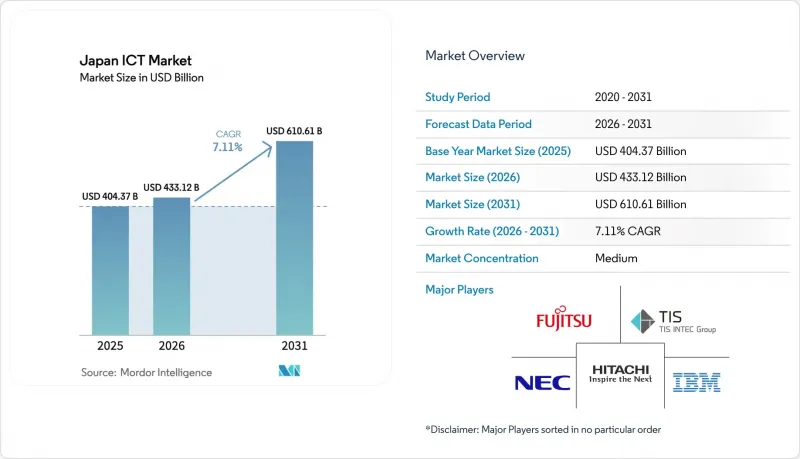
According to Mordor Intelligence, japan iCT market size in 2026 is estimated at USD 433.12 billion, growing from 2025 value of USD 404.37 billion with 2031 projections showing USD 610.61 billion, growing at 7.11% CAGR over 2026-2031.
[1] Brad Smith, "Microsoft to Spend USD 2.9 Billion on Japanese Data Centers," Data Center Dynamics, datacenterdynamics.com Enterprise commitments to modernize legacy mainframe estates before the "2025 cliff," combined with Society 5.0 policy initiatives, are accelerating spending on hybrid cloud, AI infrastructure, and cybersecurity solutions. [2] IBM Japan Press Desk, "SCSK and IBM Japan Sign Strategic Partnership for Hybrid Cloud," ibm.com Hyperscaler region build-outs exceeding USD 17.9 billion since 2024 are expanding domestic data-center capacity and creating multiplier effects for software, networking, and managed services demand Shrinking working-age population is intensifying automation investments, while ISMAP certification is reshaping procurement by favoring providers that meet more than 1,000 detailed security controls. [3] "List of ISMS Cloud Security Certified Organizations," ISMS Accreditation Center, isms.jp Despite robust growth, the Japan ICT market faces structural challenges from an acute shortage of cloud and AI professionals, an expanding cyber-attack surface, and a widening digital trade deficit that highlights continued dependency on overseas platforms. This report is Segmented by Product Type (IT Hardware, IT Software, IT Services, IT Infrastructure, IT Security, Communication Services), Enterprise Size (Small and Medium Enterprises, Large Enterprises), and End-User Industry Vertical (Government and Public Administration, BFSI, Energy and Utilities and More). The Market Forecasts are Provided in Terms of Value (USD).
Japan ICT Market Trends and Insights
Accelerating DX Spending by Large Enterprises
Large corporations are raising IT budgets to mitigate the "2025 cliff," with 78% of major firms planning to double spend by 2026 as legacy systems reach end-of-life. METI estimates that economic losses could reach JPY 12 trillion (USD 0.08 trillion) per year if modernization lags, prompting rapid uptake of mainframe-to-cloud migration services. Panasonic's COBOL-to-Java conversion has already saved tens of billions of yen in operating costs, demonstrating tangible ROI. Financial institutions lead demand, representing a JPY 500 billion (USD 3.38 billion) opportunity for legacy system transformation. Systems integrators and cloud providers alike are bundling assessment, re-platforming, and managed services into multi-year contracts that lock in recurring revenue.
Hyperscaler CAPEX Surge and Local Region Build-Outs
Microsoft, AWS, and Google Cloud have collectively earmarked more than USD 18 billion for new Japanese regions through 2025, adding power-dense campuses in Osaka, Fukuoka, and Hokkaido. SoftBank's 400 MW AI facility and KDDI's NVIDIA-powered center at the former Sharp Sakai site exemplify Japan's push for local, low-latency compute that can train trillion-parameter models. These investments stimulate domestic supply chains for power, cooling, network interconnects, and professional services. Land-constrained metros are seeing creative brownfield conversions of idle industrial sites into tier-IV data centers, increasing region diversity and energy-efficiency standards.
Acute Shortage of Cloud/AI Talent
Japan may face a 400,000-to-800,000 engineer deficit by 2030, inflating salaries 40-60% above traditional IT roles and delaying project timelines. Legacy mainframe specialists over age 50 are in unprecedented demand for COBOL remediation, commanding multiple offers. Government reskilling grants and simplified "Specified Skilled Worker" visas aim to broaden the labor pool but will have limited near-term effect. Enterprises are offshoring niche tasks, yet language and security concerns restrict strategic workloads. This scarcity raises total cost of ownership and forces prioritization of high-ROI projects, tempering the overall Japan ICT market growth momentum.
Other drivers and restraints analyzed in the detailed report include:
- Government Cloud Program Boosting Public-Sector IT
- AI-Enabled SaaS Adoption in Underserved SMB Segment
- Intensifying Cyber-Attack Surface and Compliance Costs
For complete list of drivers and restraints, kindly check the Table Of Contents.
Segment Analysis
IT Services contributed 40.73% to Japan ICT market share in 2025, reflecting persistent reliance on systems integration and managed operations for mission-critical workloads. Cloud Services, powered by USD 17.9 billion hyperscaler CAPEX, is forecast to post an 7.78% CAGR, propelling the Japan ICT market size of this sub-segment from a 2025 base of USD 197.0 billion to USD 308.9 billion by 2031.
Systems integrators bundle application refactoring, data-center decommissioning, and ongoing governance, securing multi-year annuity revenue. Meanwhile, hardware demand clusters around AI-optimized GPUs and high-density rack power distribution. Domestic software publishers lag global peers, widening the digital trade deficit and reinforcing demand for SaaS imports. Communication Services leverage 5G Stand-Alone cores that enable network slicing, creating cross-sell opportunities for edge analytics. Cybersecurity vendors integrate zero-trust suites with observability platforms, delivering unified threat detection across hybrid estates.
Complete Report Scope:
- By Product Type
- IT Hardware
- Computer Hardware
- Networking Equipment
- Peripherals
- IT Software
- IT Services
- IT Consulting and Implementation
- IT Outsourcing (ITO)
- Business Process Outsourcing (BPO)
- Managed Security Services
- Cloud and Platform Services
- IT Infrastructure
- IT Security/Cybersecurity
- Communication Services
- IT Hardware
- By Enterprise Size
- Small and Medium-sized Enterprises
- Large Enterprises
- By End-user Industry Vertical
- Government and Public Administration
- BFSI
- IT and Telecom
- Energy and Utilities
- Retail, E-commerce, and Logistics
- Manufacturing and Industry 4.0
- Healthcare and Life Sciences
- Oil and Gas
- Other Verticals
List of Companies Covered in this Report:
- Fujitsu Limited
- NEC Corporation
- Hitachi, Ltd.
- TIS Inc.
- IBM Japan, Ltd.
- ITOCHU Techno-Solutions Corporation
- Panasonic Holdings Corporation
- Sony Group Corporation
- Salesforce Japan Co., Ltd.
- SCSK Corporation
- NTT DATA Corporation
- KDDI Corporation
- SoftBank Corp.
- Internet Initiative Japan Inc.
- Rakuten Group, Inc.
- Nomura Research Institute, Ltd.
- Oracle Corporation Japan
- Microsoft Japan Co., Ltd.
- Google Cloud Japan G.K.
- Amazon Web Services Japan G.K.
Additional Benefits:
- The market estimate (ME) sheet in Excel format
- 3 months of analyst support
TABLE OF CONTENTS
1 INTRODUCTION
- 1.1 Study Assumptions and Market Definitions
- 1.2 Scope of the Study
2 RESEARCH METHODOLOGY
3 EXECUTIVE SUMMARY
4 MARKET LANDSCAPE
- 4.1 Market Overview
- 4.2 Market Drivers
- 4.2.1 Accelerating DX spending by large enterprises
- 4.2.2 Hyperscaler CAPEX surge and local region build-outs
- 4.2.3 Government Cloud program boosting public?sector IT
- 4.2.4 AI-enabled SaaS adoption in underserved SMB segment
- 4.2.5 Semiconductor-equipment investments for AI infrastructure
- 4.2.6 Workforce-automation demand amid ageing demographics
- 4.3 Market Restraints
- 4.3.1 Acute shortage of cloud/AI talent
- 4.3.2 Intensifying cyber-attack surface and compliance costs
- 4.3.3 Legacy mainframe dependence raising migration risk
- 4.3.4 Digital-trade deficit draining domestic software spend
- 4.4 Value Chain Analysis
- 4.5 Regulatory Landscape
- 4.6 Technological Outlook
- 4.7 Porter's Five Forces Analysis
- 4.7.1 Bargaining Power of Suppliers
- 4.7.2 Bargaining Power of Buyers
- 4.7.3 Threat of New Entrants
- 4.7.4 Threat of Substitutes
- 4.7.5 Intensity of Competitive Rivalry
- 4.8 Investment Analysis
- 4.9 Impact of Macroeconomic Factors
- 4.10 Industry Stakeholder Analysis
5 MARKET SIZE AND GROWTH FORECASTS (VALUE)
- 5.1 By Product Type
- 5.1.1 IT Hardware
- 5.1.1.1 Computer Hardware
- 5.1.1.2 Networking Equipment
- 5.1.1.3 Peripherals
- 5.1.2 IT Software
- 5.1.3 IT Services
- 5.1.3.1 IT Consulting and Implementation
- 5.1.3.2 IT Outsourcing (ITO)
- 5.1.3.3 Business Process Outsourcing (BPO)
- 5.1.3.4 Managed Security Services
- 5.1.3.5 Cloud and Platform Services
- 5.1.4 IT Infrastructure
- 5.1.5 IT Security/Cybersecurity
- 5.1.6 Communication Services
- 5.1.1 IT Hardware
- 5.2 By Enterprise Size
- 5.2.1 Small and Medium-sized Enterprises
- 5.2.2 Large Enterprises
- 5.3 By End-user Industry Vertical
- 5.3.1 Government and Public Administration
- 5.3.2 BFSI
- 5.3.3 IT and Telecom
- 5.3.4 Energy and Utilities
- 5.3.5 Retail, E-commerce, and Logistics
- 5.3.6 Manufacturing and Industry 4.0
- 5.3.7 Healthcare and Life Sciences
- 5.3.8 Oil and Gas
- 5.3.9 Other Verticals
6 COMPETITIVE LANDSCAPE
- 6.1 Market Concentration
- 6.2 Strategic Moves
- 6.3 Market Share Analysis
- 6.4 Company Profiles (includes Global level Overview, Market level overview, Core Segments, Financials as available, Strategic Information, Market Rank/Share for key companies, Products and Services, and Recent Developments)
- 6.4.1 Fujitsu Limited
- 6.4.2 NEC Corporation
- 6.4.3 Hitachi, Ltd.
- 6.4.4 TIS Inc.
- 6.4.5 IBM Japan, Ltd.
- 6.4.6 ITOCHU Techno-Solutions Corporation
- 6.4.7 Panasonic Holdings Corporation
- 6.4.8 Sony Group Corporation
- 6.4.9 Salesforce Japan Co., Ltd.
- 6.4.10 SCSK Corporation
- 6.4.11 NTT DATA Corporation
- 6.4.12 KDDI Corporation
- 6.4.13 SoftBank Corp.
- 6.4.14 Internet Initiative Japan Inc.
- 6.4.15 Rakuten Group, Inc.
- 6.4.16 Nomura Research Institute, Ltd.
- 6.4.17 Oracle Corporation Japan
- 6.4.18 Microsoft Japan Co., Ltd.
- 6.4.19 Google Cloud Japan G.K.
- 6.4.20 Amazon Web Services Japan G.K.
7 MARKET OPPORTUNITIES AND FUTURE OUTLOOK
- 7.1 White-space and Unmet-need Assessment

