PUBLISHER: Mordor Intelligence | PRODUCT CODE: 2116926

PUBLISHER: Mordor Intelligence | PRODUCT CODE: 2116926
Indonesia ICT - Market Share Analysis, Industry Trends & Statistics, Growth Forecasts (2026 - 2031)
According to Mordor Intelligence, indonesia iCT market size is USD 57.71 billion in 2026 and is projected to reach USD 114.96 billion by 2031, reflecting a 14.78% CAGR.
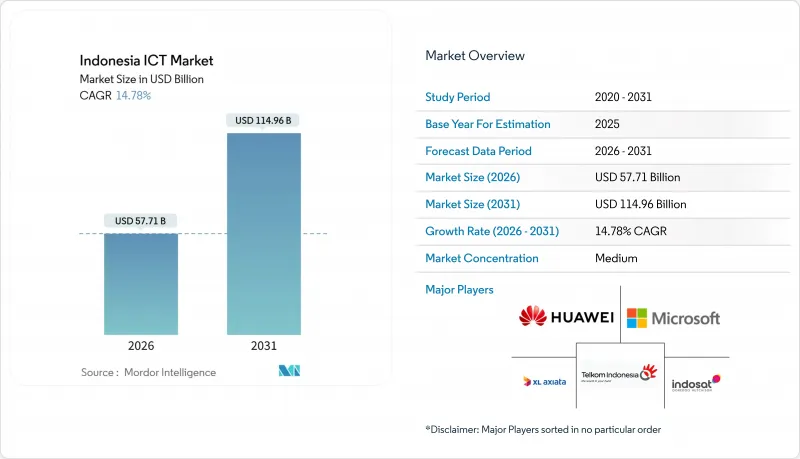
This report is Segmented by Product Type (IT Hardware, IT Software, and More), Enterprise Size (Small and Medium-Sized Enterprises, and Large Enterprises), End-User Industry Vertical (BFSI, Government and Public Sector, Oil and Gas, IT and Telecom, Retail and E-Commerce, Manufacturing, Energy, and More), Deployment Model (On-Premise, Cloud, and Hybrid). The Market Forecasts are Provided in Terms of Value (USD).
Indonesia ICT Market Trends and Insights
Digital Transformation Of Indonesian Enterprises
Modernization initiatives dominate technology budgets as conglomerates migrate SAP and Oracle workloads to cloud-native stacks while deploying IoT sensors on factory floors. Accenture's collaboration with Indosat to build a sovereign AI cloud shows how telcos are recasting themselves as transformation partners rather than pure connectivity utilities. Mandatory TKDN thresholds reward local software development, prompting regional integrators to package turnkey offerings that combine compliance and technical execution. Manufacturing receives explicit policy support through the Making Indonesia 4.0 roadmap. Yet uneven in-house skill levels make outsourcing attractive, which explains the sustained double-digit expansion of services revenue within the Indonesia ICT market.
Government Digital-Skills And Infrastructure Push
The Digital Talent Scholarship delivered 1 million graduates between 2018 and 2024 and targets 100,000 more in 2025. SATRIA-1's 150 Gbps backbone now supports 30,000 public facilities, complementing the under-utilized 36,000-km Palapa Ring fiber. These initiatives extend basic connectivity to provinces that historically lacked reliable bandwidth and create new addressable demand for cloud, cybersecurity, and e-government platforms. However, employer surveys reveal that many graduates require six months of additional training before they can run production workloads, highlighting persistent capability gaps that temper the Indonesia ICT market's near-term productivity gains.
Shortage Of Advanced ICT Talent
Indonesia needs 9 million ICT professionals by 2030, but current education pipelines will supply only 6 million. Salaries for senior cloud engineers in Jakarta climbed 25-30% each year since 2023, eroding cost advantages versus regional hubs. Global vendors launch in-house academies to assure certification-grade skills, yet enterprises still budget six to twelve months of shadowing before new hires achieve full productivity. Services firms now blend local juniors with seasoned offshore architects from India or the Philippines, which mitigates wage inflation but introduces coordination overhead and potential data-sovereignty friction.
Other drivers and restraints analyzed in the detailed report include:
- E-Commerce Boom Spurring Online Payments
- Palapa Ring And SATRIA-1 Satellite Roll-Out
- Data-Privacy And Cyber-Security Concerns
For complete list of drivers and restraints, kindly check the Table Of Contents.
Segment Analysis
IT services held 32.73% of the Indonesia ICT market share in 2025 and will grow at a 15.22% CAGR through 2031. Managed security and cloud platform services claim the lion's share as enterprises outsource transformation complexity. Hardware refresh cycles lengthen while software budgets tilt toward SaaS subscriptions. Zero-trust architectures merge infrastructure and security domains, forcing vendors to deliver integrated stacks. The Indonesia ICT market size for services stands to double by 2031 as ransomware threats and compliance mandates intensify.
Demand for localized SaaS in Bahasa Indonesia encourages domestic software houses, which leverage TKDN incentives to compete with multinationals. Nevertheless, talent scarcity delays large-scale ERP migrations, requiring phased rollouts that extend project timelines. Communication services margins compress under 5G capital intensity, pushing telcos to concentrate on enterprise IoT and edge analytics as value-add layers.
Large enterprises contributed 62.84% of 2025 spend, yet SMEs clock the fastest 15.67% CAGR, shrinking the gap. Government programs integrated 17 million micro-businesses into e-commerce and fintech ecosystems, lowering onboarding hurdles. QRIS ubiquity lets merchants accept cashless payments via smartphones, sparing them point-of-sale capex. Low-code platforms further democratize application creation, reducing dependence on scarce developers and propelling SME adoption inside the Indonesia ICT market.
Legacy modernization burdens large state-owned enterprises. Mainframe dependencies and complex compliance layers stretch migration roadmaps to multi-year horizons. Telkom Indonesia's fiber spin-off reallocates capital toward cloud and security, yet reorganizations can delay internal IT upgrades. Vendors able to serve both high-velocity cloud-native SMEs and risk-averse incumbents position themselves for outsized wallet share.
Complete Report Scope:
- By Product Type
- IT Hardware
- Computer Hardware
- Networking Equipment
- Peripherals
- IT Software
- IT Services
- IT Consulting and Implementation
- IT Outsourcing (ITO)
- Business Process Outsourcing (BPO)
- Managed Security Services
- Cloud and Platform Services
- IT Infrastructure
- IT Security / Cybersecurity
- Application Security
- Cloud Security
- Data Security
- Network Security
- Endpoint Security
- Infrastructure Protection
- Integrated Risk Management
- Identity and Access Management (IAM)
- Communication Services
- IT Hardware
- By Enterprise Size
- Small and Medium-sized Enterprises
- Large Enterprises
- By End-user Industry Vertical
- BFSI
- Government and Public Sector
- Oil and Gas
- IT and Telecom
- Retail, E-Commerce and Consumers
- Manufacturing and Industrial
- Energy and Utilities
- Healthcare
- Other End-user Industry Verticals (Transport, Logistics, Education, Hospitality)
- By Deployment Model
- On-premise
- Cloud
- Hybrid
List of Companies Covered in this Report:
- PT Telkom Indonesia (Persero) Tbk
- Indosat Ooredoo Hutchison Tbk
- XL Axiata Tbk
- Huawei Technologies Co., Ltd.
- Microsoft Corporation
- Samsung Electronics Co., Ltd.
- Dell Technologies Inc.
- Lenovo Group Ltd.
- HP Inc.
- IBM Corporation
- Oracle Corporation
- SAP SE
- Accenture plc
- Cognizant Technology Solutions Corporation
- Infosys Limited
- Tata Consultancy Services Limited
- Tech Mahindra Limited
- Cisco Systems, Inc.
- Fortinet, Inc.
- Palo Alto Networks, Inc.
- Kaspersky Lab
- Trend Micro Incorporated
- Equinix, Inc.
- ST Telemedia Global Data Centres (STT GDC)
- NTT Ltd.
- Alibaba Cloud Computing Ltd. (added)
- Amazon Web Services, Inc. (added)
- Google Cloud Platform LLC (added)
- PT DCI Indonesia Tbk (added)
- PT Biznet Gio Nusantara (added)
Additional Benefits:
- The market estimate (ME) sheet in Excel format
- 3 months of analyst support
TABLE OF CONTENTS
1 INTRODUCTION
- 1.1 Study Assumptions and Market Definition
- 1.2 Scope of the Study
2 RESEARCH METHODOLOGY
3 EXECUTIVE SUMMARY
4 MARKET LANDSCAPE
- 4.1 Market Overview
- 4.2 Market Drivers
- 4.2.1 Digital Transformation of Indonesian Enterprises
- 4.2.2 Government Digital-Skills And Infrastructure Push
- 4.2.3 E-Commerce Boom Spurring Online Payments
- 4.2.4 Palapa Ring And Satria-1 Satellite Roll-Out
- 4.2.5 Shift To Green Data-Centres Amid High Power Tariffs
- 4.2.6 Ai-Driven Localisation of Cloud Services For Bahasa Indonesia
- 4.3 Market Restraints
- 4.3.1 Data-Privacy And Cyber-Security Concerns
- 4.3.2 Shortage Of Advanced Ict Talent
- 4.3.3 Local-Content (Tkdn) Rules Inflate Hardware Costs
- 4.3.4 Rising Electricity Tariffs Threaten Data-Centre Opex
- 4.4 Industry Value Chain Analysis
- 4.5 Regulatory Landscape
- 4.6 Technological Outlook
- 4.6.1 Cloud Computing
- 4.6.2 Artificial Intelligence and Analytics
- 4.6.3 Cybersecurity
- 4.6.4 IoT and Edge Computing
- 4.6.5 5G and Beyond
- 4.7 Porter's Five Forces Analysis
- 4.7.1 Bargaining Power of Suppliers
- 4.7.2 Bargaining Power of Buyers
- 4.7.3 Threat of New Entrants
- 4.7.4 Threat of Substitutes
- 4.7.5 Intensity of Competitive Rivalry
- 4.8 Impact of Macroeconomic Factors
5 MARKET SIZE AND GROWTH FORECASTS (VALUE)
- 5.1 By Product Type
- 5.1.1 IT Hardware
- 5.1.1.1 Computer Hardware
- 5.1.1.2 Networking Equipment
- 5.1.1.3 Peripherals
- 5.1.2 IT Software
- 5.1.3 IT Services
- 5.1.3.1 IT Consulting and Implementation
- 5.1.3.2 IT Outsourcing (ITO)
- 5.1.3.3 Business Process Outsourcing (BPO)
- 5.1.3.4 Managed Security Services
- 5.1.3.5 Cloud and Platform Services
- 5.1.4 IT Infrastructure
- 5.1.5 IT Security / Cybersecurity
- 5.1.5.1 Application Security
- 5.1.5.2 Cloud Security
- 5.1.5.3 Data Security
- 5.1.5.4 Network Security
- 5.1.5.5 Endpoint Security
- 5.1.5.6 Infrastructure Protection
- 5.1.5.7 Integrated Risk Management
- 5.1.5.8 Identity and Access Management (IAM)
- 5.1.6 Communication Services
- 5.1.1 IT Hardware
- 5.2 By Enterprise Size
- 5.2.1 Small and Medium-sized Enterprises
- 5.2.2 Large Enterprises
- 5.3 By End-user Industry Vertical
- 5.3.1 BFSI
- 5.3.2 Government and Public Sector
- 5.3.3 Oil and Gas
- 5.3.4 IT and Telecom
- 5.3.5 Retail, E-Commerce and Consumers
- 5.3.6 Manufacturing and Industrial
- 5.3.7 Energy and Utilities
- 5.3.8 Healthcare
- 5.3.9 Other End-user Industry Verticals (Transport, Logistics, Education, Hospitality)
- 5.4 By Deployment Model
- 5.4.1 On-premise
- 5.4.2 Cloud
- 5.4.3 Hybrid
6 COMPETITIVE LANDSCAPE
- 6.1 Market Concentration
- 6.2 Strategic Moves
- 6.3 Market Share Analysis
- 6.4 Company Profiles (includes Global-level Overview, Market-level Overview, Core Segments, Financials as available, Strategic Information, Market Rank/Share, Products and Services, Recent Developments)
- 6.4.1 PT Telkom Indonesia (Persero) Tbk
- 6.4.2 Indosat Ooredoo Hutchison Tbk
- 6.4.3 XL Axiata Tbk
- 6.4.4 Huawei Technologies Co., Ltd.
- 6.4.5 Microsoft Corporation
- 6.4.6 Samsung Electronics Co., Ltd.
- 6.4.7 Dell Technologies Inc.
- 6.4.8 Lenovo Group Ltd.
- 6.4.9 HP Inc.
- 6.4.10 IBM Corporation
- 6.4.11 Oracle Corporation
- 6.4.12 SAP SE
- 6.4.13 Accenture plc
- 6.4.14 Cognizant Technology Solutions Corporation
- 6.4.15 Infosys Limited
- 6.4.16 Tata Consultancy Services Limited
- 6.4.17 Tech Mahindra Limited
- 6.4.18 Cisco Systems, Inc.
- 6.4.19 Fortinet, Inc.
- 6.4.20 Palo Alto Networks, Inc.
- 6.4.21 Kaspersky Lab
- 6.4.22 Trend Micro Incorporated
- 6.4.23 Equinix, Inc.
- 6.4.24 ST Telemedia Global Data Centres (STT GDC)
- 6.4.25 NTT Ltd.
- 6.4.26 Alibaba Cloud Computing Ltd. (added)
- 6.4.27 Amazon Web Services, Inc. (added)
- 6.4.28 Google Cloud Platform LLC (added)
- 6.4.29 PT DCI Indonesia Tbk (added)
- 6.4.30 PT Biznet Gio Nusantara (added)
7 MARKET OPPORTUNITIES AND FUTURE OUTLOOK
- 7.1 White-space and Unmet-need Assessment

