PUBLISHER: Mordor Intelligence | PRODUCT CODE: 2119802

PUBLISHER: Mordor Intelligence | PRODUCT CODE: 2119802
MENA Information And Communications Technology (ICT) - Market Share Analysis, Industry Trends & Statistics, Growth Forecasts (2026 - 2031)
According to Mordor Intelligence, the Middle East and North Africa ICT market size is expected to grow from USD 177.1 billion in 2025 to USD 193.89 billion in 2026 and is forecast to reach USD 305.2 billion by 2031 at 9.5% CAGR over 2026-2031.
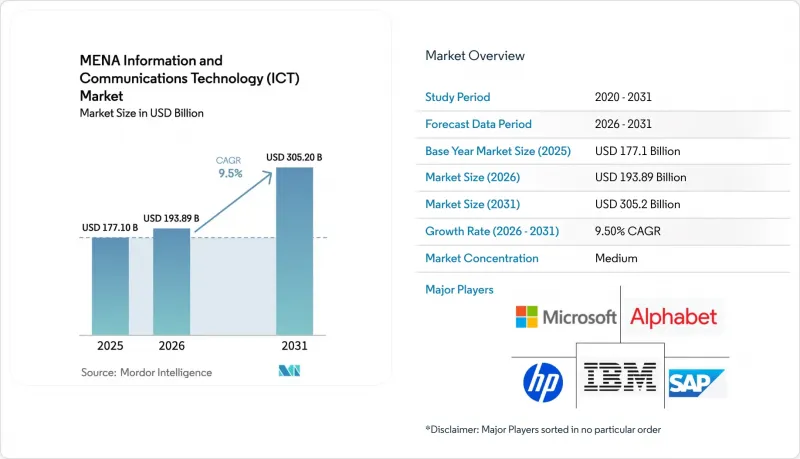
This report is Segmented by Type (IT Hardware, IT Software, and More), Enterprise Size (Small and Medium Enterprises, Large Enterprises), Deployment Model (On-Premise, Cloud, Hybrid), End-User Industry Vertical (Government and Public Administration, BFSI, and More), Country (Saudi Arabia, Qatar, and More). The Market Forecasts are Provided in Terms of Value (USD).
MENA Information And Communications Technology (ICT) Market Trends and Insights
Government-led Smart City Mega-projects
Saudi Arabia's NEOM allocates USD 5 billion for technology platforms that integrate traffic, energy, and citizen-service systems; UAE's Dubai 2040 Urban Master Plan targets AI delivery of 25% of government services by 2025. These initiatives generate recurring demand for cloud capacity, IoT sensors, and cybersecurity solutions well beyond initial construction cycles. Municipalities require interoperable platforms that aggregate data across transport, utilities, and public-safety domains, accelerating procurement of edge computing and analytics capabilities. GCC-level policy coordination enables vendor standardization, reducing integration costs for regional suppliers. Successful pilots, such as the 2.4 billion digital transactions processed under Smart Dubai, showcase scale economics that entice additional sovereign wealth-fund backing.
Hyperscale Cloud and Data-center Investments
Microsoft's USD 2.1 billion Saudi data-center complex, Oracle's USD 1.5 billion Riyadh region, and AWS's USD 5.3 billion multi-year expansion validate the Middle East and North Africa ICT market as a priority for global providers. Local presence satisfies data-sovereignty regulations while cutting latency for enterprise workloads, spurring secondary demand for networking gear, managed services, and colocation space. The UAE's AED 13 billion (USD 3.54 billion) sovereign-cloud partnership with Core42 extends the model to public-sector workloads, creating a blueprint other governments are adopting. Edge nodes are proliferating near population centers to support gaming, autonomous vehicles, and real-time analytics, further widening the infrastructure footprint.
Cyber-skill Shortages
Unfilled cybersecurity positions grew 26.8% in Saudi Arabia and 9.7% in the UAE during 2024, despite double-digit workforce expansion, widening a regional talent gap that forces enterprises to delay cloud migrations or rely on costly consultants. Public-sector networks endure about 50,000 daily cyberattack attempts, yet 51% of security leaders cite under-funding as their main obstacle. University programs cannot keep pace with 3:1 demand-supply ratios for cloud-security architects and incident-response analysts. Government initiatives, including Saudi Arabia's National Cybersecurity Authority scholarships, aim to close the gap within five years, but near-term shortages persist. This limits the speed at which enterprises adopt advanced, security-sensitive workloads such as multicloud analytics.
Other drivers and restraints analyzed in the detailed report include:
- 5G-driven Mobile Data-traffic Explosion
- National Digital-transformation Agendas
- Energy-subsidy Reforms Raising DC OPEX
For complete list of drivers and restraints, kindly check the Table Of Contents.
Segment Analysis
The IT Services segment accounted for 27.10% of the Middle East and North Africa ICT market in 2025, underscoring the need for integration expertise during complex cloud migrations. Accelerating demand for data-sovereignty compliant architectures positions system integrators and managed service providers as strategic partners to both hyperscalers and enterprises. The segment benefits from recurring revenue models tied to multiyear transformation programs, cybersecurity audits, and application modernization contracts. Rising adoption of platform-as-a-service solutions further expands advisory opportunities as organizations re-platform legacy workloads. Local providers differentiate through Arabic language support and familiarity with regional regulatory frameworks, creating barriers to entry for purely international consultancies.
Cloud Services recorded the highest growth trajectory at a 9.85% CAGR and are expected to narrow the revenue gap with IT Services by 2031. Establishment of sovereign cloud regions by Microsoft, Oracle, and AWS reduces latency and compliance hurdles, accelerating workload migration. Enterprises increasingly adopt multicloud strategies to avoid vendor lock-in, driving demand for orchestration tools and cost-optimization services. The surge in data-intensive applications such as AI model training and real-time analytics amplifies infrastructure-as-a-service consumption. Meanwhile, IT Hardware remains essential for 5G backhaul and edge-computing nodes, although its growth lags service-centric categories due to virtualization trends.
Large enterprises generated 61.35% of spending in 2025, leveraging scale to pursue end-to-end digital initiatives spanning ERP modernization, cybersecurity consolidation, and AI experimentation. This cohort secures preferential pricing from hyperscalers and telecom operators, reinforcing its procurement influence. Multinational corporations in the energy, aviation, and finance sectors anchor multi-region cloud deployments that uplift ancillary segments such as data-governance software and SD-WAN solutions.
Small and medium enterprises are set to outpace overall market growth with a 10.04% CAGR, underpinned by cloud-first policies that lower entry barriers to sophisticated software suites. UAE's Mohammed Bin Rashid Innovation Fund and Saudi Arabia's Kafalah program funnel capital toward technology upgrades that enable SMEs to fulfill electronic procurement mandates MBRF.AE. Software-as-a-service adoption among SMEs tripled since 2022, particularly in CRM, accounting, and endpoint-security tools. As supply-chain digitization deepens, large enterprises increasingly rely on SME tech vendors for niche AI, blockchain, and IoT capabilities, weaving smaller firms into regional ecosystems.
Complete Report Scope:
- By Type
- IT Hardware
- Computer Hardware
- Networking Equipment
- Peripherals
- IT Software
- IT Services
- Managed Services
- Business Process Services
- Business Consulting Services
- Cloud Services
- IT Infrastructure
- IT Security
- Communication Services
- IT Hardware
- By Enterprise Size
- Small and Medium Enterprises
- Large Enterprises
- By Deployment Model
- On-premise
- Cloud
- Hybrid
- By End-user Industry Vertical
- Government and Public Administration
- BFSI
- Energy and Utilities
- Retail, E-commerce and Logistics
- Manufacturing and Industry 4.0
- Healthcare and Life Sciences
- (Up/Mid/Down-stream)
- Gaming and Esports
- By Country
- Saudi Arabia
- United Arab Emirates
- Qatar
- Oman
- Egypt
- Rest of MENA
List of Companies Covered in this Report:
- Alphabet Inc. (Google LLC)
- IBM Corporation
- Microsoft Corporation
- HP Inc.
- SAP SE
- Emirates Telecommunications Group Company PJSC (e&)
- Oracle Corporation
- Salesforce Inc.
- Accenture plc
- Amazon Web Services, Inc.
- Cisco Systems, Inc.
- Huawei Investment and Holding Co., Ltd.
- Dell Technologies Inc.
- Orange Business Services S.A.
- Saudi Telecom Company (stc solutions)
- Ooredoo Q.P.S.C.
- Injazat Data Systems LLC
- Gulf Business Machines FZ-LLC
- Etihad Etisalat Co. (Mobily)
- Mobile Telecommunications Company K.S.C.P. (Zain Group)
- Ericsson AB
- Nokia Corporation
Additional Benefits:
- The market estimate (ME) sheet in Excel format
- 3 months of analyst support
TABLE OF CONTENTS
1 INTRODUCTION
- 1.1 Study Assumptions and Market Definition
- 1.2 Scope of the Study
2 RESEARCH METHODOLOGY
3 EXECUTIVE SUMMARY
4 MARKET LANDSCAPE
- 4.1 Market Overview
- 4.2 Market Drivers
- 4.2.1 Government-led smart city mega-projects
- 4.2.2 National digital transformation agendas
- 4.2.3 Hyperscale cloud and data-center investments
- 4.2.4 5G-driven mobile data-traffic explosion
- 4.2.5 Sovereign-wealth AI and semiconductor funding
- 4.2.6 Data-residency mandates boosting local IaaS
- 4.3 Market Restraints
- 4.3.1 Cyber-skill shortages
- 4.3.2 Energy-subsidy reforms raising DC OPEX
- 4.3.3 Water-power nexus limiting N. Africa DCs
- 4.3.4 Political risk in Levant fiber corridors
- 4.4 Industry Value Chain Analysis
- 4.5 Regulatory Landscape
- 4.6 Impact of Macroeconomic Factors
- 4.7 Technological Outlook
- 4.8 Porter's Five Forces Analysis
- 4.8.1 Bargaining Power of Suppliers
- 4.8.2 Bargaining Power of Consumers
- 4.8.3 Threat of New Entrants
- 4.8.4 Threat of Substitutes
- 4.8.5 Intensity of Competitive Rivalry
- 4.9 Key Use-Cases
- 4.10 Government Projects and Initiatives
- 4.11 Ecosystem Analysis
5 MARKET SIZE AND GROWTH FORECASTS (VALUE)
- 5.1 By Type
- 5.1.1 IT Hardware
- 5.1.1.1 Computer Hardware
- 5.1.1.2 Networking Equipment
- 5.1.1.3 Peripherals
- 5.1.2 IT Software
- 5.1.3 IT Services
- 5.1.3.1 Managed Services
- 5.1.3.2 Business Process Services
- 5.1.3.3 Business Consulting Services
- 5.1.3.4 Cloud Services
- 5.1.4 IT Infrastructure
- 5.1.5 IT Security
- 5.1.6 Communication Services
- 5.1.1 IT Hardware
- 5.2 By Enterprise Size
- 5.2.1 Small and Medium Enterprises
- 5.2.2 Large Enterprises
- 5.3 By Deployment Model
- 5.3.1 On-premise
- 5.3.2 Cloud
- 5.3.3 Hybrid
- 5.4 By End-user Industry Vertical
- 5.4.1 Government and Public Administration
- 5.4.2 BFSI
- 5.4.3 Energy and Utilities
- 5.4.4 Retail, E-commerce and Logistics
- 5.4.5 Manufacturing and Industry 4.0
- 5.4.6 Healthcare and Life Sciences
- 5.4.7 (Up/Mid/Down-stream)
- 5.4.8 Gaming and Esports
- 5.5 By Country
- 5.5.1 Saudi Arabia
- 5.5.2 United Arab Emirates
- 5.5.3 Qatar
- 5.5.4 Oman
- 5.5.5 Egypt
- 5.5.6 Rest of MENA
6 COMPETITIVE LANDSCAPE
- 6.1 Market Concentration
- 6.2 Strategic Moves
- 6.3 Market Share Analysis
- 6.4 Company Profiles (includes Global level Overview, Market level overview, Core Segments, Financials as available, Strategic Information, Market Rank/Share for key companies, Products and Services, and Recent Developments)
- 6.4.1 Alphabet Inc. (Google LLC)
- 6.4.2 IBM Corporation
- 6.4.3 Microsoft Corporation
- 6.4.4 HP Inc.
- 6.4.5 SAP SE
- 6.4.6 Emirates Telecommunications Group Company PJSC (e&)
- 6.4.7 Oracle Corporation
- 6.4.8 Salesforce Inc.
- 6.4.9 Accenture plc
- 6.4.10 Amazon Web Services, Inc.
- 6.4.11 Cisco Systems, Inc.
- 6.4.12 Huawei Investment and Holding Co., Ltd.
- 6.4.13 Dell Technologies Inc.
- 6.4.14 Orange Business Services S.A.
- 6.4.15 Saudi Telecom Company (stc solutions)
- 6.4.16 Ooredoo Q.P.S.C.
- 6.4.17 Injazat Data Systems LLC
- 6.4.18 Gulf Business Machines FZ-LLC
- 6.4.19 Etihad Etisalat Co. (Mobily)
- 6.4.20 Mobile Telecommunications Company K.S.C.P. (Zain Group)
- 6.4.21 Ericsson AB
- 6.4.22 Nokia Corporation
7 MARKET OPPORTUNITIES AND FUTURE OUTLOOK
- 7.1 White-space and Unmet-Need Assessment

