PUBLISHER: Mordor Intelligence | PRODUCT CODE: 2120538

PUBLISHER: Mordor Intelligence | PRODUCT CODE: 2120538
France Hair Care - Market Share Analysis, Industry Trends & Statistics, Growth Forecasts (2026 - 2031)
According to Mordor Intelligence, the France hair care market was valued at USD 2.00 billion in 2025 and is expected to reach USD 2.07 billion in 2026, with a projected value of USD 2.49 billion by 2031, registering a CAGR of 3.73% during the forecast period.
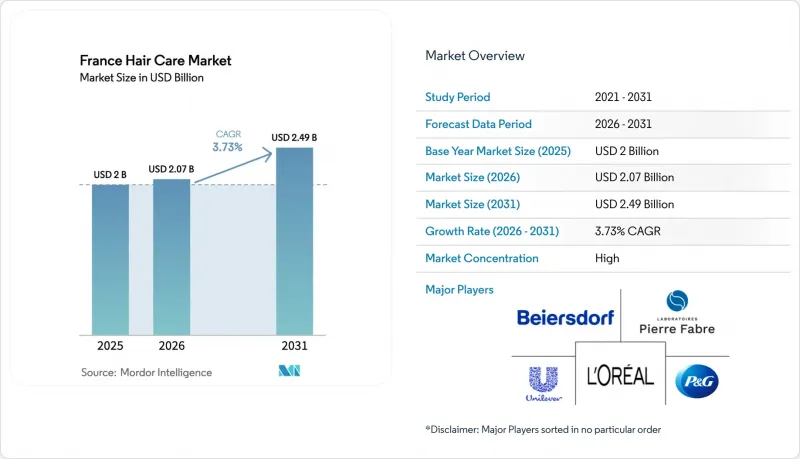
This report is Segmented by Product Type (Shampoo, Conditioner, Hair Colorants, and More), Category (Premium Products and Mass Products), Ingredient Type (Natural/Organic, and Conventional/Synthetic), and Distribution Channel (Supermarkets/Hypermarkets, Specialty Stores, and More). The Market Forecasts are Provided in Terms of Value (USD).
France Hair Care Market Trends and Insights
Rising demand for natural and organic formulations
The France hair care market is undergoing significant changes, driven by a growing consumer preference for products made with natural and organic ingredients over synthetic alternatives. This trend is primarily influenced by increased awareness of ingredient safety and a stronger emphasis on environmental sustainability. Consumers in France are paying closer attention to product labels and demanding greater transparency from brands to make informed purchasing decisions. This shift is particularly pronounced among younger consumers, who are willing to pay a premium for hair care products they consider safer, cleaner, and more environmentally friendly. In response to these evolving preferences, L'Oreal has enhanced its focus on incorporating natural ingredients and ensuring sustainable sourcing. The company's 2023 Universal Registration Document highlights its commitment to Green Sciences and sustainable innovation, demonstrating its strategic alignment with changing consumer demands in the market.
Growing scalp-health focus driving medicated shampoo
Awareness of the link between scalp health and hair quality is increasingly influencing the France hair care market. Consumers, particularly younger individuals and those experiencing hair thinning, sensitivity, or scalp irritation, are shifting their focus toward therapeutic and preventive solutions rather than purely cosmetic products. This trend, often referred to as the "skinification" of hair care, mirrors the adoption of skincare-inspired routines, including multi-step processes such as cleansing, exfoliation, and targeted treatments. Consequently, the demand for medicated shampoos and scalp-focused formulations has grown significantly. These products incorporate ingredients aimed at addressing issues like dandruff, dryness, inflammation, and hair fall, while also promoting hair growth and shine. Brands such as L'Oreal Paris, with products like Elvive Glycolic Gloss, are utilizing science-backed ingredients to cater to both scalp and hair care needs, combining functional benefits with a premium market position. This emphasis on scalp health is driving innovation, premiumization, and increased consumer investment in products that deliver tangible results, positioning medicated shampoos as one of the fastest-growing segments in the France hair care market.
Adoption of traditional at-home hair care solutions
The France hair care market faces challenges from a segment of consumers, particularly older individuals and those in rural areas, who continue to prefer traditional at-home remedies over commercial products. These consumers often rely on generational knowledge and household ingredients, such as vinegar rinses, herbal infusions, and oil treatments, which directly compete with natural and organic hair care products. These remedies are perceived as cost-effective, easily accessible, and free from synthetic chemicals, making them appealing to this demographic. Although demand for natural and clean-label products is increasing, a portion of the market remains inclined toward DIY solutions, limiting the adoption of commercial alternatives. This trend poses a challenge for manufacturers aiming to expand in the natural segment, as their products must either align with or complement these traditional practices to effectively engage this consumer group. Additionally, building trust and educating these consumers on the benefits of commercial natural products may be necessary to encourage a shift in preferences.
Other drivers and restraints analyzed in the detailed report include:
- Demand for clean, sustainable, and ethical products
- Technological innovations in product formulations
- Proliferation of counterfeit products
For complete list of drivers and restraints, kindly check the Table Of Contents.
Segment Analysis
In 2025, the shampoo segment remained the largest category in the France hair care market, accounting for a 31.43% share and serving as a key component of daily hair care routines across various demographics. Its market leadership is supported by ongoing innovations in formulations, particularly in medicated, anti-dandruff, and scalp-focused shampoos, addressing consumer concerns such as hair thinning, scalp sensitivity, and overall scalp health. The segment also reflects a trend toward premiumization, with brands incorporating natural, clean-label, and sustainably sourced ingredients to align with evolving consumer preferences. Meanwhile, hair styling products are emerging as the fastest-growing segment, with a projected compound annual growth rate (CAGR) of 4.23% between 2026 and 2031. This growth is driven by technological advancements that enhance product performance, such as improved hold, reduced breakage, and enhanced natural shine and texture.
Trends like "glass hair" styles, anti-frizz treatments, and salon-inspired looks are gaining popularity, particularly among younger, fashion-conscious consumers. Leading brands, including Kerastase and L'Oreal Professionnel, are expanding their premium styling product lines with formulations inspired by skincare, combining styling benefits with nourishing and protective ingredients for the scalp and hair fibers. The segment is further benefiting from the adoption of AI-driven personalization tools, smart applicators, and multifunctional products, enabling consumers to achieve professional-quality results at home. This combination of performance, wellness, and personalization positions hair styling products as a high-growth category in the France market, complementing the established dominance of the shampoo segment.
In 2025, mass-market products maintained their dominance in the France hair care market, representing 72.32% of the market share. However, the premium segment is anticipated to grow at a faster CAGR of 4.46% between 2026 and 2031, indicating a gradual shift in consumer preferences toward higher-quality, performance-oriented hair care products. This trend aligns with broader skincare-inspired consumer behaviors, as French consumers increasingly prioritize products that offer a combination of efficacy, innovation, and indulgence. Hair care remains a significant growth driver for major companies, for example, L'Oreal's Consumer Products Division recorded a 12.6% like-for-like growth in 2023, highlighting the strategic importance of this segment.
The distinction between mass and premium categories is becoming less defined. Mass-market brands are introducing premiumized product lines featuring advanced formulations, innovative ingredients, and higher price points to appeal to aspirational consumers. In urban areas such as Paris, luxury hair care products are prominently showcased in specialized boutiques and department store beauty halls. These locations emphasize curated selections, immersive brand experiences, and personalized services, reinforcing the premium positioning and justifying higher price tags. This blending of accessibility and luxury is transforming competitive dynamics, as both mass-market and prestige brands aim to attract consumers who value quality, effectiveness, and experiential elements in their hair care products.
Complete Report Scope:
- By Product Type
- Shampoo
- Conditioner
- Hair Colorants
- Hair Styling Products
- Other Product Types
- By Category
- Premium Products
- Mass Products
- By Ingredient Type
- Natural/Organic
- Conventional/Synthetic
- By Distribution Channel
- Specialty Stores
- Supermarkets/Hypermarkets
- Online Retail Stores
- Other Channels
List of Companies Covered in this Report:
- L'Oreal S.A.
- Unilever PLC
- Procter & Gamble Company
- Henkel AG & Co. KGaA
- Pierre Fabre Group
- Beiersdorf AG
- Kenvue Inc.
- Shiseido Company, Limited
- Natura & Co
- Kao Corporation
- Revlon Inc.
- Moroccanoil Inc.
- Wella Company
- Coty Inc.
- The Estee Lauder Companies Inc.
- L'Occitane International
- Ales Groupe (Phyto)
- Christophe Robin
- Serge d'Estel Paris
- Groupe Rocher
Additional Benefits:
- The market estimate (ME) sheet in Excel format
- 3 months of analyst support
TABLE OF CONTENTS
1 INTRODUCTION
- 1.1 Study Assumptions and Market Definition
- 1.2 Scope of the Study
2 RESEARCH METHODOLOGY
3 EXECUTIVE SUMMARY
4 MARKET LANDSCAPE
- 4.1 Market Overview
- 4.2 Market Drivers
- 4.2.1 Rising demand for natural and organic formulations
- 4.2.2 Growing scalp-health focus driving medicated shampoo
- 4.2.3 Demand for clean, sustainable, and ethical products
- 4.2.4 Technological innovations in product formulations
- 4.2.5 Rising popularity of premium hair care products
- 4.2.6 Increased awareness of hair damage from environmental factors
- 4.3 Market Restraints
- 4.3.1 Adoption of traditional at-home hair care solutions
- 4.3.2 Proliferation of counterfeit products
- 4.3.3 High cost of premium hair care products
- 4.3.4 Stringent regulations on cosmetic ingredients
- 4.4 Consumer Behaviour Analysis
- 4.5 Regulatory Outlook
- 4.6 Porter's Five Forces
- 4.6.1 Bargaining Power of Suppliers
- 4.6.2 Bargaining Power of Buyers
- 4.6.3 Threat of New Entrants
- 4.6.4 Threat of Substitutes
- 4.6.5 Degree of Competition
5 MARKET SIZE AND GROWTH FORECASTS (VALUE)
- 5.1 By Product Type
- 5.1.1 Shampoo
- 5.1.2 Conditioner
- 5.1.3 Hair Colorants
- 5.1.4 Hair Styling Products
- 5.1.5 Other Product Types
- 5.2 By Category
- 5.2.1 Premium Products
- 5.2.2 Mass Products
- 5.3 By Ingredient Type
- 5.3.1 Natural/Organic
- 5.3.2 Conventional/Synthetic
- 5.4 By Distribution Channel
- 5.4.1 Specialty Stores
- 5.4.2 Supermarkets/Hypermarkets
- 5.4.3 Online Retail Stores
- 5.4.4 Other Channels
6 COMPETITIVE LANDSCAPE
- 6.1 Market Concentration
- 6.2 Strategic Moves
- 6.3 Market Share Analysis
- 6.4 Company Profiles (includes Global level Overview, Market level overview, Core Segments, Financials as available, Strategic Information, Market Rank/Share for key companies, Products and Services, and Recent Developments)
- 6.4.1 L'Oreal S.A.
- 6.4.2 Unilever PLC
- 6.4.3 Procter & Gamble Company
- 6.4.4 Henkel AG & Co. KGaA
- 6.4.5 Pierre Fabre Group
- 6.4.6 Beiersdorf AG
- 6.4.7 Kenvue Inc.
- 6.4.8 Shiseido Company, Limited
- 6.4.9 Natura & Co
- 6.4.10 Kao Corporation
- 6.4.11 Revlon Inc.
- 6.4.12 Moroccanoil Inc.
- 6.4.13 Wella Company
- 6.4.14 Coty Inc.
- 6.4.15 The Estee Lauder Companies Inc.
- 6.4.16 L'Occitane International
- 6.4.17 Ales Groupe (Phyto)
- 6.4.18 Christophe Robin
- 6.4.19 Serge d'Estel Paris
- 6.4.20 Groupe Rocher
7 MARKET OPPORTUNITIES AND FUTURE OUTLOOK

