PUBLISHER: Mordor Intelligence | PRODUCT CODE: 2120807

PUBLISHER: Mordor Intelligence | PRODUCT CODE: 2120807
Middle East And Africa Hair Care - Market Share Analysis, Industry Trends & Statistics, Growth Forecasts (2026 - 2031)
According to Mordor Intelligence, the Middle East and Africa hair care market size in 2026 is estimated at USD 6.16 billion, growing from 2025 value of USD 5.91 billion with 2031 projections showing USD 7.55 billion, growing at 4.18% CAGR over 2026-2031.
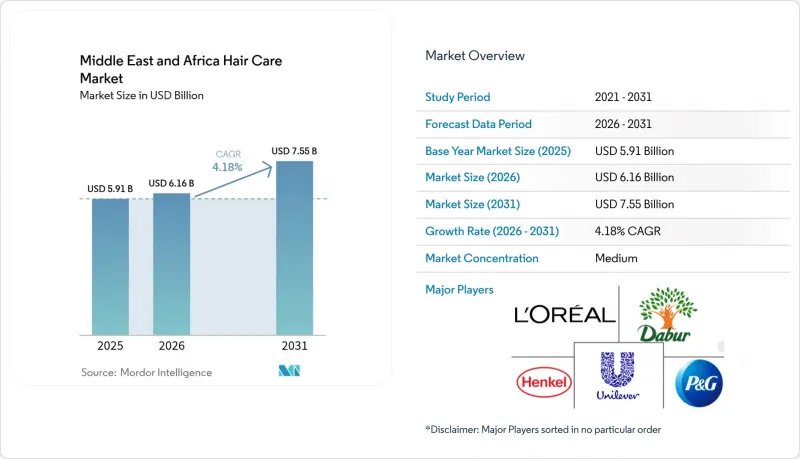
This report is Segmented by Product Type (Shampoo, Conditioner, and More), Category (Mass, Premium), Ingredient Type (Synthetic, Natural/Organic), Distribution Channel (Hypermarkets/Supermarkets, Convenience and Grocery Stores, and More), and Geography (Saudi Arabia, United Kingdom, Kuwait, Qatar, and More). The Market Forecasts are Provided in Terms of Value (USD).
Middle East And Africa Hair Care Market Trends and Insights
Premium halal-certified product launches
Premium halal certification is evolving from regulatory compliance to strategic differentiation, with brands leveraging certification to command price premiums while accessing broader Muslim consumer segments. The Standards and Metrology Institute for Islamic Countries (SMIIC) operates technical committees specifically for halal cosmetic issues, with Saudi Arabia's SFDA participating as a member organization to harmonize regional standards. Indonesia's mandatory halal certification framework, requiring BPJPH-issued certificates from October 2026, establishes operational precedents that MEA manufacturers are adopting proactively to maintain export competitiveness. This regulatory evolution creates first-mover advantages for brands that integrate halal compliance into product development rather than retrofitting existing formulations. The certification process demands segregated production lines, halal-compliant ingredient sourcing, and comprehensive supply chain traceability, effectively raising barriers to entry while rewarding established players with robust quality systems. Premium positioning becomes sustainable when halal certification combines with performance claims, enabling brands to capture both religious compliance and efficacy-driven purchase decisions across diverse consumer segments.
Rising male-grooming spend influenced by social media
Male grooming expenditure is accelerating across MEA markets, driven by social media influence and changing cultural attitudes toward male personal care investment. Saudi Arabia's demographic profile, with 63% of the population under 30 years and 82% social media penetration, creates concentrated demand for male-targeted hair care products influenced by digital content creators and grooming tutorials. This trend extends beyond traditional markets, with Marico's MENA operations delivering 47% growth in 2024, partly attributed to expanding male consumer segments and premiumization strategies targeting younger demographics. Social media platforms are reshaping purchase journeys, with approximately 90% of UAE and Saudi consumers influenced by online content, creating opportunities for brands that develop authentic influencer partnerships and educational content around male hair care routines. The shift represents a fundamental change in male consumer behavior, moving from functional hair care to lifestyle-driven grooming regimens that incorporate multiple products and premium price points. Brands that successfully navigate cultural sensitivities while delivering social media-worthy results are capturing disproportionate market share growth in this emerging segment.
Price sensitivity and grey-market imports
Price sensitivity remains a fundamental constraint across MEA markets, exacerbated by grey-market imports that undermine authorized distribution channels and erode brand equity through counterfeit proliferation. Nigeria's beauty and cosmetics industry faces significant counterfeiting challenges, with consumers identifying fake products primarily through packaging quality (28.1%), product performance (17.6%), and suspiciously low pricing (12.6%), indicating sophisticated counterfeit operations that exploit price-conscious consumer segments. The UAE's position as a major trade hub creates both opportunities and risks, with Dubai Customs reporting 2,147 seizures and 388 intellectual property disputes in 2022, including significant volumes of counterfeit cosmetics entering regional supply chains through physical markets and e-commerce platforms. Currency devaluations compound pricing pressures, with companies like Godrej Consumer Products experiencing a 25% revenue decline in their Africa, United States and Middle East operations due to Naira devaluation and currency impacts, despite margin improvements through mix optimization. The challenge intensifies as grey-market operators leverage accessible packaging technology and e-commerce platforms to distribute counterfeit products at scale, requiring brands to invest heavily in authentication technologies, consumer education, and enforcement partnerships with customs authorities.
Other drivers and restraints analyzed in the detailed report include:
- Growing demand for natural and sulfate-free formulations
- Government incentives for local cosmetics manufacturing
- Water-scarcity driven sustainability pressures on factories
For complete list of drivers and restraints, kindly check the Table Of Contents.
Segment Analysis
Shampoos maintain market leadership with 37.74% share in 2025, reflecting their essential role in daily hair care routines across diverse MEA consumer segments. The category's dominance stems from universal usage patterns and frequent repurchase cycles that create stable revenue streams for manufacturers. Hair styling products emerge as the fastest-growing segment with a 5.07% CAGR through 2031, driven by urbanization trends and social media influence on grooming standards. Conditioners occupy the second-largest position, benefiting from increased consumer awareness of hair damage caused by harsh climate conditions prevalent across MEA regions. Hair colorants represent a specialized segment with growth potential tied to cultural acceptance and regulatory approvals for specific ingredients.
L'Oreal's product innovation demonstrates category evolution, with the company unveiling AirLight Pro at CES 2024, a professional-grade hair dryer incorporating infrared-light technology that delivers up to 33% more hydrated hair while consuming 31% less energy than premium competitors. This technological advancement reflects the industry's shift toward multifunctional products that combine styling efficiency with hair health benefits. The Others category, encompassing treatments and specialized products, shows promise as consumers become more sophisticated in their hair care routines and seek targeted solutions for specific concerns like hair loss and scalp health.
Premium segments are experiencing rapid expansion at 5.87% CAGR through 2031, despite mass-market products commanding 72.58% share in 2025. This growth differential reflects evolving consumer preferences toward quality and efficacy over price sensitivity, particularly among younger demographics who prioritize product performance and brand authenticity. The premium segment's acceleration is supported by increasing disposable incomes in key markets and the influence of social media on beauty standards and product awareness.
Unilever's strategic focus on premium positioning exemplifies this trend, with the company launching its high-end Nexxus Promend collection in Shanghai in February 2025, targeting the premium sector that is growing approximately 12% annually. The mass-market segment's continued dominance reflects the region's diverse economic landscape, where price accessibility remains crucial for market penetration. However, the gap between mass and premium growth rates suggests a gradual market evolution toward higher-value products as economic development progresses across MEA countries.
Complete Report Scope:
- By Product Type
- Shampoo
- Conditioner
- Hair Colorants
- Hair Styling Products
- Others
- By Category
- Mass
- Premium
- By Ingredient Type
- Synthetic
- Natural / Organic
- By Distribution Channel
- Hypermarkets / Supermarkets
- Convenience and Grocery Stores
- Specialty Beauty Stores
- Pharmacies / Drug Stores
- Online Channels
- Others
- By Geography
- Saudi Arabia
- United Arab Emirates
- Kuwait
- Qatar
- Oman
- Bahrain
- South Africa
- Nigeria
- Kenya
- Egypt
- Morocco
- Rest of Middle East and Africa
List of Companies Covered in this Report:
- L'Oreal S.A.
- Unilever PLC
- Procter & Gamble Co.
- Henkel AG & Co. KGaA
- Johnson & Johnson
- Coty Inc.
- Shiseido Co., Ltd.
- Dabur International
- Godrej Consumer Products Ltd.
- Marico Ltd.
- AVON Products Inc.
- Amka Products (Pty) Ltd.
- Wipro Unza (Malaysia) Sdn Bhd
- The Himalaya Drug Company
- Bhuman Waterless Skincare
- Curls in Bloom
- Amorepacific Corp.
- Mami Naturals KSA
- Natures Gentle Touch (Recare Ltd.)
- SilkyCool Cosmetics UAE
Additional Benefits:
- The market estimate (ME) sheet in Excel format
- 3 months of analyst support
TABLE OF CONTENTS
1 INTRODUCTION
- 1.1 Study Assumptions and Market Definition
- 1.2 Scope of the Study
2 RESEARCH METHODOLOGY
3 EXECUTIVE SUMMARY
4 MARKET LANDSCAPE
- 4.1 Market Overview
- 4.2 Market Drivers
- 4.2.1 Premium halal-certified product launches
- 4.2.2 Rising male-grooming spend influenced by social media
- 4.2.3 Growing demand for natural and sulfate-free formulations
- 4.2.4 Government incentives for local cosmetics manufacturing
- 4.2.5 High vitamin-D deficiency driving hair-loss remedies
- 4.2.6 Technological advancements in product manufacturing
- 4.3 Market Restraints
- 4.3.1 Price sensitivity and grey-market imports
- 4.3.2 Regulatory approval delays for new cosmetic actives
- 4.3.3 Water-scarcity driven sustainability pressures on factories
- 4.3.4 Cultural preference for DIY herbal remedies
- 4.4 Value / Supply-Chain Analysis
- 4.5 Regulatory Landscape
- 4.6 Technological Outlook
- 4.7 Porter's Five Forces
- 4.7.1 Threat of New Entrants
- 4.7.2 Bargaining Power of Buyers/Consumers
- 4.7.3 Bargaining Power of Suppliers
- 4.7.4 Threat of Substitute Products
- 4.7.5 Intensity of Competitive Rivalry
5 MARKET SIZE AND GROWTH FORECASTS (VALUE)
- 5.1 By Product Type
- 5.1.1 Shampoo
- 5.1.2 Conditioner
- 5.1.3 Hair Colorants
- 5.1.4 Hair Styling Products
- 5.1.5 Others
- 5.2 By Category
- 5.2.1 Mass
- 5.2.2 Premium
- 5.3 By Ingredient Type
- 5.3.1 Synthetic
- 5.3.2 Natural / Organic
- 5.4 By Distribution Channel
- 5.4.1 Hypermarkets / Supermarkets
- 5.4.2 Convenience and Grocery Stores
- 5.4.3 Specialty Beauty Stores
- 5.4.4 Pharmacies / Drug Stores
- 5.4.5 Online Channels
- 5.4.6 Others
- 5.5 By Geography
- 5.5.1 Saudi Arabia
- 5.5.2 United Arab Emirates
- 5.5.3 Kuwait
- 5.5.4 Qatar
- 5.5.5 Oman
- 5.5.6 Bahrain
- 5.5.7 South Africa
- 5.5.8 Nigeria
- 5.5.9 Kenya
- 5.5.10 Egypt
- 5.5.11 Morocco
- 5.5.12 Rest of Middle East and Africa
6 COMPETITIVE LANDSCAPE
- 6.1 Market Concentration
- 6.2 Strategic Moves
- 6.3 Market Share Analysis
- 6.4 Company Profiles (includes Global level Overview, Market level overview, Core Segments, Financials as available, Strategic Information, Market Rank/Share for key companies, Products and Services, and Recent Developments)
- 6.4.1 L'Oreal S.A.
- 6.4.2 Unilever PLC
- 6.4.3 Procter & Gamble Co.
- 6.4.4 Henkel AG & Co. KGaA
- 6.4.5 Johnson & Johnson
- 6.4.6 Coty Inc.
- 6.4.7 Shiseido Co., Ltd.
- 6.4.8 Dabur International
- 6.4.9 Godrej Consumer Products Ltd.
- 6.4.10 Marico Ltd.
- 6.4.11 AVON Products Inc.
- 6.4.12 Amka Products (Pty) Ltd.
- 6.4.13 Wipro Unza (Malaysia) Sdn Bhd
- 6.4.14 The Himalaya Drug Company
- 6.4.15 Bhuman Waterless Skincare
- 6.4.16 Curls in Bloom
- 6.4.17 Amorepacific Corp.
- 6.4.18 Mami Naturals KSA
- 6.4.19 Natures Gentle Touch (Recare Ltd.)
- 6.4.20 SilkyCool Cosmetics UAE
7 MARKET OPPORTUNITIES AND FUTURE OUTLOOK

