PUBLISHER: Mordor Intelligence | PRODUCT CODE: 2119022

PUBLISHER: Mordor Intelligence | PRODUCT CODE: 2119022
Germany Wire and Cable - Market Share Analysis, Industry Trends & Statistics, Growth Forecasts (2026 - 2031)
According to Mordor Intelligence, the Germany wire and Cable Market size is projected to be USD 7.08 billion in 2025, USD 7.42 billion in 2026, and reach USD 9.52 billion by 2031, growing at a CAGR of 5.11% from 2026 to 2031.
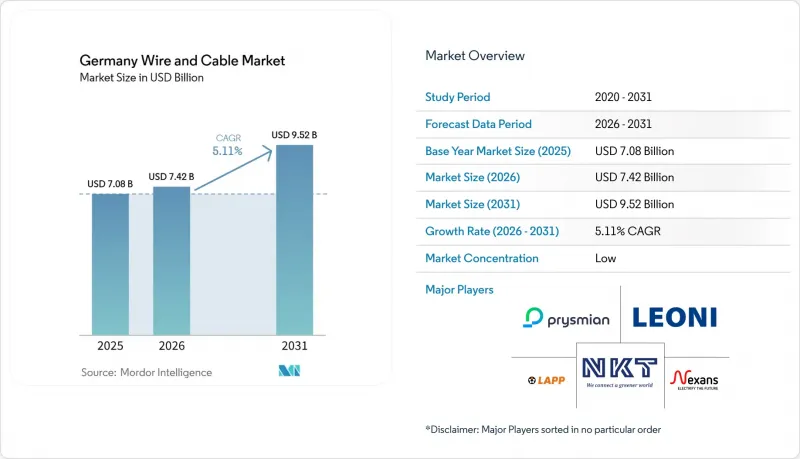
This report is Segmented by Voltage (Extra- and High-Voltage (Greater Than 35 KV), and More), Cable Type (Power Cable, and More), Conductor (Copper, Aluminum, and More), Installation (Overhead, Underground, and More), End-User Vertical (Construction (Residential and Commercial), and More), and Insulation (Insulated, and Non-Insulated). The Market Forecasts are Provided in Terms of Value (USD).
Germany Wire and Cable Market Trends and Insights
Renewable-Power Grid Expansion Reshapes Cable Demand At Scale
Germany's target is 30 GW of installed offshore wind capacity by 2030 and 50 GW by 2035, supporting demand for high-voltage and extra-high-voltage systems. The Offshore Network Development Plan 2025 set out connection requirements for offshore areas through 2034. The Bundesnetzagentur approved the final section of the 543 km SuedOstLink at 525 kV and 2 GW in July 2025. BDEW and ZVEI said more than 500,000 km of power cables will be needed by 2045 to replace aging assets and connect renewable generation, heat pumps, and charging infrastructure. This volume encourages long-term supply arrangements, because transmission projects require qualified production capacity years before cable installation. The Germany wire and cable market is consequently exposed to a durable grid-led procurement cycle rather than a short construction cycle.
Industrial Automation and Industry 4.0 Investment Supports Specialty Cable Demand
Industrial automation continues to support demand for flexible, oil-resistant, and electromagnetically shielded cables in German factories. Factory upgrades require dependable signal, control, and power connections for machinery, robotics, and production equipment. This work supports both replacement demand and new installations, as moving cable systems require periodic renewal. Single-pair Ethernet and power-over-data cable designs can increase the value of cable content in individual machines, even when installed lengths are shorter. The Germany wire and cable market also benefits when manufacturers adopt cable specifications that meet higher reliability and motion requirements. These needs are most visible in manufacturing corridors in Bavaria, Baden-Wurttemberg, and North Rhine-Westphalia.
Copper and Aluminum Price Volatility Pressures Margins Across the Value Chain
Copper reached an intraday high of USD 14,527.50 per tonne on the London Metal Exchange on January 29, 2026. The copper-to-aluminum price ratio reached 4.3 in January 2026, above the 3.5-4.0 range cited for increased material substitution. This situation can increase aluminum use in main feeders and transmission applications where project specifications permit it. Fixed-price engineering, procurement, and construction contracts leave suppliers exposed when metal prices change between bid submission and delivery. Formula pricing tied to commodity benchmarks can reduce this risk, though it requires the project owners' acceptance. The Germany wire and cable market remains sensitive to suppliers' ability to hedge material purchases and recover costs through contracts.
Other drivers and restraints analyzed in the detailed report include:
- Fiber-Optic and Data-Center Infrastructure Expansion Creates a Parallel Demand Cycle
- Electric-Vehicle and Charging-Infrastructure Electrification Increases Cable Requirements
- High Installation Costs For Underground and Submarine Cables Strain Project Economics
For complete list of drivers and restraints, kindly check the Table Of Contents.
Segment Analysis
Low-voltage cable accounted for 49.68% of the German wire and cable market share in 2025. It is used in building wiring, charging circuits, industrial machinery, and last-mile distribution connections, creating a broad replacement base. New residential construction remained weak, with the ifo Business Climate Index for residential construction at -20.6 points in December 2025. This reduced some building-wire orders during the period. Industrial retrofits and charging installation programs provided demand in other low-voltage uses.
Medium-voltage cable supports distribution-grid reinforcement, renewable collector networks, industrial substation connections, and the replacement of aging overhead assets with underground systems. This work supports recurring demand across urban, rural, and industrial locations. Extra- and high-voltage cable is projected to record a 6.48% CAGR through 2031. SuedLink, SuedOstLink, A-Nord, Ultranet, and Korridor B require large volumes of land cable. Technical testing and utility qualification requirements limit the field of suppliers able to serve these projects.
Power cable accounted for 59.84% of the Germany wire and cable market in 2025. It transmits renewable electricity from generation sites and distributes power through industrial and urban networks using copper and aluminum systems. Signal and control cable supports automation equipment and process-industry instrumentation. Coaxial and data cables continue to play a role in broadcast systems and existing infrastructure. These applications keep the power cable at the center of the Germany wire and cable market.
Fiber-optic cable is expected to expand at a 5.89% CAGR through 2031. The category benefits from fiber-to-the-home deployment, 5G backhaul requirements, and data-center interconnection, while the VDE's updated guideline supports in-building connections. Data-center campuses require dense fiber routing that can accommodate later network upgrades. Fiber demand also includes access connections, backbone links, and connections inside commercial properties. This broad role makes fiber cable an important growth area, while power cable retains the largest share.
Complete Report Scope:
- By Voltage
- Extra- and High-Voltage (Greater Than 35 kV)
- Medium-Voltage (1-35 kV)
- Low-Voltage (Less Than 1 kV)
- By Cable Type
- Power Cable
- Fiber-Optic Cable
- Signal and Control Cable
- Coaxial and Data Cable
- By Conductor Material
- Copper
- Aluminum
- Optical Glass/Polymer
- By Installation
- Overhead
- Underground
- Submarine
- By End-User Vertical
- Construction
- Residential
- Commercial
- Power Infrastructure (Utilities and Renewables)
- Telecommunications and Data Centers
- Oil and Gas and Petrochemicals
- Automotive and Mobility
- Industrial Manufacturing
- Construction
- By Insulation
- Insulated
- Non-Insulated
List of Companies Covered in this Report:
- Prysmian S.p.A.
- Nexans S.A.
- NKT A/S
- LEONI AG
- LAPP GmbH
- HELUKABEL GmbH
- PHOENIX CONTACT GmbH and Co. KG
- igus GmbH
- Murrelektronik GmbH
- Weidmuller Interface GmbH and Co. KG
- Hans Turck GmbH and Co. KG
- TKD Kabel GmbH
- Kabelwerk Eupen AG
- SAB Brockskes GmbH and Co. KG
- Faber Kabel GmbH
- Sudkabel GmbH
- Waskonig + Walter Kabel-Werk GmbH and Co. KG
- Gebauer and Griller Kabelwerke GmbH
- METZ CONNECT GmbH
- Sumitomo Electric Industries, Ltd.
- TE Connectivity Ltd.
Additional Benefits:
- The market estimate (ME) sheet in Excel format
- 3 months of analyst support
TABLE OF CONTENTS
1 INTRODUCTION
- 1.1 Study Assumptions and Market Definition
- 1.2 Scope of the Study
2 RESEARCH METHODOLOGY
3 EXECUTIVE SUMMARY
4 MARKET LANDSCAPE
- 4.1 Market Overview
- 4.2 Market Drivers
- 4.2.1 Renewable-Power Grid Expansion
- 4.2.2 Industrial Automation and Industry 4.0 Investment
- 4.2.3 Fiber-Optic and Data-Center Infrastructure Expansion
- 4.2.4 Electric-Vehicle and Charging-Infrastructure Electrification
- 4.2.5 High-Voltage Cable Demand from North-South Transmission Corridors
- 4.2.6 Cable-Theft Prevention and Smart Cable Monitoring Adoption
- 4.3 Market Restraints
- 4.3.1 Copper and Aluminum Price Volatility
- 4.3.2 High Installation Costs for Underground and Submarine Cables
- 4.3.3 Skilled-Labor Shortages and Approval Delays
- 4.3.4 Cybersecurity and Physical-Security Requirements for Connected Cable Systems
- 4.4 Industry Supply Chain Analysis
- 4.5 Regulatory Landscape
- 4.6 Technological Outlook
- 4.7 Impact of Macroeconomic Factors on the Market
- 4.8 Investment Analysis
- 4.9 Porter's Five Forces Analysis
- 4.9.1 Bargaining Power of Suppliers
- 4.9.2 Bargaining Power of Buyers
- 4.9.3 Threat of New Entrants
- 4.9.4 Threat of Substitutes
- 4.9.5 Intensity of Competitive Rivalry
5 MARKET SIZE AND GROWTH FORECASTS (VALUE)
- 5.1 By Voltage
- 5.1.1 Extra- and High-Voltage (Greater Than 35 kV)
- 5.1.2 Medium-Voltage (1-35 kV)
- 5.1.3 Low-Voltage (Less Than 1 kV)
- 5.2 By Cable Type
- 5.2.1 Power Cable
- 5.2.2 Fiber-Optic Cable
- 5.2.3 Signal and Control Cable
- 5.2.4 Coaxial and Data Cable
- 5.3 By Conductor Material
- 5.3.1 Copper
- 5.3.2 Aluminum
- 5.3.3 Optical Glass/Polymer
- 5.4 By Installation
- 5.4.1 Overhead
- 5.4.2 Underground
- 5.4.3 Submarine
- 5.5 By End-User Vertical
- 5.5.1 Construction
- 5.5.1.1 Residential
- 5.5.1.2 Commercial
- 5.5.2 Power Infrastructure (Utilities and Renewables)
- 5.5.3 Telecommunications and Data Centers
- 5.5.4 Oil and Gas and Petrochemicals
- 5.5.5 Automotive and Mobility
- 5.5.6 Industrial Manufacturing
- 5.5.1 Construction
- 5.6 By Insulation
- 5.6.1 Insulated
- 5.6.2 Non-Insulated
6 COMPETITIVE LANDSCAPE
- 6.1 Market Concentration
- 6.2 Strategic Moves
- 6.3 Vendor Positioning Analysis
- 6.4 Company Profiles (includes Global Level Overview, Market Level Overview, Core Segments, Financials as available, Strategic Information, Market Rank/Share, Products and Services, Recent Developments)
- 6.4.1 Prysmian S.p.A.
- 6.4.2 Nexans S.A.
- 6.4.3 NKT A/S
- 6.4.4 LEONI AG
- 6.4.5 LAPP GmbH
- 6.4.6 HELUKABEL GmbH
- 6.4.7 PHOENIX CONTACT GmbH and Co. KG
- 6.4.8 igus GmbH
- 6.4.9 Murrelektronik GmbH
- 6.4.10 Weidmuller Interface GmbH and Co. KG
- 6.4.11 Hans Turck GmbH and Co. KG
- 6.4.12 TKD Kabel GmbH
- 6.4.13 Kabelwerk Eupen AG
- 6.4.14 SAB Brockskes GmbH and Co. KG
- 6.4.15 Faber Kabel GmbH
- 6.4.16 Sudkabel GmbH
- 6.4.17 Waskonig + Walter Kabel-Werk GmbH and Co. KG
- 6.4.18 Gebauer and Griller Kabelwerke GmbH
- 6.4.19 METZ CONNECT GmbH
- 6.4.20 Sumitomo Electric Industries, Ltd.
- 6.4.21 TE Connectivity Ltd.
7 MARKET OPPORTUNITIES AND FUTURE OUTLOOK
- 7.1 White-Space and Unmet-Need Assessment

