PUBLISHER: Mordor Intelligence | PRODUCT CODE: 2119030

PUBLISHER: Mordor Intelligence | PRODUCT CODE: 2119030
France Wire and Cable - Market Share Analysis, Industry Trends & Statistics, Growth Forecasts (2026 - 2031)
According to Mordor Intelligence, the France wire and Cable Market size was valued at USD 5.76 billion in 2025 and is estimated to grow from USD 6.05 billion in 2026 to reach USD 7.71 billion by 2031, at a CAGR of 4.97% during the forecast period (2026-2031).
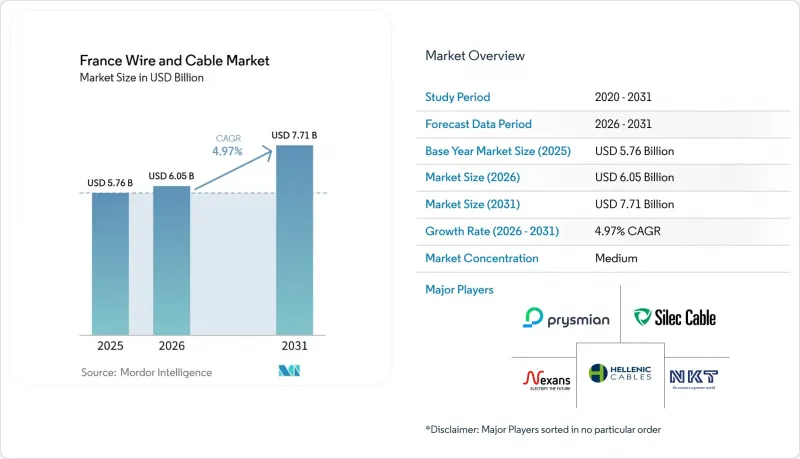
This report is Segmented by Voltage (Extra- and High-Voltage (Greater Than 35 KV), and More), Cable Type (Power Cable, and More), Conductor (Copper, Aluminum, and More), Installation (Overhead, Underground, and More), End-User Vertical (Construction (Residential and Commercial), and More), and Insulation (Insulated, and Non-Insulated). The Market Forecasts are Provided in Terms of Value (USD).
France Wire and Cable Market Trends and Insights
Grid Modernization and Electrification of End Uses
France entered a capital-intensive period of grid investment, supporting demand in the France wire and cable market. RTE recorded EUR 3.346 billion (USD 3.61 billion) in total investment expenditure in 2025, 29% higher than the prior year, while grid-renewal spending reached EUR 1.3 billion (USD 1.4 billion). Its SDDR 2025 set out a EUR 100 billion (USD 112 billion) investment path over 15 years, rising from EUR 3 billion (USD 3.24 billion) in 2025 to EUR 8 billion (USD 8.64 billion) annually by 2040. CRE approved RTE's 2026 program, including EUR 1.5 billion (USD 1.68 billion) in annual renewal spending and EUR 64.1 million (USD 71.8 million), EUR 67.4 million (USD 75.5 million), and EUR 37.3 million (USD 41.8 million) for Dunkerque, Fos-sur-Mer, and Le Havre, respectively. More than half of RTE connection investments in 2025 served industrial projects in port areas, while more than 200 industrial and data center projects secured access, totaling 33 GW. Enedis also received a EUR 1 billion (USD 1.08 billion) European Investment Bank loan, including a EUR 500 million (USD 540 million) tranche signed in July 2025, to support 7 GW of renewable connections and 2,500 km of buried lines.
Renewable Energy and Offshore Wind Interconnection Build-Out
Offshore wind projects are increasing demand for submarine and extra-high-voltage cables in the France wire and cable market. Nexans secured an RTE framework agreement in March 2025 worth more than EUR 1 billion (USD 1.08 billion) for 450 km of HVDC subsea cable and 280 km of onshore cable for Centre Manche 1, Centre Manche 2, and Oleron. Prysmian's RTE framework agreement for Fos and Narbonnaise included 2 EPCI contracts estimated at EUR 700 million (USD 756 million), with call-offs expected during 2026-2027. Hellenic Cables and Asso.subsea received an RTE contract for 32 km of 225 kV submarine cable and 38 km of underground cable for the 500-600 MW Dunkerque project. In May 2026, Nexans, RTE, SuperGrid Institute, and other partners launched the EUR 16 million (USD 17.9 million) RHODE project to develop floating HVDC systems for deep-water Atlantic wind farms. RTE also identified a French submarine cable plant as a strategic feasibility priority, reflecting concern about capacity concentrated in a limited number of European facilities.
Copper and Aluminum Price Volatility
Material pricing remains a material risk for cable manufacturers and contractors. Copper reached an intraday high of USD 14,527.50 per tonne on January 29, 2026, and traded at USD 13,544 per tonne in May 2026. The copper-to-aluminum price ratio reached 4.3 in January 2026 and remained near 4.2 at the end of June, above the 3.5-4.0 range that commonly prompts material substitution. This can reduce margins where manufacturers hold copper-priced inventory against fixed-price contracts. Prysmian used 40% aluminum by weight and 60% copper, an increase of 3 percentage points over 5 years. Fixed-price tenders over 12-month periods are becoming less attractive, prompting a shift toward LME-linked or COMEX-indexed prices with quarterly adjustment clauses. The resulting contract negotiations can take longer and complicate multi-year public procurements.
Other drivers and restraints analyzed in the detailed report include:
- Fiber-to-the-Premises and 5G Network Expansion
- Electric Vehicle Charging Infrastructure Deployment
- Stringent Fire, Environmental, and Product-Compliance Requirements
For complete list of drivers and restraints, kindly check the Table Of Contents.
Segment Analysis
Low-voltage cables held 51.62% of France wire and cable market share in 2025. Their use across buildings, charging infrastructure, and local distribution made them the largest voltage category. Medium-voltage cables remain central to Enedis's distribution system. Nexans and Prysmian signed 7-year Enedis agreements totaling EUR 600 million (USD 672 million) and EUR 550 million (USD 616 million), respectively, in 2026, including 3 optional years, intended to double average annual deliveries through 2032.
Extra- and high-voltage cables are projected to record the highest growth, at a 6.32% CAGR through 2031. Offshore wind export links and grid reinforcement are the main sources of demand. RTE planned EUR 1.5 billion (USD 1.68 billion) in annual renewal spending for 2026. Projects have supplier qualification lead times of 24-36 months and EPCI structures that secure capacity well before installation. Order-book depth is therefore more relevant than short-term demand measures for qualified producers.
Power cables accounted for 62.08% of the France wire and cable market size in 2025. Utility investment and industrial demand support this leading position. Signal and control cables support process automation and building management, while coaxial and data cables support broadcasting, CCTV, and legacy telecommunications. Fiber-optic cable is projected to grow at a 5.37% CAGR through 2031. Its growth is supported by 2.6 million premises that still require FttH connections at the end of 2025.
France had 27.7 million active FttH subscriptions at the end of the first quarter of 2026, equal to 84% of fixed internet subscriptions. Remaining connections generally require longer and more difficult routes. Fifth-generation densification and in-building antenna systems add feeder and backhaul demand. Data center campuses are also increasing the need for fiber interconnections. Dense wavelength-division multiplexing increases fiber count per cable and broadens demand beyond last-mile rollout.
Complete Report Scope:
- By Voltage
- Extra- and High-Voltage (Greater Than 35 kV)
- Medium-Voltage (1-35 kV)
- Low-Voltage (Less Than 1 kV)
- By Cable Type
- Power Cable
- Fiber-Optic Cable
- Signal and Control Cable
- Coaxial and Data Cable
- By Conductor Material
- Copper
- Aluminum
- Optical Glass/Polymer
- By Installation
- Overhead
- Underground
- Submarine
- By End-User Vertical
- Construction
- Residential
- Commercial
- Power Infrastructure (Utilities and Renewables)
- Telecommunications and Data Centers
- Oil and Gas and Petrochemicals
- Automotive and Mobility
- Industrial Manufacturing
- Construction
- By Insulation
- Insulated
- Non-Insulated
List of Companies Covered in this Report:
- Nexans S.A.
- Prysmian S.p.A.
- NKT A/S
- Hellenic Cables S.A.
- SILEC Cable SAS
- Lapp Group
- LS Cable & System Ltd.
- HUBER+SUHNER AG
- TKH Group N.V.
- Belden Inc.
- LEONI AG
- TE Connectivity Corporation
- HELUKABEL GmbH
- OMERIN SAS
- Lynxeo France SAS
- SAB France SAS
- CEV SAS
- Favier Group S.a.r.l.
Additional Benefits:
- The market estimate (ME) sheet in Excel format
- 3 months of analyst support
TABLE OF CONTENTS
1 INTRODUCTION
- 1.1 Study Assumptions and Market Definition
- 1.2 Scope of the Study
2 RESEARCH METHODOLOGY
3 EXECUTIVE SUMMARY
4 MARKET LANDSCAPE
- 4.1 Market Overview
- 4.2 Market Drivers
- 4.2.1 Grid Modernization and Electrification of End Uses
- 4.2.2 Renewable Energy and Offshore Wind Interconnection Build-Out
- 4.2.3 Fiber-to-the-Premises and 5G Network Expansion
- 4.2.4 Electric Vehicle Charging Infrastructure Deployment
- 4.2.5 Industrial Reindustrialization and Nuclear Fleet Modernization
- 4.2.6 Long-Term Procurement Visibility From Transmission-System Contracts
- 4.3 Market Restraints
- 4.3.1 Copper and Aluminum Price Volatility
- 4.3.2 Stringent Fire, Environmental, and Product-Compliance Requirements
- 4.3.3 Skilled Installation and Qualification Bottlenecks
- 4.3.4 Grid-Connection Queue and Permitting Friction for Large Loads
- 4.4 Industry Supply Chain Analysis
- 4.5 Regulatory Landscape
- 4.6 Technological Outlook
- 4.7 Impact of Macroeconomic Factors on the Market
- 4.8 Investment Analysis
- 4.9 Porter's Five Forces Analysis
- 4.9.1 Bargaining Power of Suppliers
- 4.9.2 Bargaining Power of Buyers
- 4.9.3 Threat of New Entrants
- 4.9.4 Threat of Substitutes
- 4.9.5 Intensity of Competitive Rivalry
5 MARKET SIZE AND GROWTH FORECASTS (VALUE)
- 5.1 By Voltage
- 5.1.1 Extra- and High-Voltage (Greater Than 35 kV)
- 5.1.2 Medium-Voltage (1-35 kV)
- 5.1.3 Low-Voltage (Less Than 1 kV)
- 5.2 By Cable Type
- 5.2.1 Power Cable
- 5.2.2 Fiber-Optic Cable
- 5.2.3 Signal and Control Cable
- 5.2.4 Coaxial and Data Cable
- 5.3 By Conductor Material
- 5.3.1 Copper
- 5.3.2 Aluminum
- 5.3.3 Optical Glass/Polymer
- 5.4 By Installation
- 5.4.1 Overhead
- 5.4.2 Underground
- 5.4.3 Submarine
- 5.5 By End-User Vertical
- 5.5.1 Construction
- 5.5.1.1 Residential
- 5.5.1.2 Commercial
- 5.5.2 Power Infrastructure (Utilities and Renewables)
- 5.5.3 Telecommunications and Data Centers
- 5.5.4 Oil and Gas and Petrochemicals
- 5.5.5 Automotive and Mobility
- 5.5.6 Industrial Manufacturing
- 5.5.1 Construction
- 5.6 By Insulation
- 5.6.1 Insulated
- 5.6.2 Non-Insulated
6 COMPETITIVE LANDSCAPE
- 6.1 Market Concentration
- 6.2 Strategic Moves
- 6.3 Vendor Positioning Analysis
- 6.4 Company Profiles (includes Global Level Overview, Market Level Overview, Core Segments, Financials as available, Strategic Information, Market Rank/Share, Products and Services, Recent Developments)
- 6.4.1 Nexans S.A.
- 6.4.2 Prysmian S.p.A.
- 6.4.3 NKT A/S
- 6.4.4 Hellenic Cables S.A.
- 6.4.5 SILEC Cable SAS
- 6.4.6 Lapp Group
- 6.4.7 LS Cable & System Ltd.
- 6.4.8 HUBER+SUHNER AG
- 6.4.9 TKH Group N.V.
- 6.4.10 Belden Inc.
- 6.4.11 LEONI AG
- 6.4.12 TE Connectivity Corporation
- 6.4.13 HELUKABEL GmbH
- 6.4.14 OMERIN SAS
- 6.4.15 Lynxeo France SAS
- 6.4.16 SAB France SAS
- 6.4.17 CEV SAS
- 6.4.18 Favier Group S.a.r.l.
7 MARKET OPPORTUNITIES AND FUTURE OUTLOOK
- 7.1 White-Space and Unmet-Need Assessment

