PUBLISHER: Mordor Intelligence | PRODUCT CODE: 2119159

PUBLISHER: Mordor Intelligence | PRODUCT CODE: 2119159
Vietnam Wire and Cable - Market Share Analysis, Industry Trends & Statistics, Growth Forecasts (2026 - 2031)
According to Mordor Intelligence, the Vietnam wire and cable market size is projected to expand from USD 0.95 billion in 2025 and USD 1.01 billion in 2026 to USD 1.28 billion by 2031, registering a CAGR of 5.06% between 2026 to 2031.
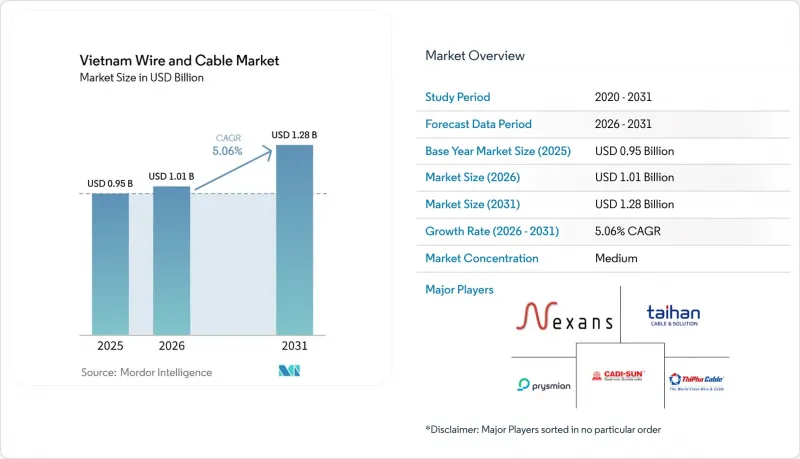
This report is Segmented by Voltage (Extra-And High-Voltage, and More), Cable Type (Power Cable, Fiber-Optic Cable, and More), Conductor Material (Copper, and More), Installation (Overhead, and More), End-User Vertical (Telecommunications and Data Centers, Automotive and Mobility, and More), and Insulation (Insulated, and Non-Insulated). The Market Forecasts are Provided in Terms of Value (USD).
Vietnam Wire and Cable Market Trends and Insights
Grid Modernization and Renewable Energy Interconnection Support Cable Demand
Vietnam's grid upgrade program remains the leading source of long-cycle demand for the Vietnam wire and cable market. Decision 768/QD-TTg confirmed the revised Power Development Plan VIII in April 2026 and set a direction for a grid capable of integrating a larger renewable generation base. The plan's transmission corridors require more high-voltage connections than comparable distributed generation projects. The 500kV Monsoon-Thanh My line was energized in January 2025, enabling 600MW of electricity imports from Laos. Northern demand centers have a local generation deficit, making long-distance transmission investment important for supply security. Resolution 253/2025/QH15 also established special energy development mechanisms through 2030, including faster decision-making for qualifying state-owned grid projects.
Industrial Manufacturing and Electronics Expansion Increases Facility-Scale Cabling
Manufacturing investment supports demand for electrical and data cabling within new industrial facilities. Vietnam recorded USD 38.42 billion in registered foreign direct investment in 2025, including USD 27.62 billion in disbursed investment. The draft also reported USD 24.81 billion in registered foreign direct investment during the first 5 months of 2026, with manufacturing receiving USD 15.01 billion. This creates construction demand before facilities begin operating and replacement demand as production capacity expands. Semiconductor, precision manufacturing, and electric-vehicle component facilities need more controlled power, shielding, and data connections than earlier light-assembly operations. Their cable requirements may include medium-voltage distribution, shielded signal cables, and low-smoke, halogen-free control products.
Copper and Aluminum Price Volatility Pressures Manufacturer Margins
Elevated metal prices have created an immediate cost challenge for cable producers. LME copper reached an intraday record of USD 14,527.50 per tonne on January 29, 2026, while the copper-to-aluminum price ratio remained near 4.2 at the end of June 2026. Copper can account for 70%-85% of total cable manufacturing cost, leaving producers exposed when contract prices do not adjust quickly. The Vietnam wire and cable market faces more pressure in fixed-price contracts because raw material prices can change before delivery. Producers have responded by using formulas linked to market prices with monthly or quarterly adjustments. This can complicate government tenders designed around multi-year fixed pricing.
Other drivers and restraints analyzed in the detailed report include:
- Urban Construction, Transport, and Airport Infrastructure Broadens Cable Use
- Fiber-Optic, Data Center, and 5G Connectivity Buildout Opens New Demand
- Project Approval, Tendering, and Grid Connection Delays Postpone Orders
For complete list of drivers and restraints, kindly check the Table Of Contents.
Segment Analysis
Extra-and high-voltage cables are projected to register the highest growth among voltage categories, with a CAGR of 7.12% between 2026 and 2031 in the Vietnam wire and cable market. This forecast reflects the expansion of 500 kV corridors, cross-border interconnections, and the need to evacuate renewable power. Northern Vietnam is projected to require 5,000-8,000 MW of electricity imports by 2030, supporting demand for long-distance transmission links. Each major interconnection requires longer and more specialized cable systems than local distribution projects, creating a sustained procurement cycle for high-specification products. This trend also increases the importance of suppliers with proven technical compliance.
Low-voltage cables are expected to account for 41.11% of the Vietnam wire and cable market in 2025, supported by residential wiring, commercial construction, and light industrial activity. Their large volume base reflects the broad number of buildings and small facilities that require basic power connections. Medium-voltage products serve industrial parks, urban substations, offshore wind array systems, and larger production facilities. Semiconductor and electric-vehicle component plants are increasing demand for products with higher temperature ratings and stronger electromagnetic shielding. LS-VINA is expected to receive KEMA certification for its 230-kV ultra-high-voltage cable in January 2026, enabling the Hai Phong plant to pursue U.S. power grid projects. This development highlights the expansion of domestic capability into higher-voltage and export-grade products.
Power cables are expected to account for 39.76% of the Vietnam wire and cable market share in 2025, making them the leading cable category. Grid transmission and industrial power distribution provide the largest spending base for this segment. Utility upgrades, renewable interconnections, and factory construction require power cables across different voltage levels. Their broad application supports demand across state, private, and industrial projects. The category also benefits from upgrades to urban distribution and airport construction. As a result, demand for power cables remains closely linked to the pace of capital projects.
Fiber-optic cables are projected to record a CAGR of 6.98% between 2026 and 2031 in the Vietnam wire and cable market. Growth is supported by 5G backhaul, data centers, enterprise networks, and smart-city deployments. Nearly 40,000 5G base stations are expected to be installed by February 2026, and the planned addition of 20,000 more stations during 2026 is expected to create further backhaul demand. Signal and control cables support automation in semiconductor, automotive, and precision manufacturing plants. Coaxial and data cables also benefit from distributed antenna systems, cable-network upgrades, and enterprise connectivity. The shift from PVC to cross-linked polyethylene insulation in medium-voltage power cables further reflects rising demand for thermal performance in industrial and data-center settings.
Complete Report Scope:
- By Voltage
- Extra- and High-Voltage (Greater Than 35 kV)
- Medium-Voltage (1-35 kV)
- Low-Voltage (Less Than 1 kV)
- By Cable Type
- Power Cable
- Fiber-Optic Cable
- Signal and Control Cable
- Coaxial and Data Cable
- By Conductor Material
- Copper
- Aluminum
- Optical Glass / Polymer
- By Installation
- Overhead
- Underground
- Submarine
- By End-User Vertical
- Residential Construction
- Commercial Construction
- Power Infrastructure (Utilities and Renewables)
- Telecommunications and Data Centers
- Oil and Gas and Petrochemicals
- Automotive and Mobility
- Industrial Manufacturing
- By Insulation
- Insulated
- Non-Insulated
List of Companies Covered in this Report:
- LS-VINA Cable and System Joint Stock Company
- ThiPha Cable Joint Stock Company
- CADISUN Vietnam Joint Stock Company
- Taihan Cable Vina Co., Ltd.
- Daphaco Cable Joint Stock Company
- Thịnh Phat Cable Joint Stock Company
- Trần Phu Electric Mechanical Joint Stock Company
- Taya (Vietnam) Electric Wire and Cable Joint Stock Company
- Vietnam-Okaya Electric Wire and Cable Co., Ltd.
- LIOA Manufacturing and Trading Joint Stock Company
- VELCO Vietnam Electric Cable Joint Stock Company
- Cap Dien Vĩnh Khanh Joint Stock Company
- Cat Vạn Lợi Manufacturing and Trading Joint Stock Company
- Dong Tam Cable Joint Stock Company
- Ha Noi Cable Joint Stock Company
- Phu Mỹ Cable Joint Stock Company
- Prysmian S.p.A.
- Nexans S.A.
Additional Benefits:
- The market estimate (ME) sheet in Excel format
- 3 months of analyst support
TABLE OF CONTENTS
1 INTRODUCTION
- 1.1 Study Assumptions and Market Definition
- 1.2 Scope of the Study
2 RESEARCH METHODOLOGY
3 EXECUTIVE SUMMARY
4 MARKET LANDSCAPE
- 4.1 Market Overview
- 4.2 Market Drivers
- 4.2.1 Grid Modernization and Renewable-Energy Interconnection
- 4.2.2 Industrial Manufacturing and Electronics-Ecosystem Expansion
- 4.2.3 Urban Construction, Transport, and Airport Infrastructure
- 4.2.4 Fiber-Optic, Data-Center, and 5G Connectivity Buildout
- 4.2.5 Export-Oriented Cable Manufacturing and Regional Supply-Chain Integration
- 4.2.6 Rising Demand for High-Specification and Low-Smoke Cable Products
- 4.3 Market Restraints
- 4.3.1 Copper and Aluminum Price Volatility
- 4.3.2 Project Approval, Tendering, and Grid-Connection Delays
- 4.3.3 Dependence on Imported High-Grade Resins and Specialized Components
- 4.3.4 Subsea-Cable Reliability, Weather Exposure, and Route-Redundancy Risk
- 4.4 Industry Supply Chain Analysis
- 4.5 Regulatory Landscape
- 4.6 Technological Outlook
- 4.7 The Impact of Macroeconomic Factors on the Market
- 4.8 Investment Analysis
- 4.9 Porter's Five Forces Analysis
- 4.9.1 Bargaining Power of Suppliers
- 4.9.2 Bargaining Power of Buyers
- 4.9.3 Threat of New Entrants
- 4.9.4 Threat of Substitutes
- 4.9.5 Intensity of Competitive Rivalry
5 MARKET SIZE AND GROWTH FORECASTS (VALUE)
- 5.1 By Voltage
- 5.1.1 Extra- and High-Voltage (Greater Than 35 kV)
- 5.1.2 Medium-Voltage (1-35 kV)
- 5.1.3 Low-Voltage (Less Than 1 kV)
- 5.2 By Cable Type
- 5.2.1 Power Cable
- 5.2.2 Fiber-Optic Cable
- 5.2.3 Signal and Control Cable
- 5.2.4 Coaxial and Data Cable
- 5.3 By Conductor Material
- 5.3.1 Copper
- 5.3.2 Aluminum
- 5.3.3 Optical Glass / Polymer
- 5.4 By Installation
- 5.4.1 Overhead
- 5.4.2 Underground
- 5.4.3 Submarine
- 5.5 By End-User Vertical
- 5.5.1 Residential Construction
- 5.5.2 Commercial Construction
- 5.5.3 Power Infrastructure (Utilities and Renewables)
- 5.5.4 Telecommunications and Data Centers
- 5.5.5 Oil and Gas and Petrochemicals
- 5.5.6 Automotive and Mobility
- 5.5.7 Industrial Manufacturing
- 5.6 By Insulation
- 5.6.1 Insulated
- 5.6.2 Non-Insulated
6 COMPETITIVE LANDSCAPE
- 6.1 Market Concentration
- 6.2 Strategic Moves
- 6.3 Vendor Positioning Analysis
- 6.4 Company Profiles (Includes Global Level Overview, Market Level Overview, Core Segments, Financials as Available, Strategic Information, Market Rank/Share for Key Companies, Products and Services, and Recent Developments)
- 6.4.1 LS-VINA Cable and System Joint Stock Company
- 6.4.2 ThiPha Cable Joint Stock Company
- 6.4.3 CADISUN Vietnam Joint Stock Company
- 6.4.4 Taihan Cable Vina Co., Ltd.
- 6.4.5 Daphaco Cable Joint Stock Company
- 6.4.6 Thịnh Phat Cable Joint Stock Company
- 6.4.7 Trần Phu Electric Mechanical Joint Stock Company
- 6.4.8 Taya (Vietnam) Electric Wire and Cable Joint Stock Company
- 6.4.9 Vietnam-Okaya Electric Wire and Cable Co., Ltd.
- 6.4.10 LIOA Manufacturing and Trading Joint Stock Company
- 6.4.11 VELCO Vietnam Electric Cable Joint Stock Company
- 6.4.12 Cap Dien Vĩnh Khanh Joint Stock Company
- 6.4.13 Cat Vạn Lợi Manufacturing and Trading Joint Stock Company
- 6.4.14 Dong Tam Cable Joint Stock Company
- 6.4.15 Ha Noi Cable Joint Stock Company
- 6.4.16 Phu Mỹ Cable Joint Stock Company
- 6.4.17 Prysmian S.p.A.
- 6.4.18 Nexans S.A.
7 MARKET OPPORTUNITIES AND FUTURE OUTLOOK
- 7.1 White-Space and Unmet-Need Assessment

