PUBLISHER: Mordor Intelligence | PRODUCT CODE: 2119194

PUBLISHER: Mordor Intelligence | PRODUCT CODE: 2119194
Europe Low Smoke Zero Halogen (LSZH) Cables - Market Share Analysis, Industry Trends & Statistics, Growth Forecasts (2026 - 2031)
According to Mordor Intelligence, the Europe low-smoke zero-halogen cables (LSZH) market size is projected to expand from USD 2.85 billion in 2025 to USD 3.05 billion in 2026, and to USD 4.36 billion by 2031, registering a CAGR of 7.41% from 2026 to 2031.
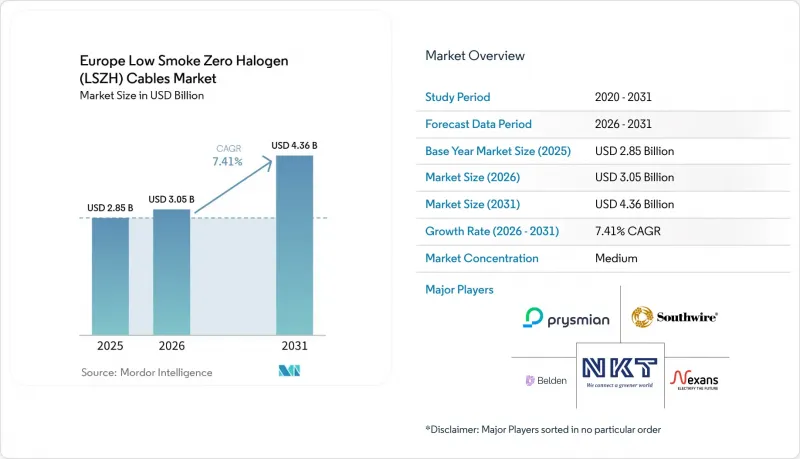
This report is Segmented by Cable Type (Power Cables, Control and Instrumentation Cables, and More), Voltage Rating (Less Than 1 KV, 1-35 KV, 36-65 KV, and Above 65 KV), Insulation Material (PVC (Polyvinyl Chloride), and More), End-User Industry (Commercial Buildings, Industrial Manufacturing, and More), and Country. The Market Forecasts are Provided in Terms of Value (USD).
Europe Low Smoke Zero Halogen (LSZH) Cables Market Trends and Insights
Construction Products Regulation and Mandatory Reaction-to-Fire Classification
Regulation (EU) 2024/3110 and Commission Delegated Regulation (EU) 2026/331 retain the Euroclass reaction-to-fire system from Aca through Fca in accordance with EN 50575. The framework preserves regulatory continuity while moving manufacturers toward updated compliance requirements. A Declaration of Performance shifts more responsibility for documented cable performance from contractors to manufacturers. Cables classified B2ca and above require continuous factory production surveillance and annual notified-body audit testing under System 1+. Generic LSZH labeling does not establish compliance when a project requires a defined Euroclass rating. This makes certified production capacity more important than product labeling alone in the Europe LSZH cables market.
Expansion of Data Centers and High-Density Digital Infrastructure
Data center construction is increasing the demand for fiber-optic and structured copper cable systems used in enclosed facilities. Prysmian signed an agreement with Molex in July 2026 worth up to EUR 5.5 billion (USD 6.29 billion) for optical cables used inside data centers. The company also committed EUR 1.25 billion (USD 1.43 billion) to European and U.S. production capacity through 2031. Permanent fixed installations in regulated buildings require appropriate CPR-rated cable designs, limiting the scope for lower-compliance substitutions. Greater fiber density in AI computing environments adds cable demand per rack as interconnect requirements increase. This supports a durable demand base for the European low-smoke zero-halogen (LSZH) cables market as data-center projects progress from design to installation.
Higher Material and Qualification Cost Than Halogenated Alternatives
Halogen-free compounds based on aluminum trihydrate, Al(OH)3, or magnesium dihydroxide, Mg(OH)2, require 60%-65% filler loading by weight to provide flame suppression. Conventional PVC formulations use 15%-25% filler content. Higher filler loading increases compound density, accelerates extrusion-tooling wear, and raises the cost of finished cable by 20%-40% relative to PVC alternatives. Cables classified B2ca and above also require continuing factory production control and annual audit testing by an EU-notified body. Annual certification overhead was EUR 30,000-80,000 (USD 34,000-91,000) per product family. This cost burden is most significant for smaller manufacturers and cost-sensitive tenders in Southern and Eastern Europe.
Other drivers and restraints analyzed in the detailed report include:
- Rail, Metro, Tunnel, and Airport Safety-Critical Cabling Projects
- Renewable Power, Grid Modernization, and Battery Energy Storage Build-Out
- Fragmented National Interpretation of CPR Euroclasses
For complete list of drivers and restraints, kindly check the Table Of Contents.
Segment Analysis
Power cables held 33.23% of the Europe low smoke zero halogen (LSZH) cables market share in 2025, supported by utility grid investment and industrial electrification activity in Germany, France, and Central Europe. Their scale reflects the long cable runs required for grid-connected installations and the move away from PVC-insulated medium-voltage cables in enclosed substations, where fire-containment requirements increasingly support halogen-free systems. Control and instrumentation cables serve industrial plants, process-control facilities, and rail signaling networks, where LSZH requirements are increasingly paired with ATEX or IECEx hazardous-area certifications. Data and communication cables support smart-building systems and industrial internet of things backbones, and dense cable trays increase the potential for flame propagation in commercial construction. These conditions make CPR-compliant LSZH products a common specification for new installations across several cable categories.
Fiber optic cables are projected to expand at a 9.15% CAGR from 2026 to 2031, making them the fastest-growing cable type in the Europe LSZH cables market. Data-center interconnects, national broadband programs, and campus-backbone upgrades support this outlook, while high-count fiber needs closely controlled halogen-free jackets that meet outside-diameter and fire-classification requirements. Furukawa Electric began mass production of 13,824-fiber cables in March 2026, with a sub-40 mm outer diameter for AI data center applications. Building wires remain a high-volume category for single-dwelling and low-rise commercial construction, with Ecodesign requirements encouraging certified alternatives to conventional PVC wire. Specialty LSZH cables used in marine, mining, nuclear, and rolling-stock applications retain a premium position for manufacturers with EN 45545, NEK 606, or offshore-standard certifications.
The below-1 kV tier held 64.78% in 2025, reflecting the substantial volume of building wire, structured cabling, and control-cable installations used in CPR-regulated construction and renovation projects. This broad tier is highly price-competitive, which concentrates margin pressure where compliance costs are uniform, and product differentiation is difficult without specialty compound capability. The 36-65 kV and above-65 kV ranges serve transmission and interconnector applications, where smaller addressable volumes are balanced by higher cable value per meter. These ranges commonly use XLPE insulation and LSZH sheath systems in enclosed ducts and cable galleries. ENTSO-E planning practices and national grid codes increasingly reference halogen-free sheath materials for high-voltage cables installed in confined routes.
The 1-35 kV tier is projected to expand at an 8.25% CAGR from 2026 to 2031, supported by renewable generation-to-grid interconnects, battery energy storage ring-main connections, and urban distribution-network upgrades. Nexans signed a EUR 600 million (USD 684 million) 7-year agreement with Enedis in February 2026 for medium-voltage cables for France's distribution grid modernization. Medium-voltage LSZH cable systems used in battery storage projects must meet CPR reaction-to-fire requirements and IEC 60502-2 electrical performance requirements. This dual qualification narrows the field of certified suppliers and can bolster pricing power for qualified producers. Grid-connection permitting remains a volume risk for 2026 and 2027, and the European Grids Package seeks to address it through streamlined approval processes.
Complete Report Scope:
- By Cable Type
- LSZH Power Cables
- LSZH Control and Instrumentation Cables
- LSZH Data and Communication Cables
- LSZH Fiber Optic Cables
- LSZH Building Wires
- Specialty LSZH Cables
- By Voltage Rating
- Less Than 1 kV
- 1-35 kV
- 36-65 kV
- Above 65 kV
- By Insulation Material
- PVC (Polyvinyl Chloride)
- XLPE (Cross-linked Polyethylene)
- PE (Polyethylene)
- Other Specialty Insulation Materials
- By End-User Industry
- Commercial Buildings
- Industrial Manufacturing
- Data Centers
- Energy and Utilities
- Transportation Infrastructure
- Telecommunications
- Renewable Energy
- Other End-User Industries
- By Country
- Germany
- United Kingdom
- France
- Italy
- Spain
- Rest of Europe
List of Companies Covered in this Report:
- Prysmian Group
- Nexans S.A.
- Southwire Company, LLC
- Belden Inc.
- CommScope Holding Company, Inc. (Amphenol Corporation)
- TE Connectivity Ltd.
- Corning Incorporated
- LS Cable and System Ltd.
- Furukawa Electric Co., Ltd.
- Leoni Cable Inc.
- NKT A/S
- Brugg Cables AG
- Superior Essex Inc.
- AFL Telecommunications LLC
- Alpha Wire
- HELUKABEL GmbH
- SAB Brockskes GmbH & Co. KG
- Hellenic Cables
- Eland Cables
Additional Benefits:
- The market estimate (ME) sheet in Excel format
- 3 months of analyst support
TABLE OF CONTENTS
1 INTRODUCTION
- 1.1 Study Assumptions and Market Definition
- 1.2 Scope of the Study
2 RESEARCH METHODOLOGY
3 EXECUTIVE SUMMARY
4 MARKET LANDSCAPE
- 4.1 Market Overview
- 4.2 Market Drivers
- 4.2.1 Construction Products Regulation and Mandatory Reaction-to-Fire Classification
- 4.2.2 Expansion of Data Centers and High-Density Digital Infrastructure
- 4.2.3 Rail, Metro, Tunnel, and Airport Safety-Critical Cabling Projects
- 4.2.4 Renewable Power, Grid Modernization, and Battery Energy Storage Build-Out
- 4.2.5 Industrial Electrification and Automation in Existing European Plants
- 4.2.6 Retrofit Demand from Legacy PVC Installations in High-Occupancy Buildings
- 4.3 Market Restraints
- 4.3.1 Higher Material and Qualification Cost than Halogenated Alternatives
- 4.3.2 Fragmented National Interpretation of CPR Euroclasses
- 4.3.3 Long Replacement Cycles for Installed Cable Infrastructure
- 4.3.4 Processing and Installation Complexity of High-Filler Halogen-Free Compounds
- 4.4 Industry Value Chain Analysis
- 4.5 Porter's Five Forces Analysis
- 4.5.1 Threat of New Entrants
- 4.5.2 Bargaining Power of Suppliers
- 4.5.3 Bargaining Power of Buyers
- 4.5.4 Threat of Substitutes
- 4.5.5 Rivalry Among Existing Competitors
5 MARKET SIZE AND GROWTH FORECASTS (VALUE)
- 5.1 By Cable Type
- 5.1.1 LSZH Power Cables
- 5.1.2 LSZH Control and Instrumentation Cables
- 5.1.3 LSZH Data and Communication Cables
- 5.1.4 LSZH Fiber Optic Cables
- 5.1.5 LSZH Building Wires
- 5.1.6 Specialty LSZH Cables
- 5.2 By Voltage Rating
- 5.2.1 Less Than 1 kV
- 5.2.2 1-35 kV
- 5.2.3 36-65 kV
- 5.2.4 Above 65 kV
- 5.3 By Insulation Material
- 5.3.1 PVC (Polyvinyl Chloride)
- 5.3.2 XLPE (Cross-linked Polyethylene)
- 5.3.3 PE (Polyethylene)
- 5.3.4 Other Specialty Insulation Materials
- 5.4 By End-User Industry
- 5.4.1 Commercial Buildings
- 5.4.2 Industrial Manufacturing
- 5.4.3 Data Centers
- 5.4.4 Energy and Utilities
- 5.4.5 Transportation Infrastructure
- 5.4.6 Telecommunications
- 5.4.7 Renewable Energy
- 5.4.8 Other End-User Industries
- 5.5 By Country
- 5.5.1 Germany
- 5.5.2 United Kingdom
- 5.5.3 France
- 5.5.4 Italy
- 5.5.5 Spain
- 5.5.6 Rest of Europe
6 COMPETITIVE LANDSCAPE
- 6.1 Market Concentration
- 6.2 Strategic Moves
- 6.3 Market Share Analysis
- 6.4 Company Profiles (includes Global Level Overview, Market Level Overview, Core Segments, Financials as available, Strategic Information, Market Rank/Share, Products and Services, Recent Developments)
- 6.4.1 Prysmian Group
- 6.4.2 Nexans S.A.
- 6.4.3 Southwire Company, LLC
- 6.4.4 Belden Inc.
- 6.4.5 CommScope Holding Company, Inc. (Amphenol Corporation)
- 6.4.6 TE Connectivity Ltd.
- 6.4.7 Corning Incorporated
- 6.4.8 LS Cable and System Ltd.
- 6.4.9 Furukawa Electric Co., Ltd.
- 6.4.10 Leoni Cable Inc.
- 6.4.11 NKT A/S
- 6.4.12 Brugg Cables AG
- 6.4.13 Superior Essex Inc.
- 6.4.14 AFL Telecommunications LLC
- 6.4.15 Alpha Wire
- 6.4.16 HELUKABEL GmbH
- 6.4.17 SAB Brockskes GmbH & Co. KG
- 6.4.18 Hellenic Cables
- 6.4.19 Eland Cables
7 MARKET OPPORTUNITIES AND FUTURE OUTLOOK
- 7.1 White-Space and Unmet-Need Assessment

