PUBLISHER: Mordor Intelligence | PRODUCT CODE: 2119591

PUBLISHER: Mordor Intelligence | PRODUCT CODE: 2119591
Oslo Data Center - Market Share Analysis, Industry Trends & Statistics, Growth Forecasts (2026 - 2031)
According to Mordor Intelligence, the oslo data center market size is expected to grow from 165.39 MW in 2025 to 185.34 MW in 2026 and is forecast to reach 327.61 MW by 2031 at 12.06% CAGR over 2026-2031.
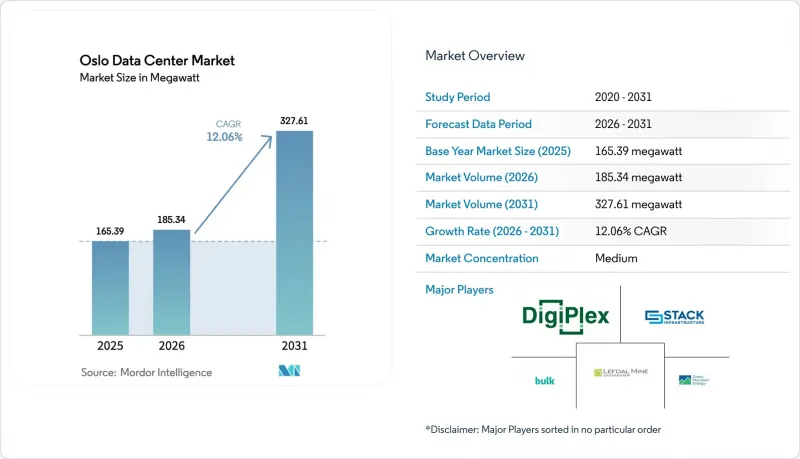
This report is Segmented by Data Center Size (Small, Medium, Large, Massive, Mega), Tier Type (Tier 1&2, Tier 3, Tier 4), and Data Center Type (Cloud Service Providers (CSPs), Colocation Type, and More). The Market Forecasts are Provided in Terms of Value (USD).
Oslo Data Center Market Trends and Insights
Favourable Climate and 100% Renewable Grid Mix
Norway supplies data centers with fully renewable hydro power, cutting operational emissions to near zero and lowering electricity costs by up to 40% versus key European peers. A cool ambient climate supports extensive free cooling, enabling typical PUE readings around 1.1, well below the 1.57 global benchmark. In February 2025 the government raised grid-allocation priority for sites with heat-recovery, rewarding operators that integrate with Oslo's district-heating grid.These factors attract global firms aligning infrastructure with corporate ESG targets while protecting margins. The combined sustainability and cost edge is a long-run catalyst for the Oslo data center market.
AI-Driven Hyperscale Demand Spike (2025-2030)
Surging AI workloads increase rack densities and push multi-megawatt expansions. By 2030, AI-ready halls are expected to represent 70% of Nordic capacity. Google's EUR 600 million facility in Skien alone could draw 5% of Norway's total power when live in 2026. Hardware vendors respond with high-bandwidth SmartNICs and liquid-cooling solutions designed for 200-400 Gbps traffic. For Oslo, hyperscale appetite means larger campuses, innovative cooling and substantial grid-connection requests that reshape power-planning discussions. This AI-centric wave is a core growth engine for the Oslo data center market.
Land-Use Moratoriums in Greater Oslo
In July 2025 "data center" became a standalone land-use category, adding scrutiny to zoning reviews. The city's Climate Budget 2024 sets a 95% emission-reduction target by 2030, tightening approval for developments near residential zones. Economic analyses show heightened friction for plots on farmland or close to housing, prompting operators to shift toward vertical designs or suburban sites. These planning obstacles temporarily slow expansions inside the beltway and influence project pipelines across the Oslo data center market.
Other drivers and restraints analyzed in the detailed report include:
- New Trans-Atlantic and Arctic Connect Cables Landing in Oslofjord
- District-Heating Off-Take Agreements Monetising Waste Heat
- Rising Grid-Connection Fees (Statnett Upgrade Backlog)
For complete list of drivers and restraints, kindly check the Table Of Contents.
Segment Analysis
Large facilities controlled 52.02% of the Oslo data center market share in 2025, reflecting the long-term prevalence of 5-20 MW builds. The mega class, defined at 45 MW and above, is projected to log a 14.93% CAGR to 2031, the fastest among all size bands. This escalation is anchored in AI and cloud scale economies, with operators consolidating capacity on campus-style estates that can double or triple through phased halls. Green Mountain's 90-150 MW TikTok project and Bulk's OS-IX expansion exemplify the path.
Mega builds stimulate innovation in supply-chain logistics, modular substation design and multi-stage liquid-cooling deployments. Land scarcity within Oslo pushes some projects to peripheral counties while keeping backbone fiber latency under 3 ms. Operators maintain medium facilities for custom enterprise deployments, and small sites increasingly migrate toward edge use cases. This rebalancing positions mega campuses as the growth nucleus of the Oslo data center market.
Tier 3 retained 70.65% share in 2025 thanks to its balance of N+1 redundancy and cost discipline. Yet Tier 4 is rising with a 19.05% CAGR as finance and government workloads demand 2N topology and fault-tolerant architecture. Facilities chasing Tier 4 certification emphasize dual active power paths, concurrent maintenance and fault-isolated cooling loops.
Projects like DigiPlex Fetsund target PUE 1.1 via indirect-evaporative air systems while meeting Tier 4 requirements. Achieving Tier 4 bolsters data-sovereignty credentials in an increasingly regulated EU context. With stricter uptime obligations, the Oslo data center market size for Tier 4 builds will grow steadily, while Tier 1/2 footprints shrink to niche requirements.
Complete Report Scope:
- By Data Center Size
- Small
- Medium
- Large
- Massive
- Mega
- By Tier Type
- Tier 1 and 2
- Tier 3
- Tier 4
- By Data Center Type
- Cloud Service Providers (CSPs)
- Enterprise, Modular and Edge
- Colocation
- Utilized
- Colocation Type
- Retail
- Wholesale
- Hyperscale
- End User
- Cloud and IT
- Telecom
- Media and Entertainment
- Government
- BFSI
- Manufacturing
- E-Commerce
- Other End User
- Colocation Type
- Non-Utilized
- Utilized
List of Companies Covered in this Report:
- Stack Infrastructure
- Bulk Infrastructure Group
- Green Mountain
- DigiPlex (Stack EMEA)
- Lefdal Mine Datacenter
- AQ Compute
- atNorth
- Orange Business Services (Basefarm)
- Blix Solutions
- Nordic Hub Data Centers
- Webspesialisten
- Equinix
- Verdane (ServeTheWorld DC)
- Atea Datacenters
- Itera
- Evry (Tietoevry) DC Services
- Capgemini Data Centre Oslo
- IBM Cloud Oslo
- Microsoft Azure Norway East (Oslo)
- Google Cloud Region Norway
Additional Benefits:
- The market estimate (ME) sheet in Excel format
- 3 months of analyst support
TABLE OF CONTENTS
1 INTRODUCTION
- 1.1 Study Assumptions and Market Definition
- 1.2 Scope of the Study
2 RESEARCH METHODOLOGY
3 EXECUTIVE SUMMARY
4 MARKET LANDSCAPE
- 4.1 Market Overview
- 4.2 Market Drivers
- 4.2.1 Favourable climate and 100 % renewable grid mix
- 4.2.2 Government tax relief on electricity for DCs
- 4.2.3 AI-driven hyperscale demand spike (2025-2030)
- 4.2.4 New trans-Atlantic and Arctic Connect cables landing in Oslofjord
- 4.2.5 Under-reported: District-heating off-take agreements monetising waste-heat
- 4.2.6 Under-reported: EU Data-for-Green taxonomy funding unlocking low-cost capital
- 4.3 Market Restraints
- 4.3.1 Land-use moratoriums in Greater Oslo
- 4.3.2 Rising grid-connection fees (statnett upgrade backlog)
- 4.3.3 Under-reported: Skilled-labour scarcity for high-density liquid cooling
- 4.3.4 Under-reported: Local opposition to high-voltage transformer yards (NIMBY)
- 4.4 Value / Supply-Chain Analysis
- 4.5 Regulatory Landscape
- 4.6 Technological Outlook
- 4.7 Porter's Five Forces
- 4.8 Assessment of the impact of Macro Economic Trends on the Market
- 4.8.1 Threat of New Entrants
- 4.8.2 Bargaining Power of Suppliers
- 4.8.3 Bargaining Power of Buyers
- 4.8.4 Threat of Substitutes
- 4.8.5 Industry Rivalry
- 4.9 Other Market Metrics
- 4.9.1 IT Load Capacity Analysis
- 4.9.2 Raised Floor Space Analysis
- 4.9.3 Rack Count Analysis
5 MARKET SIZE AND GROWTH FORECASTS (MW)
- 5.1 By Data Center Size
- 5.1.1 Small
- 5.1.2 Medium
- 5.1.3 Large
- 5.1.4 Massive
- 5.1.5 Mega
- 5.2 By Tier Type
- 5.2.1 Tier 1 and 2
- 5.2.2 Tier 3
- 5.2.3 Tier 4
- 5.3 By Data Center Type
- 5.3.1 Cloud Service Providers (CSPs)
- 5.3.2 Enterprise, Modular and Edge
- 5.3.3 Colocation
- 5.3.3.1 Utilized
- 5.3.3.1.1 Colocation Type
- 5.3.3.1.1.1 Retail
- 5.3.3.1.1.2 Wholesale
- 5.3.3.1.1.3 Hyperscale
- 5.3.3.1.2 End User
- 5.3.3.1.2.1 Cloud and IT
- 5.3.3.1.2.2 Telecom
- 5.3.3.1.2.3 Media and Entertainment
- 5.3.3.1.2.4 Government
- 5.3.3.1.2.5 BFSI
- 5.3.3.1.2.6 Manufacturing
- 5.3.3.1.2.7 E-Commerce
- 5.3.3.1.2.8 Other End User
- 5.3.3.1.1 Colocation Type
- 5.3.3.2 Non-Utilized
- 5.3.3.1 Utilized
6 COMPETITIVE LANDSCAPE
- 6.1 Market Concentration
- 6.2 Strategic Moves
- 6.3 Market Share Analysis
- 6.4 Company Profiles (includes Global level Overview, Market level overview, Core Segments, Financials as available, Strategic Information, Market Rank/Share for key companies, Products and Services, and Recent Developments)
- 6.4.1 Stack Infrastructure
- 6.4.2 Bulk Infrastructure Group
- 6.4.3 Green Mountain
- 6.4.4 DigiPlex (Stack EMEA)
- 6.4.5 Lefdal Mine Datacenter
- 6.4.6 AQ Compute
- 6.4.7 atNorth
- 6.4.8 Orange Business Services (Basefarm)
- 6.4.9 Blix Solutions
- 6.4.10 Nordic Hub Data Centers
- 6.4.11 Webspesialisten
- 6.4.12 Equinix
- 6.4.13 Verdane (ServeTheWorld DC)
- 6.4.14 Atea Datacenters
- 6.4.15 Itera
- 6.4.16 Evry (Tietoevry) DC Services
- 6.4.17 Capgemini Data Centre Oslo
- 6.4.18 IBM Cloud Oslo
- 6.4.19 Microsoft Azure Norway East (Oslo)
- 6.4.20 Google Cloud Region Norway
7 MARKET OPPORTUNITIES and FUTURE OUTLOOK
- 7.1 White-space and Unmet-need Assessment

