PUBLISHER: Mordor Intelligence | PRODUCT CODE: 2154886

PUBLISHER: Mordor Intelligence | PRODUCT CODE: 2154886
South America Soft Facility Management - Market Share Analysis, Industry Trends & Statistics, Growth Forecasts (2026 - 2031)
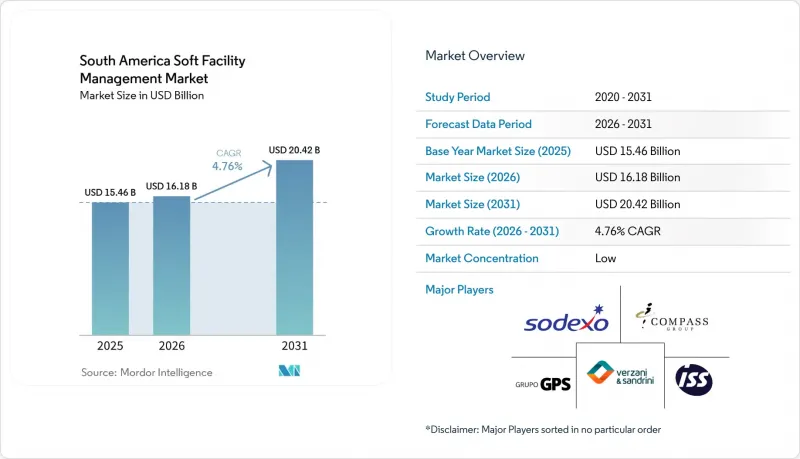
According to Mordor Intelligence, the South America soft facility management market size was valued at USD 15.46 billion in 2025 and is estimated to expand from USD 16.18 billion in 2026 to reach USD 20.42 billion by 2031, at a CAGR of 4.76% during the forecast period 2026-2031.
South America Soft Facility Management Market Trends and Insights
Commercial Real Estate and Logistics-Facility Expansion
The South America soft facility management market benefits as commercial occupiers take up better-quality space in major regional cities, creating recurring demand for cleaning, access control, guarding, waste handling, and front-of-house support. Declining Grade-A office vacancy in Sao Paulo has supported recurring demand for cleaning and security services. As office occupancy increases, clients require services that can adapt to changing footfall, shared work areas, visitor volumes, and daily security conditions. Logistics facilities and data centers require continuous service coverage because their operating schedules and uptime requirements are more demanding than those of traditional offices. Recent data center developments in Brazil, including projects by Equinix, Omnia Data Centers, and Patria Investimentos, expand demand beyond the Sao Paulo-Rio de Janeiro corridor and encourage providers to offer occupancy-based cleaning, flexible staffing, and continuous support.
Healthcare and Public-Infrastructure Investment
Healthcare and public infrastructure investment supports the South America soft facility management market through long concession periods, defined operating requirements, and public procurement standards that are often stricter than those in ordinary corporate contracts. Hospital public-private partnership contracts in Brazil often span extended periods and include cleaning, security, catering, waste management, infection-control routines, and performance reporting from the start of operations. The Inter-American Development Bank supported a hospital public-private partnership for the Hospital Regional do Mato Grosso do Sul, covering construction and long-term operations. A contract for Minas Gerais' HoPE Complex was awarded with International Finance Corporation advisory support and included ongoing maintenance and support services. The New Development Bank approved the concept for a USD 320 million Brazil Smart Hospital Project in July 2025, signaling further public investment in health assets that need professional operating support. The South America soft facility management market can therefore gain a more predictable contract pipeline, provided suppliers can meet the service, workforce, and compliance terms required over the full life of an asset.
Labor Turnover and Shortage of Trained Service Personnel
Labor turnover and shortages of trained personnel constrain the South America soft facility management market, particularly where contracts require rapid mobilization, defined service levels, and supervisors who can manage a large, dispersed workforce. Rising labor costs and increased employee benefit requirements in Brazil place pressure on provider margins, as fixed-price contract renewals may not fully offset these expenses. This situation can lead to challenging negotiations when buyers prioritize price. Shortages are more acute in supervisory and technical roles that require knowledge of building systems, digital controls, labor practices, and compliance reporting. Vacancies in secondary cities can delay contract mobilization, particularly when a new site requires trained personnel from the start of operations. Brazil's psychosocial risk obligations and credential requirements for certain maintenance activities further increase workforce planning requirements for providers serving institutional and public-private partnership sites.
Other drivers and restraints analyzed in the detailed report include:
- Increasing Outsourcing of Non-Core Facility Functions
- Digital Workforce Management and Smart-Building Adoption
- Inflation, Wage Escalation, and Consumables Cost Volatility
For complete list of drivers and restraints, kindly check the Table Of Contents.
Segment Analysis
Cleaning Services held 34.42% of the South America soft facility management market size in 2025. It is often the first service that an organization transfers from an internal team to a specialist provider because it can be mobilized quickly and needs limited capital from the client. The initial contract can create a working relationship that later extends to other services. Catering Services, Office Support, and Landscaping Services provide additional revenue where sites need regular food, reception, transport coordination, or grounds support. Catering is particularly important at remote mining camps, hospital concessions, and data center campuses, where daily site operations depend on reliable food services. Cleaning specifications are becoming more detailed in hospitals and food-service environments, which raises the importance of trained staff and documented procedures.
Security Services is projected to expand at a 4.93% CAGR through 2031, the highest rate among service types. Urban safety concerns and demand from remote mining, energy, and logistics sites support the need for physical guarding and access control. Video surveillance tools can make security contracts more differentiated than conventional labor-based cleaning contracts and allow higher-value reporting. Other Soft FM Services include pest control, document management, shuttle coordination, and reception services that can deepen client relationships after cleaning or security has become established. The South America soft facility management market gives suppliers a reason to combine these activities within broader bundled contracts.
Commercial held 39.57% of the South America soft facility management market size in 2025. Corporate offices, retail properties, and logistics assets in Brazil's Southeast and Bogota's business districts provide a broad base for routine cleaning, guarding, and workplace support. These clients commonly seek regular service schedules, clear performance standards, and flexible coverage as occupancy patterns change. Commercial sites can adopt integrated service agreements as they reduce the number of individual vendors they must supervise. The large installed base of office and logistics space makes this segment important for providers with multi-site operating capability.
Public/Infrastructure is projected to expand at a 5.11% CAGR through 2031, the fastest among end users. Hospital and transit public-private partnerships in Brazil are including facility obligations that were previously managed in-house or through informal arrangements. These contracts often use service-level agreements, transparent procurement, and long operating periods. Such conditions favor providers with certified processes, auditable labor practices, and reliable governance. The Institutional segment includes universities, schools, and corporate campuses, while industrial locations in Brazil and Argentina require regular support services and strict site controls.
Complete Report Scope:
- By Service Type
- Office Support and Landscaping Services
- Cleaning Services
- Catering Services
- Security Services
- Other Service Types
- By End User
- Commercial
- Institutional
- Public/Infrastructure
- Industrial
- Other End Users
- By Contract Mode
- In-House
- Outsourced
- Integrated and Bundled Contracts
- By Contract Duration
- Short-Term Contracts, Less Than One Year
- Medium-Term Contracts, One to Three Years
- Long-Term Contracts, More Than Three Years
- By Geography
- Brazil
- Argentina
- Colombia
- Rest of South America
List of Companies Covered in this Report:
- ISS A/S
- Sodexo S.A.
- Compass Group PLC
- CBRE Group, Inc.
- Jones Lang LaSalle Incorporated
- Cushman & Wakefield plc
- Aramark
- Grupo GPS Participacoes S.A.
- Grupo Verzani & Sandrini S.A.
- Brasanitas Servicos Integrados Ltda.
- Manserv Montagem e Manutencao S.A.
- Prosegur Compania de Seguridad, S.A.
- Securitas AB
- Grupo EULEN S.A.
- Newrest Group International S.A.S.
- Ecolab Inc.
- ABM Industries Incorporated
- Johnson Controls International plc
- Siemens Aktiengesellschaft
- Veolia Environnement S.A.
- Apleona GmbH
- OCS Group Limited
Additional Benefits:
- The market estimate (ME) sheet in Excel format
- 3 months of analyst support
TABLE OF CONTENTS
1 INTRODUCTION
- 1.1 Study Assumptions and Market Definition
- 1.2 Scope of the Study
2 RESEARCH METHODOLOGY
3 EXECUTIVE SUMMARY
4 MARKET LANDSCAPE
- 4.1 Market Overview
- 4.2 Market Drivers
- 4.2.1 Commercial Real Estate and Logistics-Facility Expansion
- 4.2.2 Healthcare and Public-Infrastructure Investment
- 4.2.3 Increasing Outsourcing of Non-Core Facility Functions
- 4.2.4 Digital Workforce Management and Smart-Building Adoption
- 4.2.5 Remote-Site Operations in Mining and Energy
- 4.2.6 Formalization of Facility Services in Secondary Cities
- 4.3 Market Restraints
- 4.3.1 Labor Turnover and Shortage of Trained Service Personnel
- 4.3.2 Inflation, Wage Escalation, and Consumables Cost Volatility
- 4.3.3 Informal Competition and Uneven Regulatory Enforcement
- 4.3.4 Fragmented Service Standards Across Multisite and Cross-Border Contracts
- 4.4 Industry Value Chain Analysis
- 4.5 Impact of Macroeconomic Factors on the Market
- 4.6 Regulatory Landscape
- 4.7 Technological Outlook
- 4.8 Porter's Five Forces Analysis
- 4.8.1 Bargaining Power of Suppliers
- 4.8.2 Bargaining Power of Buyers
- 4.8.3 Threat of New Entrants
- 4.8.4 Threat of Substitutes
- 4.8.5 Competitive Rivalry
5 MARKET SIZE AND GROWTH FORECASTS (VALUE)
- 5.1 By Service Type
- 5.1.1 Office Support and Landscaping Services
- 5.1.2 Cleaning Services
- 5.1.3 Catering Services
- 5.1.4 Security Services
- 5.1.5 Other Service Types
- 5.2 By End User
- 5.2.1 Commercial
- 5.2.2 Institutional
- 5.2.3 Public/Infrastructure
- 5.2.4 Industrial
- 5.2.5 Other End Users
- 5.3 By Contract Mode
- 5.3.1 In-House
- 5.3.2 Outsourced
- 5.3.3 Integrated and Bundled Contracts
- 5.4 By Contract Duration
- 5.4.1 Short-Term Contracts, Less Than One Year
- 5.4.2 Medium-Term Contracts, One to Three Years
- 5.4.3 Long-Term Contracts, More Than Three Years
- 5.5 By Geography
- 5.5.1 Brazil
- 5.5.2 Argentina
- 5.5.3 Colombia
- 5.5.4 Rest of South America
6 COMPETITIVE LANDSCAPE
- 6.1 Market Concentration
- 6.2 Strategic Moves
- 6.3 Market Share Analysis
- 6.4 Company Profiles (includes Global Level Overview, Market Level Overview, Core Segments, Financials as available, Strategic Information, Market Rank/Share, Products and Services, Recent Developments)
- 6.4.1 ISS A/S
- 6.4.2 Sodexo S.A.
- 6.4.3 Compass Group PLC
- 6.4.4 CBRE Group, Inc.
- 6.4.5 Jones Lang LaSalle Incorporated
- 6.4.6 Cushman & Wakefield plc
- 6.4.7 Aramark
- 6.4.8 Grupo GPS Participacoes S.A.
- 6.4.9 Grupo Verzani & Sandrini S.A.
- 6.4.10 Brasanitas Servicos Integrados Ltda.
- 6.4.11 Manserv Montagem e Manutencao S.A.
- 6.4.12 Prosegur Compania de Seguridad, S.A.
- 6.4.13 Securitas AB
- 6.4.14 Grupo EULEN S.A.
- 6.4.15 Newrest Group International S.A.S.
- 6.4.16 Ecolab Inc.
- 6.4.17 ABM Industries Incorporated
- 6.4.18 Johnson Controls International plc
- 6.4.19 Siemens Aktiengesellschaft
- 6.4.20 Veolia Environnement S.A.
- 6.4.21 Apleona GmbH
- 6.4.22 OCS Group Limited
7 MARKET OPPORTUNITIES AND FUTURE OUTLOOK
- 7.1 White-Space and Unmet-Need Assessment

