PUBLISHER: Mordor Intelligence | PRODUCT CODE: 2125579

PUBLISHER: Mordor Intelligence | PRODUCT CODE: 2125579
Facility Management Software - Market Share Analysis, Industry Trends & Statistics, Growth Forecasts (2026 - 2031)
According to Mordor Intelligence, the facility management software market size is expected to increase from USD 2.65 billion in 2025 to USD 2.98 billion in 2026 and reach USD 4.95 billion by 2031, growing at a CAGR of 10.68% over 2026-2031.
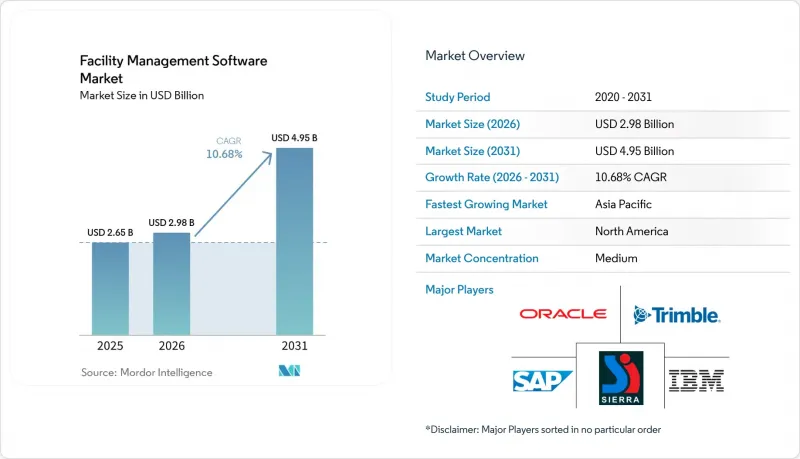
This report is Segmented by Software Type (CAFM, IWMS, and CMMS), Deployment Model (Cloud, On-Premise, and Hybrid), End User (Commercial, Institutional, Public Infrastructure, Industrial, and More), Functionality (Asset Management, Maintenance Management, Space Management, and Energy Management), and Geography. Market Forecasts are Provided in Terms of Value (USD).
Global Facility Management Software Market Trends and Insights
Growing Adoption of Cloud-Based SaaS Platforms
Subscription economics convert capital expenditure into operating expenses, broadening access for mid-market buyers while shortening deployment cycles from 18 months to roughly six months. ServiceNow's workplace suite secured 1,200 enterprise customers in 2025, citing pricing flexibility as the top factor. Multi-tenant architectures enable vendors to continuously push AI updates, a benefit that on-premises systems lack. Such agility strengthens vendor lock-in and raises switching costs, underpinning sustained double-digit expansion.
Integration of IoT Sensors for Predictive Maintenance
Sensor proliferation enables a shift from reactive to predictive maintenance, resulting in up to 40% lower downtime. Fracttal's roll-out of 50,000 vibration sensors across Latin American plants detected failures 72 hours in advance and saved USD 12 million in 2024. Edge computing and 5G connectivity enable sub-second alerts, while partnerships, such as SAP's 2025 tie-up with Siemens' MindSphere, integrate telemetry with asset histories for optimized spare-part planning.
Legacy System Integration Complexities
Proprietary protocols inflate project costs by 40-60%, with Siemens Desigo CC controllers requiring custom middleware for third-party IWMS integration. Honeywell's 2024 launch of 47 pre-built connectors reduced some friction, yet 38% of projects still exceeded budgets. Healthcare campuses illustrate the challenge: a 12-building migration to Johnson Controls OpenBlue lasted 14 months due to pneumatic legacy controls.
Other drivers and restraints analyzed in the detailed report include:
- Rising Focus on Sustainability and Energy Efficiency
- Proliferation of Hybrid-Work Models Driving Space-Optimization Tools
- High Up-Front Implementation and Training Costs
For complete list of drivers and restraints, kindly check the Table Of Contents.
Segment Analysis
Integrated workplace management systems represented the fastest-growing segment, with a 16.80% CAGR through 2031. However, computer-aided facility management retained 41.40% of the facilities management software market share in 2025. Large enterprises favor IWMS for consolidated lease, capital project, and energy analytics, as evidenced by deployments of IBM TRIRIGA and Oracle Primavera Unifier. Computerized maintenance management systems appeal to asset-intensive verticals, with mobile-first vendors such as UpKeep and MaintainX posting 89% adoption within 60 days. The facilities management software market size for IWMS is forecast to expand rapidly as CFOs strive to replace three or more point solutions by 2027, while CAFM remains entrenched in sectors prioritizing rapid roll-out and lower complexity.
IWMS complexity demands longer roll-out horizons, often six to 12 months, while CMMS achieves faster time to value technician-centric workflows. Planon's integration of CMMS within its IWMS architecture during 2024 blurred segment lines. Archibus introduced digital-twin visualization in 2025 to narrow capability gaps, although its CAFM roots still underpin its value proposition. Market bifurcation persists: Fortune 500 landlords consolidate around IWMS, mid-market industrial players lean toward CMMS simplicity, and commercial real-estate groups balance CAFM familiarity with selective IWMS upgrades.
Cloud solutions accounted for 72.12% of the revenue in 2025 and are progressing at an 11.30% CAGR through 2031, reflecting subscription affordability, continuous AI updates, and lower IT overhead. The facilities management software market size for cloud deployments surged as Oracle migrated Primavera to Oracle Cloud Infrastructure, with 78% of new clients choosing SaaS in 2024. On-premises deployments persist in defense and regulated sectors where data sovereignty matters, but R&D outlays favor cloud enhancements. Hybrid deployments bridge the security and analytics needs; SAP S/4HANA for Real Estate enables hospitals to keep sensitive room assignments on-site while processing occupancy insights in Azure.
Multi-tenant economics allow pure-play SaaS vendors to undercut legacy pricing by 40-50%. ServiceChannel handled 14 million work orders in 2024, proving scalability benefits. ISO 27001 certification has become a standard, with Eptura and Planon both achieving compliance in 2024 to alleviate enterprise security concerns. Over time, cloud adoption is expected to compress margins for on-premises support while stimulating ecosystem partnerships centered on AI, digital twins, and IoT telemetry.
Complete Report Scope:
- By Software Type
- Computer-Aided Facility Management (CAFM)
- Integrated Workplace Management Systems (IWMS)
- Computerized Maintenance Management Systems (CMMS)
- By Deployment Model
- Cloud
- On-Premise
- Hybrid
- By End User
- Commercial
- Institutional
- Public Infrastructure
- Industrial
- Other End User Segments
- By Functionality
- Asset Management
- Maintenance Management
- Space Management
- Energy Management
- By Geography
- North America
- United States
- Canada
- Mexico
- Europe
- Germany
- United Kingdom
- France
- Italy
- Spain
- Russia
- Rest of Europe
- Asia-Pacific
- China
- Japan
- India
- South Korea
- Australia
- Rest of Asia-Pacific
- Middle East
- Saudi Arabia
- United Arab Emirates
- Turkey
- Rest of Middle East
- Africa
- South Africa
- Nigeria
- Rest of Africa
- South America
- Brazil
- Argentina
- Rest of South America
- North America
Geography Analysis
North America generated 37.46% of the revenue in 2025, driven by stringent performance ordinances in cities such as New York and San Francisco that require energy benchmarking. The U.S. General Services Administration's 2024 mandate for digital building oversight opened a USD 340 million procurement avenue. Canada trails by roughly two years, but British Columbia's 2024 code update accelerated adoption in Vancouver. Mexico's nearshoring boom spurred a 28% growth in CMMS in 2024, as manufacturers prioritized uptime.
Europe's revised 2024 EPBD compels near-zero energy in new buildings, funneling EUR 500 million (USD 565 million) in German grants toward IWMS and energy platforms. France and the Nordics mirror Germany's incentives, while the United Kingdom's 2025 Building Safety Act tightens maintenance documentation rules, boosting CMMS demand.
The Asia-Pacific region is the fastest-growing region, with a 26.30% CAGR through 2031, driven by China's smart-city investments and India's digitization of municipal assets. Japan's Society 5.0 program interconnected 23,000 public buildings with national IoT backbones in 2024. South Korea allocated KRW 780 billion (USD 590 million) for smart-building retrofits. Australia's 2024 National Construction Code revisions have enforced energy modeling, leading to increased SaaS energy-management subscriptions in Sydney and Melbourne.
Middle East demand centers on mega-projects: Saudi Arabia's NEOM integrated IBM TRIRIGA and Siemens Desigo CC for end-to-end asset oversight. Dubai Municipality's 2025 rule mandates the adoption of digital twins in towers exceeding 20 floors, ensuring sustained IWMS procurement. Africa is nascent, but it gains traction as Nigeria updates its national building code. South America's momentum rests in Brazil, where Sao Paulo's 2024 performance law accelerated IWMS penetration; Chile follows with green-building incentives, while Argentina's macroeconomic headwinds dampen spending.
- IBM Corporation
- Oracle Corporation
- SAP SE
- SIERRA ODC Private Limited
- Trimble Inc.
- Broadcom Inc.
- Accruent LLC (Fortive)
- Planon Software
- Eptura
- UpKeep Technologies
- FTMaintenance (FasTrak)
- Brightly (Siemens)
- Infor (Hexagon)
- Limble CMMS
- MaintainX Inc.
- FMX (Facilities Management eXpress)
- eMaint (Fluke Corporation)
- Dude Solutions
- iOFFICE + SpaceIQ
- Archibus
- ServiceChannel
Additional Benefits:
- The market estimate (ME) sheet in Excel format
- 3 months of analyst support
TABLE OF CONTENTS
1 INTRODUCTION
- 1.1 Study Assumptions and Market Definition
- 1.2 Scope of the Study
2 RESEARCH METHODOLOGY
3 EXECUTIVE SUMMARY
4 MARKET LANDSCAPE
- 4.1 Market Overview
- 4.2 Market Drivers
- 4.2.1 Growing Adoption of Cloud-Based SaaS Platforms
- 4.2.2 Integration of IoT Sensors for Predictive Maintenance
- 4.2.3 Rising Focus on Sustainability and Energy Efficiency
- 4.2.4 Proliferation of Hybrid-Work Models Driving Space-Optimization Tools
- 4.2.5 Smart-City Mandates in Emerging Economies
- 4.2.6 Increasing Use of Digital Twins for Asset Lifecycle Management
- 4.3 Market Restraints
- 4.3.1 Legacy System Integration Complexities
- 4.3.2 High Up-Front Implementation and Training Costs
- 4.3.3 Data-Privacy and Cyber-Security Concerns
- 4.3.4 Shortage of FM-Specific Data-Analytics Talent
- 4.4 Industry Value Chain Analysis
- 4.5 Regulatory Landscape
- 4.6 Technological Outlook
- 4.7 Impact of Macroeconomic Factors
- 4.8 Porter's Five Forces Analysis
- 4.8.1 Threat of New Entrants
- 4.8.2 Bargaining Power of Suppliers
- 4.8.3 Bargaining Power of Buyers
- 4.8.4 Threat of Substitutes
- 4.8.5 Competitive Rivalry
5 MARKET SIZE AND GROWTH FORECASTS (VALUE)
- 5.1 By Software Type
- 5.1.1 Computer-Aided Facility Management (CAFM)
- 5.1.2 Integrated Workplace Management Systems (IWMS)
- 5.1.3 Computerized Maintenance Management Systems (CMMS)
- 5.2 By Deployment Model
- 5.2.1 Cloud
- 5.2.2 On-Premise
- 5.2.3 Hybrid
- 5.3 By End User
- 5.3.1 Commercial
- 5.3.2 Institutional
- 5.3.3 Public Infrastructure
- 5.3.4 Industrial
- 5.3.5 Other End User Segments
- 5.4 By Functionality
- 5.4.1 Asset Management
- 5.4.2 Maintenance Management
- 5.4.3 Space Management
- 5.4.4 Energy Management
- 5.5 By Geography
- 5.5.1 North America
- 5.5.1.1 United States
- 5.5.1.2 Canada
- 5.5.1.3 Mexico
- 5.5.2 Europe
- 5.5.2.1 Germany
- 5.5.2.2 United Kingdom
- 5.5.2.3 France
- 5.5.2.4 Italy
- 5.5.2.5 Spain
- 5.5.2.6 Russia
- 5.5.2.7 Rest of Europe
- 5.5.3 Asia-Pacific
- 5.5.3.1 China
- 5.5.3.2 Japan
- 5.5.3.3 India
- 5.5.3.4 South Korea
- 5.5.3.5 Australia
- 5.5.3.6 Rest of Asia-Pacific
- 5.5.4 Middle East
- 5.5.4.1 Saudi Arabia
- 5.5.4.2 United Arab Emirates
- 5.5.4.3 Turkey
- 5.5.4.4 Rest of Middle East
- 5.5.5 Africa
- 5.5.5.1 South Africa
- 5.5.5.2 Nigeria
- 5.5.5.3 Rest of Africa
- 5.5.6 South America
- 5.5.6.1 Brazil
- 5.5.6.2 Argentina
- 5.5.6.3 Rest of South America
- 5.5.1 North America
6 COMPETITIVE LANDSCAPE
- 6.1 Market Concentration
- 6.2 Strategic Moves
- 6.3 Market Share Analysis
- 6.4 Company Profiles (includes Global level Overview, Market level overview, Core Segments, Financials as available, Strategic Information, Market Rank/Share for key companies, Products and Services, and Recent Developments)
- 6.4.1 IBM Corporation
- 6.4.2 Oracle Corporation
- 6.4.3 SAP SE
- 6.4.4 SIERRA ODC Private Limited
- 6.4.5 Trimble Inc.
- 6.4.6 Broadcom Inc.
- 6.4.7 Accruent LLC (Fortive)
- 6.4.8 Planon Software
- 6.4.9 Eptura
- 6.4.10 UpKeep Technologies
- 6.4.11 FTMaintenance (FasTrak)
- 6.4.12 Brightly (Siemens)
- 6.4.13 Infor (Hexagon)
- 6.4.14 Limble CMMS
- 6.4.15 MaintainX Inc.
- 6.4.16 FMX (Facilities Management eXpress)
- 6.4.17 eMaint (Fluke Corporation)
- 6.4.18 Dude Solutions
- 6.4.19 iOFFICE + SpaceIQ
- 6.4.20 Archibus
- 6.4.21 ServiceChannel
7 MARKET OPPORTUNITIES AND FUTURE OUTLOOK
- 7.1 White-Space and Unmet-Need Assessment

