PUBLISHER: Mordor Intelligence | PRODUCT CODE: 2125685

PUBLISHER: Mordor Intelligence | PRODUCT CODE: 2125685
Middle East Data Center Construction - Market Share Analysis, Industry Trends & Statistics, Growth Forecasts (2026 - 2032)
According to Mordor Intelligence, the Middle East data center construction market size was valued at USD 5.24 billion in 2025 and estimated to grow from USD 6.51 billion in 2026 to reach USD 23.86 billion by 2032, at a CAGR of 24.18% during the forecast period (2026-2032).
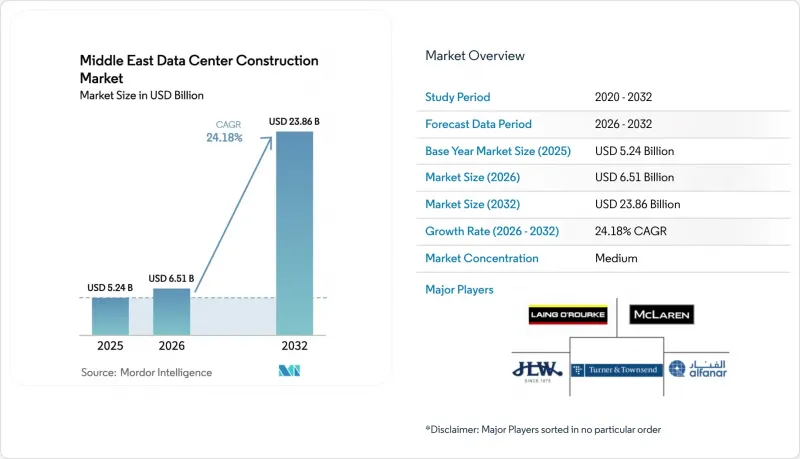
This report is Segmented by Infrastructure (Electrical Infrastructure, Mechanical Infrastructure, IT Infrastructure, and More), Tier Type (Tier I and Tier II, Tier III, Tier IV), Data Center Type (Colocation, Hyperscale/Self-built, and More), End-User Industry (BFSI, IT and Telecommunications, Government and Defense, and More), and Geography. The Market Forecasts are Provided in Terms of Value (USD).
Middle East Data Center Construction Market Trends and Insights
Hyperscale Cloud and AI Build-outs Accelerate Regional Infrastructure Transformation
OpenAI's partnership with G42 on the 5 GW "Stargate UAE" campus pushes rack power densities toward 80 kW and makes liquid cooling a baseline design. Microsoft's zero-water technologies further widen mechanical complexity in desert settings . These deployments raise electrical subsystem demand and anchor the Middle East data center construction market as a testbed for next-generation high-density designs.
Government Digital-Economy and Vision Programs Drive Sovereign Infrastructure Development
Saudi Arabia's draft Global AI Hub Law introduces data-embassy provisions favoring in-country build-outs . Parallel moves in the UAE and Oman embed local-content thresholds in procurement rules. The resulting predictable demand stream underwrites long-horizon capital spending and cements the Middle East data center construction market as the core platform for digital-government strategies.
Grid-Power Bottlenecks and Diesel Capex Inflation Constrain Rapid Deployment
Transmission upgrades trail demand, postponing energization by up to 18 months in Saudi growth corridors. Diesel backup systems cost 35-40% more than in 2024 due to steel and transport premiums . These factors slow near-term project starts inside the Middle East data center construction market.
Other drivers and restraints analyzed in the detailed report include:
- 5G-Edge Latency Requirements Spur Distributed Site Development
- Utility-Scale Solar and Nuclear PPAs Transform Energy Economics
- Cooling-Water Scarcity and Wastewater Fees Drive Innovation Requirements
For complete list of drivers and restraints, kindly check the Table Of Contents.
Segment Analysis
Electrical equipment revenue rose behind growing GPU clusters, and electrical subsystems are on pace for a 27.84% CAGR. Switchgear, PDUs, and UPS units capable of 40-80 kW per rack reshape room layouts and lift structural loads. The Middle East data center construction market size for electrical systems is projected to reach USD 6.72 billion by 2032. Integration of liquid cooling pumps raises facility electrical consumption by 15-25%, blurring boundaries between mechanical and electrical trades. Service providers therefore bundle design, integration, and renewable-energy consulting into turnkey offers, deepening specialization inside the Middle East data center construction market.
Mechanical systems still absorb the largest spend because desert locations demand robust cooling. Rapid adoption of rear-door heat exchangers and direct-to-chip loops keeps mechanical share at 37.55% in 2025. Project designs now allocate extra white-space height for manifold routing and heavier chillers, increasing civil costs. Electrical and mechanical coordination thus defines project critical path and shapes competitive positioning throughout the Middle East data center construction market.
Tier III accounted for a 53.65% stake in 2025 by balancing 99.982% uptime with cost control. Banking and public-sector clients, however, push Tier IV uptake to a 21.72% CAGR to 2032 as they adopt active-active architectures. Tier IV's higher sealing and dual-bus electrical schemes uplift capex by 25-30% yet unlock premium pricing. The Middle East data center construction market share for Tier IV is poised to hit 17.45% by 2032 as regulatory and fintech workloads climb.
Edge deployments generally favor Tier II shells to speed roll-out. Modular vendors certify components in-factory, cutting site work by half and enabling 12-week go-live cycles. Uptime Institute certificates remain a procurement prerequisite, compelling smaller builders to partner with global assessors. Certification backlogs, however, accentuate the regional skills deficit and slow some Tier III upgrades inside the Middle East data center construction market.
Complete Report Scope:
- By Infrastructure
- Electrical Infrastructure
- Power Distribution Solutions
- Power Distribution Units
- Switchgears
- Others
- Power Backup Solutions
- UPS
- Generators
- Power Distribution Solutions
- Mechanical Infrastructure
- Cooling Systems
- Liquid-based Cooling
- Air-based Cooling
- Racks and Cabinets
- Other Mechanical Infrastructure
- Cooling Systems
- IT Infrastructure
- Servers
- Storage
- Other IT Infrastructure
- General Construction
- Services (Design and Consulting, Integration, Support and Maintenance)
- Electrical Infrastructure
- By Tier Type
- Tier I and Tier II
- Tier III
- Tier IV
- By Data Center Type
- Colocation
- Hyperscale / Self-built
- Enterprise / Edge / Modular
- By End-User Industry
- Banking, Financial Services and Insurance
- IT and Telecommunications
- Government and Defense
- Healthcare
- Other End Users
- By Geography
- United Arab Emirates
- Saudi Arabia
- Qatar
- Kuwait
- Rest of Middle East
List of Companies Covered in this Report:
- Khazna Data Centers
- Center3 (stc)
- e& (formerly Etisalat)
- Gulf Data Hub
- DataVolt
- Agility Data Centers
- Equinix Inc.
- Digital Realty
- Moro Hub (DEWA)
- Oman Data Park
- Al Ghazala Data Center (Mobily)
- SAPTCO / Quantum Switch Tamasuk
- Huawei Digital Power
- Schneider Electric
- ABB Ltd.
- ALEC Engineering & Contracting
- Nesma & Partners
- Orascom Construction
- Larsen & Toubro ME
- China State Construction ME
- Trojan Group
- AtkinsRealis (SNC-Lavalin)
- Turner Construction International
- AECOM Middle East
Additional Benefits:
- The market estimate (ME) sheet in Excel format
- 3 months of analyst support
TABLE OF CONTENTS
1 INTRODUCTION
- 1.1 Study Assumptions and Market Definition
- 1.2 Scope of the Study
2 RESEARCH METHODOLOGY
3 EXECUTIVE SUMMARY
4 MARKET LANDSCAPE
- 4.1 Market Overview
- 4.2 Market Drivers
- 4.2.1 Hyperscale cloud and AI build-outs accelerate
- 4.2.2 Government digital-economy and Vision programmes
- 4.2.3 5G-edge latency requirements spur local sites
- 4.2.4 Utility-scale solar and nuclear PPAs cut OPEX
- 4.2.5 Sovereign-wealth capital enabling build-to-suit funding
- 4.2.6 Red Sea/Gulf cable landings slash inter-continental latency
- 4.3 Market Restraints
- 4.3.1 Grid-power bottlenecks and diesel capex inflation
- 4.3.2 Cooling-water scarcity and wastewater fees
- 4.3.3 Shortfall of Tier III/IV certified technicians
- 4.3.4 Local-content and data-sovereignty procurement hurdles
- 4.4 Value / Supply-Chain Analysis
- 4.5 Regulatory Landscape
- 4.6 Technological Outlook
5 MARKET SIZE and GROWTH FORECASTS (VALUE)
- 5.1 By Infrastructure
- 5.1.1 Electrical Infrastructure
- 5.1.1.1 Power Distribution Solutions
- 5.1.1.1.1 Power Distribution Units
- 5.1.1.1.2 Switchgears
- 5.1.1.1.3 Others
- 5.1.1.2 Power Backup Solutions
- 5.1.1.2.1 UPS
- 5.1.1.2.2 Generators
- 5.1.1.1 Power Distribution Solutions
- 5.1.2 Mechanical Infrastructure
- 5.1.2.1 Cooling Systems
- 5.1.2.1.1 Liquid-based Cooling
- 5.1.2.1.2 Air-based Cooling
- 5.1.2.2 Racks and Cabinets
- 5.1.2.3 Other Mechanical Infrastructure
- 5.1.2.1 Cooling Systems
- 5.1.3 IT Infrastructure
- 5.1.3.1 Servers
- 5.1.3.2 Storage
- 5.1.3.3 Other IT Infrastructure
- 5.1.4 General Construction
- 5.1.5 Services (Design and Consulting, Integration, Support and Maintenance)
- 5.1.1 Electrical Infrastructure
- 5.2 By Tier Type
- 5.2.1 Tier I and Tier II
- 5.2.2 Tier III
- 5.2.3 Tier IV
- 5.3 By Data Center Type
- 5.3.1 Colocation
- 5.3.2 Hyperscale / Self-built
- 5.3.3 Enterprise / Edge / Modular
- 5.4 By End-User Industry
- 5.4.1 Banking, Financial Services and Insurance
- 5.4.2 IT and Telecommunications
- 5.4.3 Government and Defense
- 5.4.4 Healthcare
- 5.4.5 Other End Users
- 5.5 By Geography
- 5.5.1 United Arab Emirates
- 5.5.2 Saudi Arabia
- 5.5.3 Qatar
- 5.5.4 Kuwait
- 5.5.5 Rest of Middle East
6 COMPETITIVE LANDSCAPE
- 6.1 Market Share Analysis
- 6.2 Company Profiles (includes Global-level Overview, Market-level Overview, Core Segments, Financials as available, Strategic Information, Market Rank/Share, Products and Services, Recent Developments)
- 6.2.1 Khazna Data Centers
- 6.2.2 Center3 (stc)
- 6.2.3 e& (formerly Etisalat)
- 6.2.4 Gulf Data Hub
- 6.2.5 DataVolt
- 6.2.6 Agility Data Centers
- 6.2.7 Equinix Inc.
- 6.2.8 Digital Realty
- 6.2.9 Moro Hub (DEWA)
- 6.2.10 Oman Data Park
- 6.2.11 Al Ghazala Data Center (Mobily)
- 6.2.12 SAPTCO / Quantum Switch Tamasuk
- 6.2.13 Huawei Digital Power
- 6.2.14 Schneider Electric
- 6.2.15 ABB Ltd.
- 6.2.16 ALEC Engineering & Contracting
- 6.2.17 Nesma & Partners
- 6.2.18 Orascom Construction
- 6.2.19 Larsen & Toubro ME
- 6.2.20 China State Construction ME
- 6.2.21 Trojan Group
- 6.2.22 AtkinsRealis (SNC-Lavalin)
- 6.2.23 Turner Construction International
- 6.2.24 AECOM Middle East
7 MARKET OPPORTUNITIES and FUTURE OUTLOOK
- 7.1 White-space and Unmet-Need Assessment

