PUBLISHER: Mordor Intelligence | PRODUCT CODE: 2125683

PUBLISHER: Mordor Intelligence | PRODUCT CODE: 2125683
Malaysia Data Center Construction - Market Share Analysis, Industry Trends & Statistics, Growth Forecasts (2026 - 2031)
According to Mordor Intelligence, the Malaysia data center construction market size reached USD 3.71 billion in 2026 and is projected to reach USD 7.74 billion by 2031, reflecting a robust 15.88% CAGR across the forecast horizon.
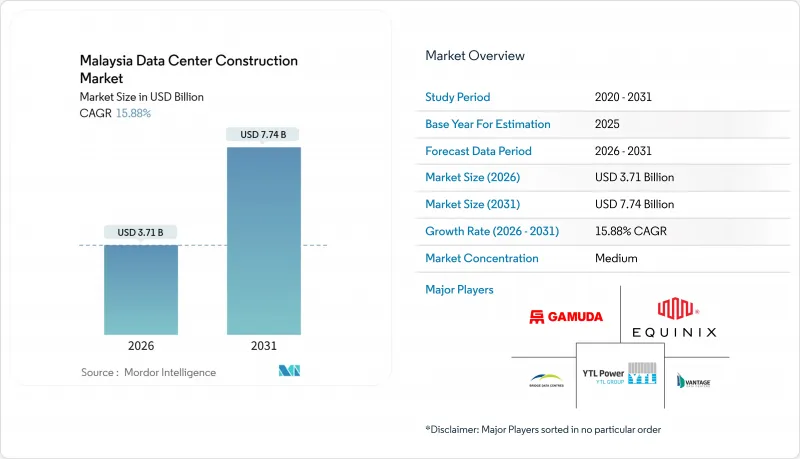
This report is Segmented by Tier Type (Tier 1 and 2, Tier 3, and Tier 4), Data Center Size (Small, Medium, Large, and Hyperscale), Data Center Type (Colocation Data Center, Hyperscalers/Cloud Service Provider, and Enterprise and Edge Data Center), and Infrastructure (Electrical Infrastructure, Mechanical Infrastructure, and More). The Market Forecasts are Provided in Terms of Value (USD).
Malaysia Data Center Construction Market Trends and Insights
Spill-Over Demand From Singapore Moratorium
Singapore's 2019 freeze on new permits pushed 200-300 megawatts of unmet hyperscale demand across the causeway, enabling operators in Johor to deliver sub-2-millisecond latency to Singapore at land prices 40-60% lower than across the Strait. Vantage Data Centers' USD 1.6 billion acquisition of a 300-megawatt campus in November 2025 and Bridge Data Centres' 400-megawatt grid agreement the previous year illustrate pre-positioning for continued overflow. Malaysia's Investment Development Authority recorded RM 20 billion in data-center FDI during 2024, a five-fold jump from 2022, confirming the structural re-allocation of regional capacity.
Hyperscale Cloud and AI Build-Outs
Microsoft committed USD 2.2 billion in May 2024 for multi-site campuses and workforce programs, while Google earmarked USD 2 billion for its first Malaysian cloud region in the same month. ByteDance followed with a RM 10 billion (USD 2.1 billion) AI hub anchored by Bridge Data Centres' MY06 site, signifying Malaysia's elevation to a primary availability zone. YTL Power's 500-megawatt Green DC Park integrates Nvidia GB200 NVL72 racks and on-site solar to achieve a 1.3 PUE, setting a regional benchmark for AI-optimized sustainability.
Grid Capacity and Peak Tariff Escalation
Tenaga Nasional Berhad lifted commercial tariffs 14% in July 2025 to finance substation upgrades, raising a 10-megawatt facility's annual electricity bill by roughly USD 200,000. Operators hedge exposure through 20-year solar PPAs under C-RESS; Vantage's 30-megawatt virtual PPA with ib vogt exemplifies this shift.
Other drivers and restraints analyzed in the detailed report include:
- Malaysia Digital Tax and Incentive Schemes
- Sub-Sea Cable Landings Elevating Connectivity
- Shortage of Certified Data-Center Technicians
For complete list of drivers and restraints, kindly check the Table Of Contents.
Segment Analysis
Tier 3 installations controlled 56.04% of 2025 revenue, yet Tier 4 capacity is forecast to post a 16.87% CAGR, outpacing all other classes. The Malaysia data center construction market size for Tier 4 projects is therefore projected to rise sharply as hyperscalers deploy concurrent-maintainable power and cooling chains. Equinix will add 2,225 cabinets with 2N electrical feeds at its JH2 campus in 2027.
Tier 1 and Tier 2 sites remain relevant for edge and disaster-recovery workloads, but the share of AI training and inference rose from under 10% to nearly 25% of new bookings between 2023 and 2025. NTT's Johor campus plans dual utility feeds and 72-hour fuel autonomy to meet business-continuity mandates. The pivot reflects end-user intolerance for even brief thermal or power excursions, pushing the Malaysia data center construction market toward higher-spec builds.
Large facilities held 55.46% share in 2025; nevertheless, hyperscale campuses, defined as single-site builds exceeding 100 megawatts, are poised to expand at a 16.34% CAGR. The Malaysia data center construction market share for hyperscale sites is thus set to grow as Vantage's 256-megawatt KUL2 and Bridge Data Centres' 400-megawatt electricity deal come online.
Campus models improve land acquisition, utility negotiation, and phased delivery. Vantage's 300-megawatt JHB1 enables multi-year tenant ramp-ups, while Bridge's MY07 reserves acreage for 200 additional megawatts. Medium and small facilities continue to support managed service providers and edge caching, but they capture a shrinking slice of the Malaysia data center construction market.
Complete Report Scope:
- By Tier Type
- Tier 1 and 2
- Tier 3
- Tier 4
- By Data Center Size
- Small
- Medium
- Large
- Hyperscale
- By Data Center Type
- Colocation Data Center
- Hyperscalers/Cloud Service Provider (CSPs)
- Enterprise and Edge Data Center
- By Infrastructure
- Electrical Infrastructure
- Power Distribution Solution
- Power Backup Solutions
- Mechanical Infrastructure
- Cooling Systems
- Racks and Cabinets
- Servers and Storage
- Other Mechanical Infrastructure
- General Construction
- Services - Design and Consulting, Integration, Support and Maintenance
- Electrical Infrastructure
List of Companies Covered in this Report:
- Aurecon Group Pty Ltd
- AECOM
- DSCO Group Pte Ltd
- Turner and Townsend Holdings Ltd
- Jacobs Engineering Group Inc.
- Gaw Capital Partners
- JLand Group Bhd
- Cyclect Group Pte Ltd
- Basis Bay Sdn Bhd
- Mah Sing Group Bhd
- Equinix Inc.
- Vantage Data Centers LLC
- Bridge Data Centres Malaysia Sdn Bhd
- YTL Power International Bhd (Green DC Park)
- Gamuda Bhd
- Telekom Malaysia Berhad
- Exabytes Capital Group Sdn Bhd
- GDS Holdings Ltd
- AIMS Data Centre (Time dotCom Bhd)
- Gamuda Engineering Sdn Bhd
Additional Benefits:
- The market estimate (ME) sheet in Excel format
- 3 months of analyst support
TABLE OF CONTENTS
1 INTRODUCTION
- 1.1 Study Assumptions and Market Definition
- 1.2 Scope of the Study
2 RESEARCH METHODOLOGY
3 EXECUTIVE SUMMARY
4 MARKET LANDSCAPE
- 4.1 Market Overview
- 4.2 Market Drivers
- 4.2.1 Spill-Over Demand From Singapore Moratorium
- 4.2.2 Malaysia Digital Tax and Incentive Schemes (MyDIGITAL, DTax)
- 4.2.3 Hyperscale Cloud and AI Build-Outs (Microsoft, Google, AWS)
- 4.2.4 Affordable Land and Power in Johor and Cyberjaya
- 4.2.5 Corporate Renewable Energy Supply Scheme (C-RESS) Enabling 20-Yr Green PPAs
- 4.2.6 Sub-Sea Cable Landings (MIST, Apricot, Bifrost) Elevating Connectivity
- 4.3 Market Restraints
- 4.3.1 Grid Capacity and Peak Tariff Escalation
- 4.3.2 Shortage of Certified Data-Center Technicians
- 4.3.3 Fragmented Multi-Tier Land-Use Approvals Causing Delays
- 4.3.4 Rising Water-Stress Risk in Johor Cooling Corridor
- 4.4 Industry Supply-Chain Analysis
- 4.5 Regulatory Landscape
- 4.6 Technological Outlook
- 4.7 Porter's Five Forces Analysis
- 4.7.1 Bargaining Power of Suppliers
- 4.7.2 Bargaining Power of Consumers
- 4.7.3 Threat of New Entrants
- 4.7.4 Threat of Substitutes
- 4.7.5 Intensity of Competitive Rivalry
- 4.8 Key Data Center Statistics
- 4.8.1 Exhaustive Data Center Operators in Malaysia (in MW)
- 4.8.2 List of Major Upcoming Data Center Projects in Malaysia (2025-2030)
- 4.8.3 CAPEX and OPEX For Malaysia Data Center Construction
- 4.8.4 Data Center Power Capacity Absorption In MW, Malaysia, 2023 and 2024
- 4.9 Artificial Intelligence (AI) Inclusion in Data Center Construction in Malaysia
- 4.10 Regulatory and Compliance Framework
- 4.11 Impact of Macroeconomic Factors on the Market
5 MARKET SIZE AND GROWTH FORECASTS (VALUE)
- 5.1 By Tier Type
- 5.1.1 Tier 1 and 2
- 5.1.2 Tier 3
- 5.1.3 Tier 4
- 5.2 By Data Center Size
- 5.2.1 Small
- 5.2.2 Medium
- 5.2.3 Large
- 5.2.4 Hyperscale
- 5.3 By Data Center Type
- 5.3.1 Colocation Data Center
- 5.3.2 Hyperscalers/Cloud Service Provider (CSPs)
- 5.3.3 Enterprise and Edge Data Center
- 5.4 By Infrastructure
- 5.4.1 Electrical Infrastructure
- 5.4.1.1 Power Distribution Solution
- 5.4.1.2 Power Backup Solutions
- 5.4.2 Mechanical Infrastructure
- 5.4.2.1 Cooling Systems
- 5.4.2.2 Racks and Cabinets
- 5.4.2.3 Servers and Storage
- 5.4.2.4 Other Mechanical Infrastructure
- 5.4.3 General Construction
- 5.4.4 Services - Design and Consulting, Integration, Support and Maintenance
- 5.4.1 Electrical Infrastructure
6 COMPETITIVE LANDSCAPE
- 6.1 Market Concentration
- 6.2 Strategic Moves
- 6.3 Market Share Analysis
- 6.4 Data Center Infrastructure Investment Based on Megawatt (MW) Capacity, 2024 vs 2030
- 6.5 Data Center Construction Landscape (Key Vendors Listings)
- 6.6 Company Profiles (includes Global Level Overview, Market Level Overview, Core Segments, Financials as Available, Strategic Information, Market Rank/Share for Key Companies, Products and Services, Recent Developments)
- 6.6.1 Aurecon Group Pty Ltd
- 6.6.2 AECOM
- 6.6.3 DSCO Group Pte Ltd
- 6.6.4 Turner and Townsend Holdings Ltd
- 6.6.5 Jacobs Engineering Group Inc.
- 6.6.6 Gaw Capital Partners
- 6.6.7 JLand Group Bhd
- 6.6.8 Cyclect Group Pte Ltd
- 6.6.9 Basis Bay Sdn Bhd
- 6.6.10 Mah Sing Group Bhd
- 6.6.11 Equinix Inc.
- 6.6.12 Vantage Data Centers LLC
- 6.6.13 Bridge Data Centres Malaysia Sdn Bhd
- 6.6.14 YTL Power International Bhd (Green DC Park)
- 6.6.15 Gamuda Bhd
- 6.6.16 Telekom Malaysia Berhad
- 6.6.17 Exabytes Capital Group Sdn Bhd
- 6.6.18 GDS Holdings Ltd
- 6.6.19 AIMS Data Centre (Time dotCom Bhd)
- 6.6.20 Gamuda Engineering Sdn Bhd
- 6.7 List of Data Center Construction Companies
7 MARKET OPPORTUNITIES AND FUTURE OUTLOOK
- 7.1 White-Space and Unmet-Need Assessment

