PUBLISHER: Mordor Intelligence | PRODUCT CODE: 2119874

PUBLISHER: Mordor Intelligence | PRODUCT CODE: 2119874
United States Data Center Networking - Market Share Analysis, Industry Trends & Statistics, Growth Forecasts (2026 - 2031)
According to Mordor Intelligence, the United States data center networking market size is expected to grow from USD 8.18 billion in 2025 to USD 8.52 billion in 2026 and is forecast to reach USD 10.43 billion by 2031 at 4.14% CAGR over 2026-2031.
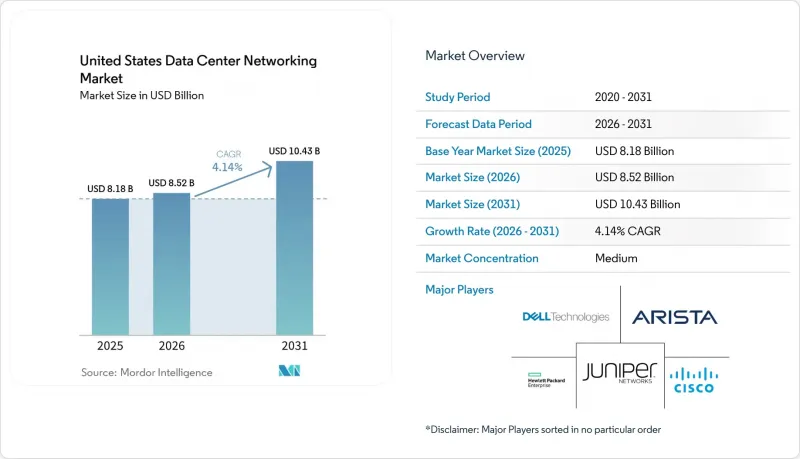
This report is Segmented by Component (Product, and Services), End User (IT and Telecommunications, Banking, Financial Services and Insurance (BFSI), Government and Defense, and More), Data Center Type (Colocation, Hyperscalers/Cloud Service Providers, and Edge/Micro Data Centers), Bandwidth (<=10 GbE, 25-40 GbE, and More). The Market Forecasts are Provided in Terms of Value (USD).
United States Data Center Networking Market Trends and Insights
Surge in Hyperscale and AI-driven Bandwidth Demand
Hyperscale operators are rebuilding networks to serve AI workloads that move 10-100 times more data than legacy applications. Meta's adoption of Arista 7700R4 platforms for training clusters highlights the spread of non-blocking, terabit-scale east-west fabrics that reduce latency for distributed GPUs. Microsoft's USD 80 billion AI build-out and AWS's USD 30 billion expansion reinforce the steep equipment pull for AI-specific switches, optics, and NICs. Custom silicon from NVIDIA and AMD underlines operators' desire to bypass general-purpose devices in favor of tightly integrated 800G parts.
Migration to 400G/800G Ethernet Fabrics
The jump to 400G and 800G is the largest step since 10 GbE, driven by GPU clusters that saturate 100G links. Broadcom's Tomahawk 6 supports 1.6 Tb/s ports, anticipating future headroom. The Ultra Ethernet Consortium ratified UEC 1.0 in June 2025, adding packet-spraying and in-network compute specifically for AI traffic. Rollouts face 18-month lead times for 800G optics, constraining some hyperscale buildouts until production ramps in 2026.
Optical Transceiver and ASIC Supply Bottlenecks
Lead times on 800G modules have stretched to 18 months as manufacturers prioritize AI-grade optics with ultra-low jitter. Lumentum shifted its roadmap to serve this niche, demonstrating the squeeze on conventional transceiver lines. Tariff impacts added 8-20% to equipment costs, prompting some enterprises to defer upgrades and sweat 100G assets longer than planned.
Other drivers and restraints analyzed in the detailed report include:
- Expansion of Edge and 5G Micro-data-centers
- State Energy-efficiency Incentives for Smart Fabrics
- High Capex for Legacy 10/40 G above 400 G Upgrades
For complete list of drivers and restraints, kindly check the Table Of Contents.
Segment Analysis
Products continued to hold 77.60% of 2025 revenue as hyperscalers bought thousands of fixed-form-factor switches. Ethernet switches remained the anchor category, while software-defined controllers gained favor for policy automation. Storage-area networking equipment lost momentum as disaggregated architectures separated compute and storage across high-speed optics. Network security appliances regained focus because zero-trust designs require pervasive segmentation.
The services slice is climbing at a 4.32% CAGR as clients seek design, integration, and managed support for multi-vendor 400G/800G fabrics. Installation teams coordinate timing-sensitive optics, while managed services offset scarce in-house automation skills. Training and consulting firms address a widening talent gap around AI-specific network tuning. The United States data center networking market increasingly rewards providers that bundle hardware, optics, and expertise under outcome-based contracts.
IT-telecom operators retained a 34.15% share in 2025, anchored by early 5G core deployments and public-cloud backbone refreshes. Financial institutions followed, upgrading latency paths for algorithmic trading. Manufacturing, however, is posting a 5.08% CAGR as Industry 4.0 plants retrofit with real-time analytics and robotic lines. Automotive giants are installing deterministic fabrics that blend industrial protocols with enterprise traffic.
Government and defense agencies are modernizing classified networks to enable secure AI model training. Healthcare providers expand bandwidth for diagnostic imaging and electronic records. Media firms push 4K/8K pipelines that need burst capacity and jitter control. The United States data center networking market is therefore becoming a patchwork of vertical use cases rather than a monolithic telecom-led domain.
Complete Report Scope:
- By Component
- Products
- Ethernet Switches
- Routers
- Storage Area Network (SAN)
- Application Delivery Controllers (ADC)
- Network Security Appliances
- Software-Defined Networking (SDN) Controllers
- Optical Interconnects
- Services
- Installation and Integration
- Training and Consulting
- Support and Maintenance
- Managed Network Services
- Products
- By End-User
- IT and Telecommunications
- Banking, Financial Services and Insurance (BFSI)
- Government and Defense
- Media and Entertainment
- Healthcare and Life Sciences
- Manufacturing and Industrial
- Other End-Users
- By Data-Center Type
- Colocation
- Hyperscalers/Cloud Service Providers
- Edge/Micro Data Centers
- By Bandwidth
- Less Than or Equal to 10 GbE
- 25-40 GbE
- 50-100 GbE
- Greater Than 100 GbE
List of Companies Covered in this Report:
- Cisco Systems, Inc.
- Arista Networks, Inc.
- Juniper Networks, Inc.
- Dell Technologies, Inc.
- Hewlett Packard Enterprise (HPE)
- NVIDIA Corp. (Mellanox and Cumulus)
- Intel Corporation
- Broadcom Inc.
- Extreme Networks, Inc.
- Microsoft (SONiC Open-Source)
- VMware by Broadcom
- Huawei Technologies Co., Ltd.
- IBM Corporation
- Schneider Electric SE
- Eaton Corporation plc
- Emerson Electric Co.
- NetApp, Inc.
- Super Micro Computer, Inc.
- Nvidia Networking (Infiniband)
- Equinix, Inc. (Interconnection)
- Digital Realty Trust, Inc.
- Panduit Corp.
- CommScope Holding Co., Inc.
Additional Benefits:
- The market estimate (ME) sheet in Excel format
- 3 months of analyst support
TABLE OF CONTENTS
1 INTRODUCTION
- 1.1 Study Assumptions and Market Definition
- 1.2 Scope of the Study
2 RESEARCH METHODOLOGY
3 EXECUTIVE SUMMARY
4 MARKET LANDSCAPE
- 4.1 Market Overview
- 4.2 Market Drivers
- 4.2.1 Surge in hyperscale and AI-driven bandwidth demand
- 4.2.2 Migration to 400G/800G Ethernet fabrics
- 4.2.3 Expansion of edge and 5G micro-data-centers
- 4.2.4 State energy-efficiency incentives for smart fabrics
- 4.2.5 Adoption of CXL-enabled disaggregated architectures
- 4.2.6 Zero-trust push driving fabric-level micro-segmentation
- 4.3 Market Restraints
- 4.3.1 Optical transceiver and ASIC supply bottlenecks
- 4.3.2 High capex for legacy 10/40 G above 400 G upgrades
- 4.3.3 Rising water-usage limits curbing hyperscale expansion
- 4.3.4 Scarcity of automation-skilled network engineers
- 4.4 Supply-Chain Analysis
- 4.5 Regulatory Landscape
- 4.6 Technological Outlook
- 4.7 Porter's Five Forces Analysis
- 4.7.1 Threat of New Entrants
- 4.7.2 Bargaining Power of Buyers
- 4.7.3 Bargaining Power of Suppliers
- 4.7.4 Threat of Substitutes
- 4.7.5 Intensity of Competitive Rivalry
- 4.8 Assesment of Macroeconomic Factors on the Market
5 MARKET SIZE AND GROWTH FORECASTS (VALUE)
- 5.1 By Component
- 5.1.1 Products
- 5.1.1.1 Ethernet Switches
- 5.1.1.2 Routers
- 5.1.1.3 Storage Area Network (SAN)
- 5.1.1.4 Application Delivery Controllers (ADC)
- 5.1.1.5 Network Security Appliances
- 5.1.1.6 Software-Defined Networking (SDN) Controllers
- 5.1.1.7 Optical Interconnects
- 5.1.2 Services
- 5.1.2.1 Installation and Integration
- 5.1.2.2 Training and Consulting
- 5.1.2.3 Support and Maintenance
- 5.1.2.4 Managed Network Services
- 5.1.1 Products
- 5.2 By End-User
- 5.2.1 IT and Telecommunications
- 5.2.2 Banking, Financial Services and Insurance (BFSI)
- 5.2.3 Government and Defense
- 5.2.4 Media and Entertainment
- 5.2.5 Healthcare and Life Sciences
- 5.2.6 Manufacturing and Industrial
- 5.2.7 Other End-Users
- 5.3 By Data-Center Type
- 5.3.1 Colocation
- 5.3.2 Hyperscalers/Cloud Service Providers
- 5.3.3 Edge/Micro Data Centers
- 5.4 By Bandwidth
- 5.4.1 Less Than or Equal to 10 GbE
- 5.4.2 25-40 GbE
- 5.4.3 50-100 GbE
- 5.4.4 Greater Than 100 GbE
6 COMPETITIVE LANDSCAPE
- 6.1 Market Concentration
- 6.2 Strategic Moves
- 6.3 Market Share Analysis
- 6.4 Company Profiles (includes Global level Overview, Market level overview, Core Segments, Financials as available, Strategic Information, Market Rank/Share for key companies, Products and Services, and Recent Developments)
- 6.4.1 Cisco Systems, Inc.
- 6.4.2 Arista Networks, Inc.
- 6.4.3 Juniper Networks, Inc.
- 6.4.4 Dell Technologies, Inc.
- 6.4.5 Hewlett Packard Enterprise (HPE)
- 6.4.6 NVIDIA Corp. (Mellanox and Cumulus)
- 6.4.7 Intel Corporation
- 6.4.8 Broadcom Inc.
- 6.4.9 Extreme Networks, Inc.
- 6.4.10 Microsoft (SONiC Open-Source)
- 6.4.11 VMware by Broadcom
- 6.4.12 Huawei Technologies Co., Ltd.
- 6.4.13 IBM Corporation
- 6.4.14 Schneider Electric SE
- 6.4.15 Eaton Corporation plc
- 6.4.16 Emerson Electric Co.
- 6.4.17 NetApp, Inc.
- 6.4.18 Super Micro Computer, Inc.
- 6.4.19 Nvidia Networking (Infiniband)
- 6.4.20 Equinix, Inc. (Interconnection)
- 6.4.21 Digital Realty Trust, Inc.
- 6.4.22 Panduit Corp.
- 6.4.23 CommScope Holding Co., Inc.
7 MARKET OPPORTUNITIES AND FUTURE OUTLOOK
- 7.1 White-space and Unmet-Need Assessment

