PUBLISHER: Mordor Intelligence | PRODUCT CODE: 2119877

PUBLISHER: Mordor Intelligence | PRODUCT CODE: 2119877
India Data Center Networking - Market Share Analysis, Industry Trends & Statistics, Growth Forecasts (2026 - 2031)
According to Mordor Intelligence, the India data center networking market size was valued at USD 1.36 billion in 2025 and is estimated to grow from USD 1.59 billion in 2026 to reach USD 3.45 billion by 2031, at a CAGR of 16.78% during the forecast period (2026-2031).
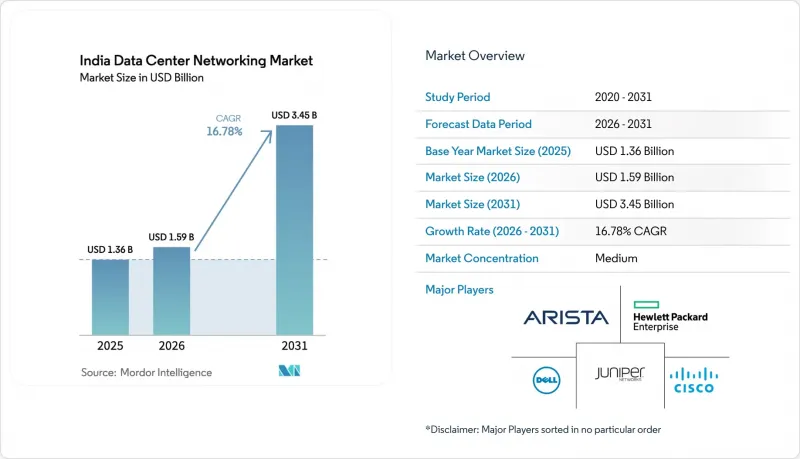
This report Segments the Industry Into Components (By Product, by Services), End-Users (IT and Telecommunication, BFSI, Other End-Users). Data-Center Type(Colocation, Hyperscalers/Cloud Service Providers, and More), and Bandwidth (<=10 GbE, 25-40 GbE, and More). The Market Forecasts are Provided in Terms of Value (USD).
India Data Center Networking Market Trends and Insights
Accelerated hyperscale campus build-outs by domestic conglomerates
Indian conglomerates have earmarked multibillion-dollar capital outlays to deploy nationwide hyperscale grids, alleviating land-scarcity pressures in crowded metros by distributing capacity across emerging tier-2 and tier-3 cities. Adani ConneX's pledge to install 10 GW of IT load and ST Telemedia Global Data Centres' plan to add 550 MW underline a supply pipeline that far exceeds historical norms. These campuses require ultra-dense leaf-spine fabrics, software-defined overlays, and campus-to-edge optical backbones capable of line-rate encryption. Operators also demand transparent telemetry for power and cooling because regional grids experience wider voltage swings. Vendors able to bundle switching, optics, and intent-based automation, therefore, gain a strategic edge in this phase of the India data center networking market.
Mandatory data-localization under Digital Personal Data Protection Act 2023
The Act enforces in-country processing for sensitive personal data, forcing multinational cloud and SaaS providers to replicate complete workloads inside India. The localisation rule drives a sharp uptick in intra-India east-west traffic as enterprises migrate from cross-border links to domestic availability zones, reinforcing growth momentum across the wider data center market in India. Latency ceilings tighten because workloads that formerly traversed submarine cables now stay within sovereign borders, requiring city-level interconnects and high-throughput encryption. In financial services and healthcare, regulators also mandate in-flight encryption across campus fabrics, spurring demand for MACsec-enabled switches and zero-trust segmentation engines.
Chronic power-supply deficits in tier-2 DC clusters
Frequent voltage fluctuations and multi-hour brownouts in second-tier cities compel operators to over-provision diesel generation and energy-storage systems, adding as much as 22% to capex per MW. High-speed optics and AI-optimized switches push rack power density above 20 kW, making battery runtime and transformer sizing critical. Although the National Broadband Mission earmarks USD 100 billion for grid upgrades, execution schedules stretch beyond the 2030 horizon, perpetuating risk for investors. Consequently, some hyperscalers adopt modular microgrid architectures with solar PV, but energy-yield variability complicates network capacity planning.
Other drivers and restraints analyzed in the detailed report include:
- Rapid 400 GbE / 800 GbE migration timelines in Indian cloud PoPs
- Low-latency edge nodes for 5G and ONDC commerce traffic
- Scarcity of CCIE/JNCIE-level talent outside top metros
For complete list of drivers and restraints, kindly check the Table Of Contents.
Segment Analysis
Products contributed USD 985.32 million in revenue during 2025, equal to 72.45% of total spend, underpinned by large orders for 400 GbE-capable leaf and spine switches. The India data center networking market size for Services reached USD 374.68 million and is projected to expand 20.7% CAGR through 2031 as enterprises outsource integration, testing, and lifecycle management. Installation and integration workstreams represent over half of Services revenue because AI-ready fabrics require precision timing and lossless queue tuning. Managed network services appeal to mid-market cloud providers that lack in-house Layer-3/Layer-4 expertise. Cisco's co-innovation with NVIDIA on end-to-end AI fabrics exemplifies a hardware-plus-services model that compresses deployment timelines.
Product vendors are simultaneously embedding telemetry agents to ease predictive maintenance, thereby blurring hardware-software boundaries. Field-replaceable optics produced locally under PLI subsidies shorten spares logistics, a decisive advantage in power-constrained tier-2 sites. Over the forecast period, professional services linked to zero-trust segmentation and intent-based orchestration will outpace traditional break-fix contracts.
IT & Telecommunications retained 36.02% share in 2025 as 5G backhaul upgrades and cloud availability-zone rollouts consumed high-capacity switches. Manufacturing, however, is set to log a 19.6% CAGR, propelled by Industry 4.0 data lakes, digital twins, and PLI incentives for electronics assembly. Automotive and semiconductor fabs now deploy deterministic Ethernet rings inside plants, driving fresh demand for low-latency aggregation switches. Banking and Financial Services continue steady upgrades to meet data-sovereignty guidelines, while Healthcare accelerates adoption of tele-ICU and robotic surgery workflows requiring encrypted 400 GbE uplinks. The diversity of use cases reduces concentration risk within the India data center networking market and spurs vendors to offer vertical-specific templates.
Complete Report Scope:
- By Component
- Products
- Ethernet Switches
- Routers
- Storage Area Network (SAN)
- Application Delivery Controllers (ADC)
- Network Security Appliances
- Software-Defined Networking (SDN) Controllers
- Optical Interconnects
- Services
- Installation and Integration
- Training and Consulting
- Support and Maintenance
- Managed Network Services
- Products
- By End-User
- IT and Telecommunications
- Banking, Financial Services and Insurance (BFSI)
- Government and Defense
- Media and Entertainment
- Healthcare and Life Sciences
- Manufacturing and Industrial
- Other End-Users
- By Data-Center Type
- Colocation
- Hyperscalers/Cloud Service Providers
- Edge/Micro Data Centers
- By Bandwidth
- Less Than equals to 10 GbE
- 25-40 GbE
- 50-100 GbE
- Greater Than 100 GbE
List of Companies Covered in this Report:
- Cisco Systems Inc.
- VMware Inc.
- NVIDIA Corporation
- Dell Technologies Inc.
- NEC Corporation
- International Business Machines Corporation
- HP Enterprise Company LP
- Schneider Electric SE
- Fujitsu Limited
- Keysight Technologies Inc.
- Arista Networks Inc.
- Juniper Networks Inc.
- Broadcom Inc. (incl. Brocade)
- Extreme Networks Inc.
- Huawei Technologies Co. Ltd.
- Lenovo Group Ltd.
- NetApp Inc.
- CommScope Holding Co. Inc.
- AdaniConneX Pvt. Ltd.
- Sify Technologies Ltd.
Additional Benefits:
- The market estimate (ME) sheet in Excel format
- 3 months of analyst support
TABLE OF CONTENTS
1 INTRODUCTION
- 1.1 Study Assumptions and Market Definition
- 1.2 Scope of the Study
2 RESEARCH METHODOLOGY
3 EXECUTIVE SUMMARY
4 MARKET LANDSCAPE
- 4.1 Market Overview
- 4.2 Market Drivers
- 4.2.1 Accelerated hyperscale campus build-outs by domestic conglomerates (Adani, Reliance, STT)
- 4.2.2 Mandatory data-localisation under the Digital Personal Data Protection Act 2023
- 4.2.3 Rapid 400 GbE / 800 GbE migration timelines in Indian cloud PoPs
- 4.2.4 Low-latency edge nodes for 5G and ONDC commerce traffic
- 4.2.5 PLI-linked local manufacturing of optical and switching gear
- 4.2.6 AI-optimised fabrics for Gen-AI model training clusters
- 4.3 Market Restraints
- 4.3.1 Chronic power-supply deficits in tier-2 DC clusters
- 4.3.2 Long-cycle MoEF clearances for large DC campuses
- 4.3.3 Scarcity of CCIE / JNCIE-level talent outside top metros
- 4.3.4 Heightened capex due to rupee depreciation on imported optics
- 4.4 Industry Value Chain Analysis
- 4.5 Regulatory Landscape
- 4.6 Technological Outlook
- 4.7 Porter's Five Forces
- 4.7.1 Threat of New Entrants
- 4.7.2 Bargaining Power of Buyers
- 4.7.3 Bargaining Power of Suppliers
- 4.7.4 Threat of Substitutes
- 4.7.5 Intensity of Competitive Rivalry
- 4.8 Assessment of the Impact on Macro Economic Trends on the Market
5 MARKET SIZE AND GROWTH FORECASTS (VALUE)
- 5.1 By Component
- 5.1.1 Products
- 5.1.1.1 Ethernet Switches
- 5.1.1.2 Routers
- 5.1.1.3 Storage Area Network (SAN)
- 5.1.1.4 Application Delivery Controllers (ADC)
- 5.1.1.5 Network Security Appliances
- 5.1.1.6 Software-Defined Networking (SDN) Controllers
- 5.1.1.7 Optical Interconnects
- 5.1.2 Services
- 5.1.2.1 Installation and Integration
- 5.1.2.2 Training and Consulting
- 5.1.2.3 Support and Maintenance
- 5.1.2.4 Managed Network Services
- 5.1.1 Products
- 5.2 By End-User
- 5.2.1 IT and Telecommunications
- 5.2.2 Banking, Financial Services and Insurance (BFSI)
- 5.2.3 Government and Defense
- 5.2.4 Media and Entertainment
- 5.2.5 Healthcare and Life Sciences
- 5.2.6 Manufacturing and Industrial
- 5.2.7 Other End-Users
- 5.3 By Data-Center Type
- 5.3.1 Colocation
- 5.3.2 Hyperscalers/Cloud Service Providers
- 5.3.3 Edge/Micro Data Centers
- 5.4 By Bandwidth
- 5.4.1 Less Than equals to 10 GbE
- 5.4.2 25-40 GbE
- 5.4.3 50-100 GbE
- 5.4.4 Greater Than 100 GbE
6 COMPETITIVE LANDSCAPE
- 6.1 Market Concentration
- 6.2 Strategic Moves
- 6.3 Market Share Analysis
- 6.4 Company Profiles (includes Global level Overview, Market level overview, Core Segments, Financials as available, Strategic Information, Market Rank/Share for key companies, Products and Services, and Recent Developments)
- 6.4.1 Cisco Systems Inc.
- 6.4.2 VMware Inc.
- 6.4.3 NVIDIA Corporation
- 6.4.4 Dell Technologies Inc.
- 6.4.5 NEC Corporation
- 6.4.6 International Business Machines Corporation
- 6.4.7 HP Enterprise Company LP
- 6.4.8 Schneider Electric SE
- 6.4.9 Fujitsu Limited
- 6.4.10 Keysight Technologies Inc.
- 6.4.11 Arista Networks Inc.
- 6.4.12 Juniper Networks Inc.
- 6.4.13 Broadcom Inc. (incl. Brocade)
- 6.4.14 Extreme Networks Inc.
- 6.4.15 Huawei Technologies Co. Ltd.
- 6.4.16 Lenovo Group Ltd.
- 6.4.17 NetApp Inc.
- 6.4.18 CommScope Holding Co. Inc.
- 6.4.19 AdaniConneX Pvt. Ltd.
- 6.4.20 Sify Technologies Ltd.
7 MARKET OPPORTUNITIES AND FUTURE OUTLOOK
- 7.1 White-space and Unmet-Need Assessment

