PUBLISHER: Mordor Intelligence | PRODUCT CODE: 2120516

PUBLISHER: Mordor Intelligence | PRODUCT CODE: 2120516
Europe Pharmaceutical Packaging - Market Share Analysis, Industry Trends & Statistics, Growth Forecasts (2026 - 2031)
According to Mordor Intelligence, the Europe pharmaceutical packaging market size was valued at USD 43.99 billion in 2025 and estimated to grow from USD 46.46 billion in 2026 to reach USD 61.02 billion by 2031, at a CAGR of 5.61% during the forecast period (2026-2031).
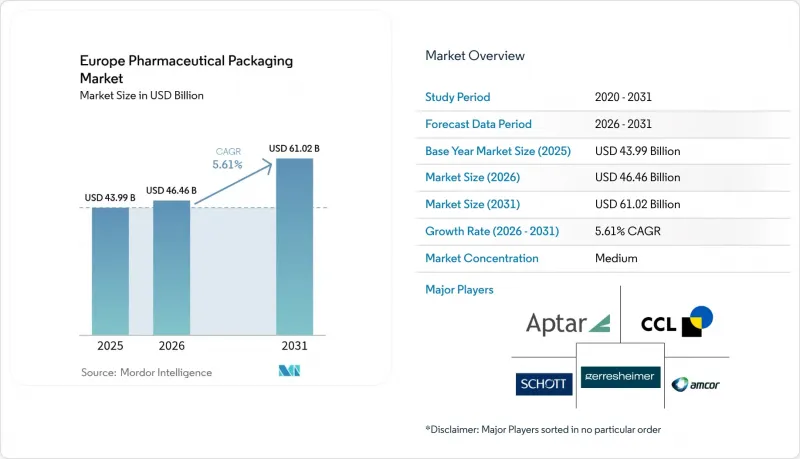
This report is Segmented by Material Type (Plastic, Glass, Metal/Foil, and More), Packaging Type (Primary Packaging, Secondary Packaging, Tertiary Packaging), Technology (Conventional, Aseptic and Sterile, and More), End User (Pharmaceutical Manufacturers, Specialty/Biotech Firms, Hospitals and Clinics, and More), and Country. The Market Forecasts are Provided in Terms of Value (USD).
Europe Pharmaceutical Packaging Market Trends and Insights
Growth of Biologics and Injectable Therapies
Biologics accounted for more than 30% of new molecular entities approved by the European Medicines Agency in 2024, elevating demand for parenteral containers with low extractables and tight dimensional tolerances. SCHOTT Pharma reported EUR 2.095 billion (USD 2.30 billion) in fiscal 2024 revenue, 78% of which came from drug containment solutions, including Type I borosilicate vials and cyclic olefin polymer cartridges. West Pharmaceutical Services derived USD 1.98 billion from proprietary components, including NovaPure stoppers and Daikyo Crystal Zenith syringes in the nine months to September 2024. Stevanato Group grew its first-half 2024 revenue 11.6% year over year, driven by EZ-fill vials and the Nexa autoinjector platform. A September 2024 alliance among Gerresheimer, Stevanato, and SCHOTT Pharma is expected to harmonize ready-to-fill specifications, potentially reducing qualification timelines for biosimilars, particularly in Poland and Italy, where contract manufacturing growth is strongest.
Stringent EU Serialization Mandates
The Falsified Medicines Directive requires every prescription pack distributed in the European Union to carry a unique identifier and a tamper-evident device, generating a EUR 1.2 billion aftermarket for serialized labels, 2D barcodes, and NFC-equipped cartons through 2026. Schreiner MediPharm has expanded its NFC label portfolio to support authentication and patient engagement use cases. CCL Industries reported CAD 5.1 billion (USD 3.75 billion) revenue for the first nine months of 2024, with healthcare and specialty labels benefiting from aggregation upgrades. The United Kingdom has mirrored EU serialization rules post-Brexit, compelling label converters to deliver interoperable solutions for pan-European supply chains.
Volatility in Pharmaceutical-Grade Raw Material Prices
Borosilicate glass tubing and cyclic olefin copolymer resins climbed 18-22% in 2024 as European energy costs surged. Continuous glass furnaces require an operating temperature of 1,500 °C, anchoring producers to natural-gas inputs that remain vulnerable to geopolitical shocks. West Pharmaceutical Services now secures its supply with multi-year resin contracts to protect Daikyo Crystal Zenith components from spot-price fluctuations. Elevated input costs have accelerated material-substitution studies involving cyclic olefin polymer and polyethylene terephthalate glycol; however, these alternatives require extensive stability data before EMA approval.
Other drivers and restraints analyzed in the detailed report include:
- Adoption of NFC-Enabled Smart Labels for Anti-Counterfeiting
- Expansion of Temperature-Controlled Mail-Order Pharmacies
- Capacity Bottlenecks for Pharma-Grade Molded Glass Vials
For complete list of drivers and restraints, kindly check the Table Of Contents.
Segment Analysis
Plastics dominated the Europe pharmaceutical packaging market with a 52.03% share in 2025, led by polyethylene terephthalate bottles and polypropylene blister films. Glass remained second in value, owing to Type I borosilicate vials and cartridges, a segment fortified by EUR 1.5 billion (USD 1.65 billion) in furnace investments from Gerresheimer, Schott Pharma, and SGD Pharma between 2023 and 2027. Biopolymers and composite materials are projected to grow at a 6.86% CAGR, driven by brand owners seeking to meet PPWR recycled-content requirements without compromising barrier properties. Amcor and Nolato are qualifying polylactic and polyhydroxyalkanoate resins for non-contact layers that still meet the ISO 15378 process validation thresholds.
Regulatory hurdles slow the uptake of biopolymers in primary containers, yet converters with scale can amortize validation costs, creating a two-tier supplier landscape. As PPWR enforcement tightens after 2028, growth in plastics for oral-solid dosage formats will moderate, while Glass and cyclic olefin polymers will retain their premium status in high-value biologics.
Primary formats are expected to account for 62.10% of the Europe pharmaceutical packaging market size in 2025 and are projected to rise at a 6.58% CAGR through 2031. Bottles for tablets remain the largest sub-segment, but their growth lags as injectables and inhalables gain share. Pre-fillable syringes and cartridges underpin West Pharmaceutical Services' USD 1.98 billion proprietary-components revenue, highlighting the margin leverage embedded in drug-delivery systems. Vials and ampules face intermittent supply constraints despite the introduction of new capacity in Hungary and Serbia.
Secondary packaging, which accounts for 30-35% of spending, grows in tandem with serialization and NFC adoption, as evidenced by CCL Industries' healthcare-label revenue uptick. Tertiary corrugated packs hold the balance, aided by e-commerce distribution for chronic-disease therapies. The underlying shift concentrates value creation in primary packs where regulatory moats and technical complexity remain highest.
Complete Report Scope:
- By Material Type
- Plastic
- Glass
- Paper and Paperboard
- Metal/Foil
- Biopolymers and Composite Materials
- By Packaging Type
- Primary Packaging
- Bottles
- Blister Packs
- Pre-fillable Syringes
- Vials and Ampoules
- IV Containers
- Inhalers
- Other Primary Packagings
- Secondary Packaging
- Folding Cartons
- Labels and Inserts
- Bags and Pouches
- Trays
- Other Secondary Packagings
- Tertiary Packaging
- Corrugated Shippers
- Pallets
- Other Tertiary Packagings
- Primary Packaging
- By Technology
- Conventional
- Aseptic and Sterile
- Smart and Connected (NFC/RFID)
- Anti-counterfeit / Serialisation
- Sustainable / Recyclable Solutions
- Child-Resistant and Tamper-Evident Solutions
- By End User
- Pharmaceutical Manufacturers
- Specialty/Biotech Firms
- Contract Manufacturing and Packaging Organizations
- Hospitals and Clinics
- By Country
- United Kingdom
- Germany
- France
- Spain
- Italy
- Poland
- Rest of Europe
List of Companies Covered in this Report:
- Amcor Plc
- Gerresheimer AG
- Schott AG
- AptarGroup Inc.
- CCL Industries Inc.
- Stevanato Group S.p.A.
- West Pharmaceutical Services Inc.
- SGD Pharma SAS
- Nolato AB
- Ardagh Group S.A.
- Bormioli Pharma S.p.A.
- Nipro Corporation
- Origin Pharma Packaging Ltd.
- Gaplast GmbH
- DWK Life Sciences GmbH
- IntraPac International LLC
- Vetter Pharma-Fertigung GmbH and Co. KG
- Romaco Group GmbH
- APG Europe B.V.
- Piramal Pharma Solutions
Additional Benefits:
- The market estimate (ME) sheet in Excel format
- 3 months of analyst support
TABLE OF CONTENTS
1 INTRODUCTION
- 1.1 Study Assumptions and Market Definition
- 1.2 Scope of the Study
2 RESEARCH METHODOLOGY
3 EXECUTIVE SUMMARY
4 MARKET LANDSCAPE
- 4.1 Market Overview
- 4.2 Market Drivers
- 4.2.1 Growth of Biologics and Injectable Therapies
- 4.2.2 Stringent EU Serialization Mandates
- 4.2.3 Rising Demand for Patient-Friendly Drug Delivery Formats
- 4.2.4 Adoption of NFC-Enabled Smart Labels for Anti-Counterfeiting
- 4.2.5 Expansion of Temperature-Controlled Mail-Order Pharmacies
- 4.2.6 Recycled Medical-Grade Plastics Mandate Under EU PPWR
- 4.3 Market Restraints
- 4.3.1 Volatility in Pharmaceutical-Grade Raw Material Prices
- 4.3.2 Increasing Sustainability Compliance Costs
- 4.3.3 Capacity Bottlenecks for Pharma-Grade Molded Glass Vials
- 4.3.4 Extended CE-Mark Review Timelines for Combination Products
- 4.4 Industry Value Chain Analysis
- 4.5 Regulatory Landscape
- 4.6 Technological Outlook
- 4.7 Porter's Five Forces Analysis
- 4.7.1 Threat of New Entrants
- 4.7.2 Bargaining Power of Buyers
- 4.7.3 Bargaining Power of Suppliers
- 4.7.4 Threat of Substitute Products
- 4.7.5 Intensity of Competitive Rivalry
- 4.8 Impact of Macroeconomic Factors on the Market
- 4.9 Packaging Demand Analysis by Dosage Form (Qualitative Assessment)
5 MARKET SIZE AND GROWTH FORECASTS (VALUE)
- 5.1 By Material Type
- 5.1.1 Plastic
- 5.1.2 Glass
- 5.1.3 Paper and Paperboard
- 5.1.4 Metal/Foil
- 5.1.5 Biopolymers and Composite Materials
- 5.2 By Packaging Type
- 5.2.1 Primary Packaging
- 5.2.1.1 Bottles
- 5.2.1.2 Blister Packs
- 5.2.1.3 Pre-fillable Syringes
- 5.2.1.4 Vials and Ampoules
- 5.2.1.5 IV Containers
- 5.2.1.6 Inhalers
- 5.2.1.7 Other Primary Packagings
- 5.2.2 Secondary Packaging
- 5.2.2.1 Folding Cartons
- 5.2.2.2 Labels and Inserts
- 5.2.2.3 Bags and Pouches
- 5.2.2.4 Trays
- 5.2.2.5 Other Secondary Packagings
- 5.2.3 Tertiary Packaging
- 5.2.3.1 Corrugated Shippers
- 5.2.3.2 Pallets
- 5.2.3.3 Other Tertiary Packagings
- 5.2.1 Primary Packaging
- 5.3 By Technology
- 5.3.1 Conventional
- 5.3.2 Aseptic and Sterile
- 5.3.3 Smart and Connected (NFC/RFID)
- 5.3.4 Anti-counterfeit / Serialisation
- 5.3.5 Sustainable / Recyclable Solutions
- 5.3.6 Child-Resistant and Tamper-Evident Solutions
- 5.4 By End User
- 5.4.1 Pharmaceutical Manufacturers
- 5.4.2 Specialty/Biotech Firms
- 5.4.3 Contract Manufacturing and Packaging Organizations
- 5.4.4 Hospitals and Clinics
- 5.5 By Country
- 5.5.1 United Kingdom
- 5.5.2 Germany
- 5.5.3 France
- 5.5.4 Spain
- 5.5.5 Italy
- 5.5.6 Poland
- 5.5.7 Rest of Europe
6 COMPETITIVE LANDSCAPE
- 6.1 Market Concentration
- 6.2 Strategic Moves
- 6.3 Market Share Analysis
- 6.4 Company Profiles (includes Global Level Overview, Market Level Overview, Core Segments, Financials as available, Strategic Information, Market Rank/Share for Key Companies, Products and Services, and Recent Developments)
- 6.4.1 Amcor Plc
- 6.4.2 Gerresheimer AG
- 6.4.3 Schott AG
- 6.4.4 AptarGroup Inc.
- 6.4.5 CCL Industries Inc.
- 6.4.6 Stevanato Group S.p.A.
- 6.4.7 West Pharmaceutical Services Inc.
- 6.4.8 SGD Pharma SAS
- 6.4.9 Nolato AB
- 6.4.10 Ardagh Group S.A.
- 6.4.11 Bormioli Pharma S.p.A.
- 6.4.12 Nipro Corporation
- 6.4.13 Origin Pharma Packaging Ltd.
- 6.4.14 Gaplast GmbH
- 6.4.15 DWK Life Sciences GmbH
- 6.4.16 IntraPac International LLC
- 6.4.17 Vetter Pharma-Fertigung GmbH and Co. KG
- 6.4.18 Romaco Group GmbH
- 6.4.19 APG Europe B.V.
- 6.4.20 Piramal Pharma Solutions
7 MARKET OPPORTUNITIES AND FUTURE OUTLOOK
- 7.1 White-Space and Unmet-Need Assessment

