PUBLISHER: Mordor Intelligence | PRODUCT CODE: 2125744

PUBLISHER: Mordor Intelligence | PRODUCT CODE: 2125744
China Pharmaceutical Packaging - Market Share Analysis, Industry Trends & Statistics, Growth Forecasts (2026 - 2031)
According to Mordor Intelligence, the China pharmaceutical packaging market size is expected to grow from USD 21.13 billion in 2025 to USD 22.41 billion in 2026 and is forecast to reach USD 30.07 billion by 2031 at 6.05% CAGR over 2026-2031.
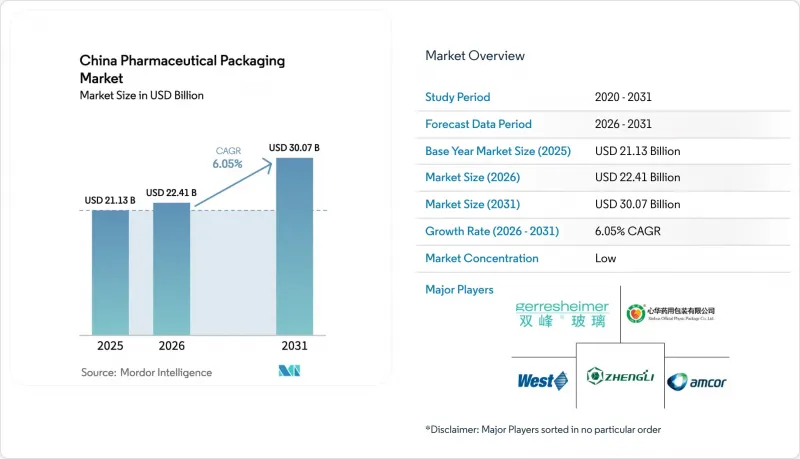
This report is Segmented by Packaging Type (Primary Packaging, Secondary Packaging, Tertiary Packaging), Material (Plastics, Glass, and More), Drug Form (Solid Oral, Parenteral, and More), End-User (Pharma Manufacturers, and More), Technology (Conventional, Aseptic and Sterile, and More), and Geography. The Market Forecasts are Provided in Terms of Value (USD).
China Pharmaceutical Packaging Market Trends and Insights
Stringent Regulatory Clamp-Down on Counterfeit Medicines
Enhanced oversight now extends from active ingredients to every packaging layer, underpinned by the National Medical Products Administration's YY 1001-2024 standards for all-glass syringes. Mandatory serialization at each saleable unit has curtailed supply-chain opacity, prompting larger converters to install interoperable track-and-trace systems that harmonize with EU FMD and U.S. DSCSA rules. Provincial authorities in Shanghai and Shenzhen deploy blockchain-enabled customs channels that shorten clearance times while authenticating serialized codes. Early adopters of open architecture solutions record fewer product-recall incidents and negotiate premium pricing with multinational clients, whereas SMEs grapple with upfront investment and maintenance fees. Market exit of non-compliant lines removes low-price capacity, slowly lifting average selling prices for serialized packs in the China pharmaceutical packaging market.
Expansion of Domestic Generics and Biologics Manufacturing Base
China's biopharma value exceeded CNY 650.6 billion (USD 91.5 billion) in 2024 and is projected to double by 2029, fueling a pivot from commodity bottles toward sterile barrier systems. Provincial clusters in Jiangsu, Shandong, and Guangdong anchor integrated supply networks where bulk resin suppliers, container converters, and fill-finish plants co-locate to pare logistics cost. Luye Pharma's U.S. FDA clearance for ERZOFRI(R), a long-acting injectable, underscores domestic innovators' rising demand for cyclic olefin polymer syringes that resist low-temperature storage. Multinationals deepen local footprints through R&D incubators and joint ventures, intensifying competition for packaging partners certified to U.S. and EU pharmacopeia standards. The resulting capacity race spurs capex in ISO 5 cleanrooms and nested vial trays, fortifying growth prospects for the China pharmaceutical packaging market.
Volatile Petro-Feedstock Prices Inflating Plastic Pack Costs
High-density polyethylene averaged USD 910 per ton in 2024, but a 5 million-ton capacity influx in 2025 skews pricing unpredictably. Simultaneously, PVC import duties rose from 1% to 5.5%, adding USD 23 per ton and squeezing converters reliant on specialized film grades. Currency volatility and crude-oil price swings complicate long-term resin contracts, forcing packaging makers to diversify into glass or fiber substrates when feasible. Manufacturers unable to hedge resin exposure face shrinking margins within the China pharmaceutical packaging market.
Other drivers and restraints analyzed in the detailed report include:
- Ageing Population Driving Chronic-Care Drug Volumes
- Provincial Reimbursement Tilt Toward Patient-Friendly Formats
- Capex Burden of Serialisation/Anti-Counterfeit Lines for SMEs
For complete list of drivers and restraints, kindly check the Table Of Contents.
Segment Analysis
Primary containers captured 61.88% share in 2025 and are projected to grow at 8.96% CAGR through 2031 as drug-delivery functionality merges with containment. SCHOTT Pharma's TOPPAC polymer syringe range posted 54% sales growth in 2024, signaling appetite for cyclic olefin solutions suitable for mRNA vaccines.Within the China pharmaceutical packaging market size for parenteral packs, nested ready-to-use configurations lower aseptic setup time in fill-finish plants. Secondary and tertiary packs evolve alongside booming e-commerce; corrugated shippers integrate shock sensors, enabling parcel-ready compliance for global export hubs in Shanghai free-trade zones.
Secondary packs advance at mid-single-digit growth, propelled by folding-carton demand that accompanies serialized QR codes and color-coded logistics labels. Tertiary formats integrate with AI-enabled Smart Customs scanners that clear pallets faster, reducing in-bond detention fees. Collectively, these shifts entrench primary-pack-centric innovation as the engine of the China pharmaceutical packaging market.
Plastics retained 50.05% share in 2025, buttressed by cost-effective HDPE bottles and polypropylene blisters. Yet fiber substrates clock an 8.35% CAGR as carbon-pricing schemes and hospital green-procurement policies gain traction. DS Smith's TailorTemp shipper shows that molded-fiber can match thermal performance while trimming CO2 by 40%. The China pharmaceutical packaging market size for glass vials and cartridges expands steadily amid biologics growth and premium positioning.
Aluminum remains critical for cold-form blisters when barrier integrity outweighs cost. SMEs explore poly(propylene carbonate) blends to meet impending PFAS prohibitions without sacrificing moisture resistance. Material substitution decisions thus balance regulatory headwinds, carbon accounting, and drug-stability imperatives across the China pharmaceutical packaging market.
Complete Report Scope:
- By Packaging Type
- Primary Packaging
- Plastic Bottles (HDPE, PET)
- Blister Packs (PVC, Cold-form Alu)
- Pre-fillable Syringes
- Vials and Ampoules
- IV Containers
- Inhalers
- Others Primary Packaging
- Secondary Packaging
- Folding Cartons
- Corrugated Shippers
- Bags and Pouches
- Clamshells and Trays
- Tertiary Packaging
- Primary Packaging
- By Material
- Plastics
- Glass
- Aluminium Foil / Laminate
- Paper and Paperboard
- By Drug Form
- Solid Oral
- Parenteral
- Topical / Transdermal
- Inhalation
- Ophthalmic
- Other Drug Form
- By End-User
- Pharma Manufacturers
- Contract Manufacturing Organisations (CMOs)
- Hospitals and Clinics
- By Technology
- Conventional
- Aseptic and Sterile
- Smart and Connected (NFC/RFID)
- Anti-counterfeit / Serialisation
- Sustainable / Recyclable Solutions
List of Companies Covered in this Report:
- Amcor Plc
- Gerresheimer AG (Gerresheimer Shuangfeng)
- West Pharmaceutical Services Inc.
- Shandong Pharmaceutical Glass Co. Ltd
- Taishan Xinhua Pharmaceutical Packaging Co. Ltd
- SCHOTT AG
- Nipro PharmaPackaging
- AptarGroup Inc.
- Perlen Packaging (Suzhou) Co. Ltd
- Ningbo Zhengli Pharmaceutical Packaging
- Yuhuan Kang-jia Enterprise Co. Ltd
- Dongguan Fukang Plastic Products Co. Ltd
- Hangzhou Xunda Packaging Co. Ltd
- Jiangsu Hanlin Pharmaceutical Packaging
- Luoyang Dirante Pharmaceutical Packaging
- JOTOP Glass
- SGD Pharma
- Chongqing Zhengchuan Pharmaceutical Packaging
- Zhejiang B.I. Industrial Co. Ltd
- China National Pharmaceutical Packaging Corp.
Additional Benefits:
- The market estimate (ME) sheet in Excel format
- 3 months of analyst support
TABLE OF CONTENTS
1 INTRODUCTION
- 1.1 Study Assumptions and Market Definition
- 1.2 Scope of the Study
2 RESEARCH METHODOLOGY
3 EXECUTIVE SUMMARY
4 MARKET LANDSCAPE
- 4.1 Market Overview
- 4.2 Market Drivers
- 4.2.1 Stringent regulatory clamp-down on counterfeit medicines
- 4.2.2 Expansion of domestic generics and biologics manufacturing base
- 4.2.3 Ageing population driving chronic-care drug volumes
- 4.2.4 Provincial reimbursement tilt toward patient-friendly formats
- 4.2.5 Cross-border e-pharmacy boom needing parcel-ready packs
- 4.2.6 Carbon-neutrality targets boosting recyclable/biopolymer packs
- 4.3 Market Restraints
- 4.3.1 Volatile petro-feedstock prices inflating plastic pack costs
- 4.3.2 Capex burden of serialisation/anti-counterfeit lines for SMEs
- 4.3.3 Impending PFAS restrictions threatening blister film obsolescence
- 4.3.4 GMP packaging-design talent shortage slows innovation
- 4.4 Supply-Chain Analysis
- 4.5 Regulatory Landscape
- 4.6 Technological Outlook
- 4.7 Porter's Five Forces Analysis
- 4.7.1 Bargaining Power of Suppliers
- 4.7.2 Bargaining Power of Buyers
- 4.7.3 Threat of New Entrants
- 4.7.4 Threat of Substitutes
- 4.7.5 Intensity of Competitive Rivalry
- 4.8 Industry Ecosystem Analysis
- 4.9 Raw-Material Analysis
- 4.10 Recent Innovations and New Product Development
- 4.11 Emerging Trend Analysis and Key Success Factors
5 MARKET SIZE AND GROWTH FORECASTS (VALUE)
- 5.1 By Packaging Type
- 5.1.1 Primary Packaging
- 5.1.1.1 Plastic Bottles (HDPE, PET)
- 5.1.1.2 Blister Packs (PVC, Cold-form Alu)
- 5.1.1.3 Pre-fillable Syringes
- 5.1.1.4 Vials and Ampoules
- 5.1.1.5 IV Containers
- 5.1.1.6 Inhalers
- 5.1.1.7 Others Primary Packaging
- 5.1.2 Secondary Packaging
- 5.1.2.1 Folding Cartons
- 5.1.2.2 Corrugated Shippers
- 5.1.2.3 Bags and Pouches
- 5.1.2.4 Clamshells and Trays
- 5.1.3 Tertiary Packaging
- 5.1.1 Primary Packaging
- 5.2 By Material
- 5.2.1 Plastics
- 5.2.2 Glass
- 5.2.3 Aluminium Foil / Laminate
- 5.2.4 Paper and Paperboard
- 5.3 By Drug Form
- 5.3.1 Solid Oral
- 5.3.2 Parenteral
- 5.3.3 Topical / Transdermal
- 5.3.4 Inhalation
- 5.3.5 Ophthalmic
- 5.3.6 Other Drug Form
- 5.4 By End-User
- 5.4.1 Pharma Manufacturers
- 5.4.2 Contract Manufacturing Organisations (CMOs)
- 5.4.3 Hospitals and Clinics
- 5.5 By Technology
- 5.5.1 Conventional
- 5.5.2 Aseptic and Sterile
- 5.5.3 Smart and Connected (NFC/RFID)
- 5.5.4 Anti-counterfeit / Serialisation
- 5.5.5 Sustainable / Recyclable Solutions
6 COMPETITIVE LANDSCAPE
- 6.1 Market Concentration
- 6.2 Strategic Moves
- 6.3 Market Share Analysis
- 6.4 Company Profiles (includes Global-level Overview, Market-level Overview, Core Segments, Financials as available, Strategic Information, Market Rank/Share, Products and Services, Recent Developments)
- 6.4.1 Amcor Plc
- 6.4.2 Gerresheimer AG (Gerresheimer Shuangfeng)
- 6.4.3 West Pharmaceutical Services Inc.
- 6.4.4 Shandong Pharmaceutical Glass Co. Ltd
- 6.4.5 Taishan Xinhua Pharmaceutical Packaging Co. Ltd
- 6.4.6 SCHOTT AG
- 6.4.7 Nipro PharmaPackaging
- 6.4.8 AptarGroup Inc.
- 6.4.9 Perlen Packaging (Suzhou) Co. Ltd
- 6.4.10 Ningbo Zhengli Pharmaceutical Packaging
- 6.4.11 Yuhuan Kang-jia Enterprise Co. Ltd
- 6.4.12 Dongguan Fukang Plastic Products Co. Ltd
- 6.4.13 Hangzhou Xunda Packaging Co. Ltd
- 6.4.14 Jiangsu Hanlin Pharmaceutical Packaging
- 6.4.15 Luoyang Dirante Pharmaceutical Packaging
- 6.4.16 JOTOP Glass
- 6.4.17 SGD Pharma
- 6.4.18 Chongqing Zhengchuan Pharmaceutical Packaging
- 6.4.19 Zhejiang B.I. Industrial Co. Ltd
- 6.4.20 China National Pharmaceutical Packaging Corp.
7 MARKET OPPORTUNITIES AND FUTURE OUTLOOK
- 7.1 White-space and Unmet-need Assessment

