PUBLISHER: Mordor Intelligence | PRODUCT CODE: 2122177

PUBLISHER: Mordor Intelligence | PRODUCT CODE: 2122177
India Pharmaceutical Packaging - Market Share Analysis, Industry Trends & Statistics, Growth Forecasts (2026 - 2031)
According to Mordor Intelligence, the India pharmaceutical packaging market size was valued at USD 5.14 billion in 2025 and estimated to grow from USD 5.55 billion in 2026 to reach USD 8.18 billion by 2031, at a CAGR of 8.05% during the forecast period (2026-2031).
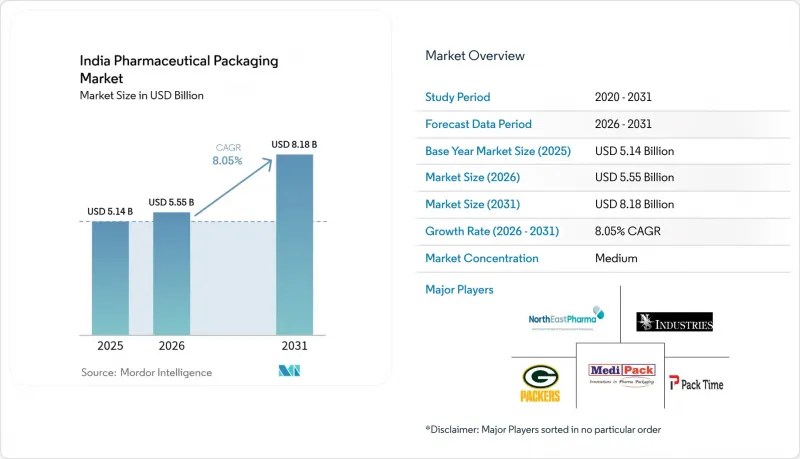
This report is Segmented by Material Type (Plastic, Glass, Metal, and More), Product Type (Bottles, Vials and Ampoules, Blister Packs and More), Packaging Level (Primary, Secondary, and Tertiary), End-User Industry (Pharmaceutical Manufacturing Companies, Contract Packaging Organizations, and More). The Market Forecasts are Provided in Terms of Value (USD).
India Pharmaceutical Packaging Market Trends and Insights
Expansion of India's Vaccine and Biologics Fill-Finish Capacity
India's ambition to become a global biologics hub is fueling specialized containment demand. Ongoing investments, including Lonza's gelatin capsule line in Rewari, require high-barrier films that withstand sterilization and maintain sub-zero stability across extended logistics chains. Growth in cold-chain packaging with integrated temperature indicators is enabling uninterrupted product integrity from plant to patient. Biologic developers also favor tamper-evident seals and unit-level serialization for supply chain visibility, encouraging converters to scale ISO-8 clean-room production.
Government PLI and GMP Upgrades for Export-Oriented Pharma
The Production-Linked Incentive scheme earmarked INR 2,444.93 crore (USD 293 million) for FY 2025-26, driving systematic upgrades in packaging infrastructure and supporting simultaneous compliance with FDA 21 CFR 211.132 and EU FMD serialisation requirements. Subsidy applicants must meet ambitious export targets, which translate into orders for premium laminated foils, tamper-proof closures, and cloud-connected vision inspection units. The December 2025 GMP upgrade deadline compels facilities to install ISO-8 compatible lines, raising recurring demand for validated primary packs and cleanroom consumables.
Volatility in Medical-Grade Polymer and Glass Input Costs
Polypropylene fluctuated between USD 970-990 per metric ton CFR India in 2025, eroding converter margins and complicating contract pricing. Glass container makers face rising energy tariffs and silica sand shortages, adding pass-through costs for high-value vials. Overall EBITDA margins for flexible packaging dipped to 8% in FY 2024-25 amid resin oversupply and lukewarm export demand. These factors force packaging firms to hedge raw materials and optimize formulations to cushion profitability.
Other drivers and restraints analyzed in the detailed report include:
- E-Pharmacy Boom Driving Tamper-Evident, Home-Delivery Packs
- Sustainability Mandates Pushing rPET and PCR Rigid Plastics
- Single-Use-Plastic EPR and Recycling Logistics Gaps
For complete list of drivers and restraints, kindly check the Table Of Contents.
Segment Analysis
In 2025, plastics led with 40.85% revenue, yet composites and bio-based resins surged at a 9.65% CAGR, the highest among all materials. Stringent Extended Producer Responsibility norms are spurring trials of recycled PET inserts and sugarcane-based HDPE lines. Pharmaceutical buyers insist on full extractable-leachable validation, prompting converters to build application labs and secure regulatory master files. India's pharmaceutical packaging market size for bio-based materials is set to expand quickly as contract packers market greener credentials to multinational sponsors. Parallel investments in enzymatic delamination promise recovery of aluminum layers from aseptic cartons, illustrating innovation depth. Future growth depends on a robust supply chain for high-purity recycled feedstock and harmonized national testing standards.
Sustainability themes also reshape glass and metal demand. Borosilicate vials retain relevance for biologics owing to inertness, yet lightweight coated glass variants target energy reductions during melt. Aluminum collapsible tubes find use in topical formulations where zero-leach barriers and recyclability offer dual appeal. Paperboard is regaining favor for secondary cartons as water-based coatings achieve 95% humidity resistance, satisfying patient safety while enabling fiber recovery. Collectively these shifts reflect heightened material stewardship across the India pharmaceutical packaging market.
Bottles commanded 21.05% of 2025 revenue, yet pouches and bags logged a 9.1% CAGR, the fastest among all categories, fueled by e-pharmacy parcel shipping. India's pharmaceutical packaging market share for prefilled syringes is climbing as biologic therapies proliferate, demanding silicon-oil-free plungers and tight particulate controls. Meanwhile, blister-pack upgrades focus on child-resistant push-through lidding and NFC tags that connect patients to refill portals. Smart features migrate into flexible sachets, embedding humidity sensors for at-home adherence monitoring.
Downstream, rapid swab kits and nasal sprays push demand for snap-fit caps, integrated droppers, and low-dead-volume valves. Converters offering turnkey molding plus pulsed-light sterilization win contracts where lean supply chains are pivotal. India pharmaceutical packaging market size for adaptive closures is projected to widen as personalized therapy packs and micro-dosing devices multiply. The resulting SKU complexity rewards firms capable of short-run digital printing and agile changeovers.
Complete Report Scope:
- By Material Type
- Plastic
- High-Density Polyethylene (HDPE)
- Low-Density Polyethylene (LDPE)
- Polyethylene Terephthalate (PET)
- Other Plastics
- Glass
- Metal
- Paper and Paperboard
- Composites/ Bio-based Materials
- Plastic
- By Product Type
- Bottles
- Vials and Ampoules
- Blister Packs
- Prefilled Syringes and Cartridges
- Tubes
- Caps and Closures
- Pouches and Bags
- Labels
- Other Product Types
- By Packaging Level
- Primary
- Secondary
- Tertiary
- By End-user Industry
- Pharmaceutical Manufacturing Companies
- Contract Packaging Organizations
- Retail and Institutional Pharmacies
- Hospitals and Clinics
- Other End-user Industries
List of Companies Covered in this Report:
- Amcor plc
- West Pharmaceutical Services Inc.
- Huhtamaki Oyj ( Huhtamaki India Ltd )
- Uflex Limited
- Gerresheimer AG
- Schott AG ( Schott Glass India Pvt Ltd )
- SGD S.A. ( SGD Pharma India Ltd )
- EPL Limited ( Essel Propack Ltd )
- Parekhplast India Ltd
- Hoffmann Neopac AG
- Medipack Innovations Pvt Ltd
- Packtime Innovations Pvt Ltd
- Manjushree Technopack Ltd
- Graham Blow Pack Pvt Ltd
- Regent Plast Pvt Ltd
- North East Pharmapack Pvt Ltd
- TPAC Packaging India Pvt Ltd
- JK Print Packs
- N S Industries
- A S Packers
Additional Benefits:
- The market estimate (ME) sheet in Excel format
- 3 months of analyst support
TABLE OF CONTENTS
1 INTRODUCTION
- 1.1 Study Assumptions and Market Definition
- 1.2 Scope of the Study
2 RESEARCH METHODOLOGY
3 EXECUTIVE SUMMARY
4 MARKET LANDSCAPE
- 4.1 Market Overview
- 4.2 Market Drivers
- 4.2.1 Accelerated shift to pre-fillable formats post-COVID-19
- 4.2.2 Expansion of India's vaccine and biologics fill-finish capacity
- 4.2.3 Government PLI and GMP upgrades for export-oriented pharma
- 4.2.4 E-pharmacy boom driving tamper-evident, home-delivery packs
- 4.2.5 Sustainability mandates pushing rPET and PCR rigid plastics
- 4.3 Market Restraints
- 4.3.1 Volatility in medical-grade polymer and glass input costs
- 4.3.2 Single-use-plastic EPR and recycling logistics gaps
- 4.3.3 High cap-ex for ISO-8 clean-room packaging lines
- 4.3.4 Fragmented downstream distribution inflating unit pack costs
- 4.4 Industry Value Chain Analysis
- 4.5 Porter's Five Forces Analysis
- 4.5.1 Bargaining Power of Suppliers
- 4.5.2 Bargaining Power of Buyers
- 4.5.3 Threat of New Entrants
- 4.5.4 Threat of Substitutes
- 4.5.5 Degree of Competition
- 4.6 The Impact of Macroeconomic Factors on the Market
5 MARKET SIZE AND GROWTH FORECASTS (VALUE)
- 5.1 By Material Type
- 5.1.1 Plastic
- 5.1.1.1 High-Density Polyethylene (HDPE)
- 5.1.1.2 Low-Density Polyethylene (LDPE)
- 5.1.1.3 Polyethylene Terephthalate (PET)
- 5.1.1.4 Other Plastics
- 5.1.2 Glass
- 5.1.3 Metal
- 5.1.4 Paper and Paperboard
- 5.1.5 Composites/ Bio-based Materials
- 5.1.1 Plastic
- 5.2 By Product Type
- 5.2.1 Bottles
- 5.2.2 Vials and Ampoules
- 5.2.3 Blister Packs
- 5.2.4 Prefilled Syringes and Cartridges
- 5.2.5 Tubes
- 5.2.6 Caps and Closures
- 5.2.7 Pouches and Bags
- 5.2.8 Labels
- 5.2.9 Other Product Types
- 5.3 By Packaging Level
- 5.3.1 Primary
- 5.3.2 Secondary
- 5.3.3 Tertiary
- 5.4 By End-user Industry
- 5.4.1 Pharmaceutical Manufacturing Companies
- 5.4.2 Contract Packaging Organizations
- 5.4.3 Retail and Institutional Pharmacies
- 5.4.4 Hospitals and Clinics
- 5.4.5 Other End-user Industries
6 COMPETITIVE LANDSCAPE
- 6.1 Market Concentration
- 6.2 Strategic Moves
- 6.3 Market Share Analysis
- 6.4 Company Profiles (includes Global level Overview, Market level overview, Core Segments, Financials as available, Strategic Information, Market Rank/Share for key companies, Products and Services, and Recent Developments)
- 6.4.1 Amcor plc
- 6.4.2 West Pharmaceutical Services Inc.
- 6.4.3 Huhtamaki Oyj ( Huhtamaki India Ltd )
- 6.4.4 Uflex Limited
- 6.4.5 Gerresheimer AG
- 6.4.6 Schott AG ( Schott Glass India Pvt Ltd )
- 6.4.7 SGD S.A. ( SGD Pharma India Ltd )
- 6.4.8 EPL Limited ( Essel Propack Ltd )
- 6.4.9 Parekhplast India Ltd
- 6.4.10 Hoffmann Neopac AG
- 6.4.11 Medipack Innovations Pvt Ltd
- 6.4.12 Packtime Innovations Pvt Ltd
- 6.4.13 Manjushree Technopack Ltd
- 6.4.14 Graham Blow Pack Pvt Ltd
- 6.4.15 Regent Plast Pvt Ltd
- 6.4.16 North East Pharmapack Pvt Ltd
- 6.4.17 TPAC Packaging India Pvt Ltd
- 6.4.18 JK Print Packs
- 6.4.19 N S Industries
- 6.4.20 A S Packers
7 MARKET OPPORTUNITIES AND FUTURE OUTLOOK
- 7.1 White-space and Unmet-Need Assessment

