PUBLISHER: Mordor Intelligence | PRODUCT CODE: 2125467

PUBLISHER: Mordor Intelligence | PRODUCT CODE: 2125467
Philippines Pharmaceutical Packaging - Market Share Analysis, Industry Trends & Statistics, Growth Forecasts (2026 - 2031)
According to Mordor Intelligence, the Philippines pharmaceutical packaging market size in 2026 is estimated at USD 183.97 million, growing from 2025 value of USD 176.52 million with 2031 projections showing USD 226.15 million, growing at 4.22% CAGR over 2026-2031.
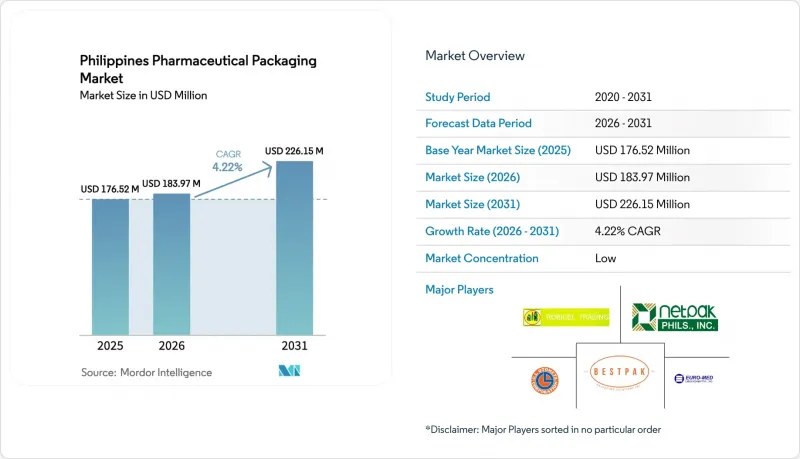
This report is Segmented by Material Type (Plastic, Glass, and More), Product Type (Bottles, Vials and Ampoules, Blister Packs, Prefilled Syringes and Cartridges, and More), Packaging Level (Primary, Secondary, and Tertiary), End-User Industry (Pharmaceutical Manufacturing Companies, Contract Packaging Organizations, and More). The Market Forecasts are Provided in Terms of Value (USD).
Philippines Pharmaceutical Packaging Market Trends and Insights
Growing Generic Drug Production
Fast-tracked approvals, now limited to 45 days, have cut market-entry timelines, prompting local firms to reformulate labels and invest in compliant blister, bottle, and pouch solutions. The generic-drug spending pool is projected to reach USD 3.8 billion by 2028, and every new molecule requires serialization-ready packaging that meets the Department of Health's generic-label mandate. Fiscal perks inside PEZA parks amplify volumes, while five India-based firms that scouted Philippine sites in August 2024 signal future demand for high-barrier bottles and tamper-evident seals. Packaging converters that pre-qualify materials under Good Manufacturing Practice guidelines are winning early supplier status with these green-field entrants, cementing volume commitments across 2025-2028 contract cycles.
Increasing Government Procurement of Essential Medicines
The Philippine Pharma Procurement Inc. roadmap aims to increase the local-producer share of tenders to 50% by 2030, securing routine orders for suppliers already accredited under the Green Lane licensing system. The Clark pharmaceutical logistics hub, a USD 35.25 million investment, features GDP-certified warehousing that caters to suppliers of serialized cartons and pre-printed labels. Essential-medicine packs, diabetes strips, anti-hypertensive blister sleeves, and oncology vals must now carry traceability QR codes that sync with the Department of Health inventory platform. Converters offering end-to-end coding services and data-integrity audits command price premiums yet secure multiyear contracts, accelerating revenue diversification within the Philippines pharmaceutical packaging market.
Heavy Reliance on Imported Raw Materials
With 98% of active ingredients and most plastic resins imported, converters face currency swings and freight disruptions that compress margins. The Philippine Pharmaceutical Industry Association notes raw-material imports grew 15% between 2015-2019; the pandemic exposed lead-time spikes beyond 120 days, forcing converters to double buffer stocks. The lack of a domestic petrochemical base keeps resin prices 8-12% higher than those of regional peers, prompting some fillers to source preforms from Thailand and Malaysia. Although the Department of Trade and Industry considers tariff relief for pellet imports, short-term volatility persists, making cost-plus contracts difficult to secure for more than one bid cycle.
Other drivers and restraints analyzed in the detailed report include:
- Expansion of Local Contract Manufacturing Organizations
- Stringent Anti-Counterfeiting Regulations
- Limited Cold Chain Infrastructure
For complete list of drivers and restraints, kindly check the Table Of Contents.
Segment Analysis
Plastics deliver the core volume advantage, capturing 39.85% of the Philippines pharmaceutical packaging market in 2025. HDPE bottles, PET jars, and polypropylene closures are the most commonly used materials because regulatory dossiers already reference their migration data, thereby reducing approval lead times. The Philippines pharmaceutical packaging market size for plastics is set to grow steadily, even as new Extended Producer Responsibility (EPR) rules raise recovery targets to 80% by 2028. EPR costs prompt brand owners to trial bio-based liners and recycled-content PET, which command price increases while unlocking tax credits.
Sustainable composites, although niche today, are projected to chart the fastest 5.96% CAGR as global clients incorporate life-cycle metrics into supplier scorecards. The Department of Science and Technology's Green Packaging Laboratory pilots chitosan and pectin films, and early adopters among multinationals co-fund scale-up trials. Glass retains a loyal base in injectables that require Type I borosilicate integrity, while aluminum tubes fill steroid creams that require oxygen barriers. Collectively, these material pivots re-align supply chains, inviting joint ventures that embed resin recycling lines within ecozones, moves that sustain the Philippines pharmaceutical packaging market over the medium term.
Bottles owned 21.09% of the Philippines pharmaceutical packaging market share in 2025, thanks to their compatibility with high-speed lines serving OTC cough-cold syrups and vitamin liquids. Automated vision systems and induction-seal liners reduce contamination risk, solidifying their use in public hospital tenders. Meanwhile, the Philippines pharmaceutical packaging market size for pouches and bags grows fastest at 5.34% CAGR as e-pharmacies prefer lightweight laminate sachets that slash freight costs by 30%.
Blister packs remain central to solid-dose compliance, especially after the FDA endorsed wallet blister formats that support QR-linked adherence apps for patients with chronic diseases. Prefilled syringes and cartridges gain popularity in vaccination drives; vials and ampules maintain the security of specialty injectables. Cartons receive functional upgrades, including RFID inlays and braille embossing, while pallet corner boards transition to recycled paper to meet EPR audits. This product-mix evolution rewards converters who are agile enough to switch between short-run, personalized kits and high-volume, commodity batches without incurring downtime penalties.
Complete Report Scope:
- By Material Type
- Plastic
- High-Density Polyethylene (HDPE)
- Low-Density Polyethylene (LDPE)
- Polyethylene Terephthalate (PET)
- Other Plastics
- Glass
- Metal
- Paper and Paperboard
- Composites/ Bio-based Materials
- Plastic
- By Product Type
- Bottles
- Vials and Ampoules
- Blister Packs
- Prefilled Syringes and Cartridges
- Tubes
- Pallets
- Pouches and Bags
- Carton Boxes
- Other Product Types
- By Packaging Level
- Primary
- Secondary
- Tertiary
- By End-user Industry
- Pharmaceutical Manufacturing Companies
- Contract Packaging Organizations
- Retail and Institutional Pharmacies
- Hospitals and Clinics
- Other End-user Industries
List of Companies Covered in this Report:
- Amcor Flexibles Philippines Corp. (Amcor plc)
- Shandong Pharmaceutical Glass Co., Ltd.
- Robicel Trading
- Bestpak Packaging Solutions, Inc.
- Euro-Med Laboratories Philippines Inc.
- Netpak Phils., Inc.
- GL Otometz Corporation
- Plastic Container Packaging Corporation
- APO International Marketing Corporation
- Merfel Plastic Products
- Versa Group Philippines Corporation
- SwissPac
- Gerresheimer AG
- Schott AG
- Nipro PharmaPackaging International NV
- SGD Pharma
- West Pharmaceutical Services Inc.
- Catalent Inc.
- Datwyler Holding AG
Additional Benefits:
- The market estimate (ME) sheet in Excel format
- 3 months of analyst support
TABLE OF CONTENTS
1 INTRODUCTION
- 1.1 Study Assumptions and Market Definition
- 1.2 Scope of the Study
2 RESEARCH METHODOLOGY
3 EXECUTIVE SUMMARY
4 MARKET LANDSCAPE
- 4.1 Market Overview
- 4.2 Market Drivers
- 4.2.1 Growing Generic Drug Production
- 4.2.2 Increasing Government Procurement of Essential Medicines
- 4.2.3 Expansion of Local Contract Manufacturing Organizations
- 4.2.4 Stringent Anti-Counterfeiting Regulations
- 4.2.5 Rising Demand for Patient-Friendly Packaging
- 4.2.6 Growth of E-Pharmacy Distribution Channels
- 4.3 Market Restraints
- 4.3.1 Heavy Reliance on Imported Raw Materials
- 4.3.2 Limited Cold Chain Infrastructure
- 4.3.3 Price Sensitivity among Local Manufacturers
- 4.3.4 Environmental Compliance Costs
- 4.4 Industry Value Chain Analysis
- 4.5 Impact of Macroeconomic Factors on the Market
- 4.6 Regulatory Landscape
- 4.7 Technological Outlook
- 4.8 Porter's Five Forces Analysis
- 4.8.1 Threat of New Entrants
- 4.8.2 Bargaining Power of Suppliers
- 4.8.3 Bargaining Power of Buyers
- 4.8.4 Threat of Substitutes
- 4.8.5 Competitive Rivalry
5 MARKET SIZE AND GROWTH FORECASTS (VALUE)
- 5.1 By Material Type
- 5.1.1 Plastic
- 5.1.1.1 High-Density Polyethylene (HDPE)
- 5.1.1.2 Low-Density Polyethylene (LDPE)
- 5.1.1.3 Polyethylene Terephthalate (PET)
- 5.1.1.4 Other Plastics
- 5.1.2 Glass
- 5.1.3 Metal
- 5.1.4 Paper and Paperboard
- 5.1.5 Composites/ Bio-based Materials
- 5.1.1 Plastic
- 5.2 By Product Type
- 5.2.1 Bottles
- 5.2.2 Vials and Ampoules
- 5.2.3 Blister Packs
- 5.2.4 Prefilled Syringes and Cartridges
- 5.2.5 Tubes
- 5.2.6 Pallets
- 5.2.7 Pouches and Bags
- 5.2.8 Carton Boxes
- 5.2.9 Other Product Types
- 5.3 By Packaging Level
- 5.3.1 Primary
- 5.3.2 Secondary
- 5.3.3 Tertiary
- 5.4 By End-user Industry
- 5.4.1 Pharmaceutical Manufacturing Companies
- 5.4.2 Contract Packaging Organizations
- 5.4.3 Retail and Institutional Pharmacies
- 5.4.4 Hospitals and Clinics
- 5.4.5 Other End-user Industries
6 COMPETITIVE LANDSCAPE
- 6.1 Market Concentration
- 6.2 Strategic Moves
- 6.3 Market Share Analysis
- 6.4 Company Profiles (includes Global level Overview, Market level overview, Core Segments, Financials as available, Strategic Information, Market Rank/Share for key companies, Products and Services, and Recent Developments)
- 6.4.1 Amcor Flexibles Philippines Corp. (Amcor plc)
- 6.4.2 Shandong Pharmaceutical Glass Co., Ltd.
- 6.4.3 Robicel Trading
- 6.4.4 Bestpak Packaging Solutions, Inc.
- 6.4.5 Euro-Med Laboratories Philippines Inc.
- 6.4.6 Netpak Phils., Inc.
- 6.4.7 GL Otometz Corporation
- 6.4.8 Plastic Container Packaging Corporation
- 6.4.9 APO International Marketing Corporation
- 6.4.10 Merfel Plastic Products
- 6.4.11 Versa Group Philippines Corporation
- 6.4.12 SwissPac
- 6.4.13 Gerresheimer AG
- 6.4.14 Schott AG
- 6.4.15 Nipro PharmaPackaging International NV
- 6.4.16 SGD Pharma
- 6.4.17 West Pharmaceutical Services Inc.
- 6.4.18 Catalent Inc.
- 6.4.19 Datwyler Holding AG
7 MARKET OPPORTUNITIES AND FUTURE OUTLOOK
- 7.1 White-space and Unmet-need Assessment

