PUBLISHER: Mordor Intelligence | PRODUCT CODE: 2120544

PUBLISHER: Mordor Intelligence | PRODUCT CODE: 2120544
India Agrochemicals Industry - Market Share Analysis, Industry Trends & Statistics, Growth Forecasts (2026 - 2031)
According to Mordor Intelligence, India agrochemicals market size in 2026 is estimated at USD 9.59 billion, growing from 2025 value of USD 9 billion with 2031 projections showing USD 13.25 billion, growing at 6.66% CAGR over 2026-2031.
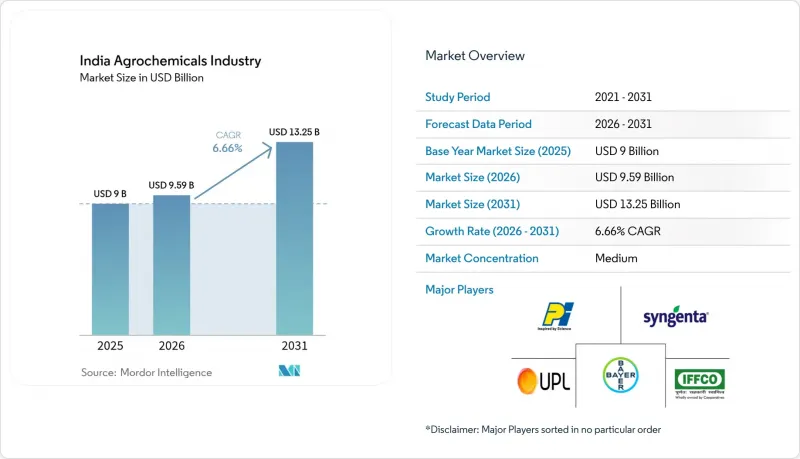
This report is Segmented by Product Type (Fertilizers, Pesticides, Adjuvants, Plant Growth Regulators), Application (Cereals and Grains, Pulses and Oilseeds, Fruits and Vegetables, Commercial Crops). The Market Forecasts are Provided in Terms of Value (USD).
India Agrochemicals Industry Trends and Insights
Government Subsidy Rationalization Spurring Bio-inputs Adoption
New subsidy frameworks reward states for curbing blanket fertilizer consumption and channel budgetary support toward compost, biofertilizers, and nano-nutrient liquids. The 2025 Union Budget set aside for agriculture and launched the Prime Minister Dhan-Dhanya Krishi Yojana, creating a formal mechanism to reimburse farmers who switch to certified biologicals . Parallel programs such as PM-PRANAM link disbursements to chemical reduction targets, encouraging administrators to fast-track training modules and field demonstrations.
Digitized Agri-credit and E-commerce Networks Widening Last-mile Reach
Government-funded digital infrastructure now integrates land records, soil health cards, and Kisan Credit Card limits into a unified farmer registry, allowing input companies to vet credit profiles in minutes and dispatch orders through app-based platforms. In 2024, Indian Farmers Fertiliser Cooperative Limited (IFFCO) e-Bazar, for instance, fulfilled more than 200,000 online transactions in the past fiscal year and delivered to 27,000 pin codes, a scale previously unimaginable for bulk inputs. For the India agrochemicals market, these digital rails translate into higher off-take of premium formulations, especially in tier-II districts where assortment depth had long been a constraint.
Disruptive Raw-material Dependence on China Raising Cost Volatility
Indian plants import a bulk of technical intermediates such as bismuth, tellurium, and graphite from Chinese suppliers, leaving local formulators exposed to price swings and shipping delays during geopolitical flashpoints. Domestic producers must carry higher safety stocks, locking working capital and eroding margins when global freight rates spike. Government task forces have identified 10 critical minerals where India is 100% import-dependent and are drafting incentive packages to fast-track alternative sources.
Other drivers and restraints analyzed in the detailed report include:
- Drone-based Precision Spraying Unlocking Smallholder Demand
- Off-patent Molecule Wave Expanding Export Pipeline
- Accelerating State-level Bans on High-toxicity Actives
For complete list of drivers and restraints, kindly check the Table Of Contents.
Segment Analysis
Fertilizers captured 54.60% of the India agrochemicals market size, and continue to anchor food security policies for rice, wheat, and sugarcane systems. Di-ammonium phosphate and urea dominate volumes, yet escalating subsidy reforms are nudging growers toward micronutrient blends and nano-liquids that minimize groundwater contamination.
Pesticides, though starting from a smaller base, are projected to add nearly incremental sales by 2031 at a 10.12% CAGR, underpinned by compost incentives, residue-linked export standards, and expanding organic certification acreage. The rising popularity of microbial consortia and seaweed-based stimulants is encouraging conventional fertilizer majors to launch dedicated bio-divisions. Producers that master shelf-life extension, cold-chain independent packaging, and farmer education stand to capture early mover loyalty.
Complete Report Scope:
- By Product Type
- Fertilizers
- Nitrogenous
- Phosphatic
- Potassic
- Other Fertilizers
- Pesticides
- Herbicides
- Insecticides
- Fungicides
- Other Pesticides
- Adjuvants
- Plant Growth Regulators
- Fertilizers
- By Application
- Cereals and Grains
- Pulses and Oilseeds
- Fruits and Vegetables
- Commercial Crops
List of Companies Covered in this Report:
- Bayer AG
- BASF SE
- Syngenta India Private Limited
- UPL Ltd.
- Corteva Agriscience
- PI Industries Limited
- IFFCO
- Coromandel International Ltd.
- Chambal Fertilisers and Chemicals Limited
- Rallis India Limited
- Deepak Fertilisers and Petrochemicals Corporation Limited (DFPCL)
- Crystal Crop Protection Ltd.
- Sumitomo Chemical India ltd.
- Dhanuka Agritech Ltd.
- Indofil Industries Limited (Modi Enterprises)
Additional Benefits:
- The market estimate (ME) sheet in Excel format
- 3 months of analyst support
TABLE OF CONTENTS
1 Introduction
- 1.1 Study Assumptions and Market Definition
- 1.2 Scope of the Study
2 Research Methodology
3 Executive Summary
4 Market Landscape
- 4.1 Market Overview
- 4.2 Market Drivers
- 4.2.1 Government subsidy rationalisation spurring bio-inputs adoption
- 4.2.2 Digitised agri-credit and e-commerce platforms expanding chemical reach
- 4.2.3 Drone-based precision spraying unlocking untapped smallholder demand
- 4.2.4 Off-patent molecule wave enlarges export pipeline
- 4.2.5 Climate-linked pest outbreaks increasing pesticide intensity
- 4.2.6 Government schemes boosting domestic manufacturing capacity
- 4.3 Market Restraints
- 4.3.1 Disruptive raw-material dependence on China raising cost volatility
- 4.3.2 Accelerating state-level bans on high-toxicity actives
- 4.3.3 Growing counterfeit channel eroding branded volumes
- 4.3.4 Intensifying resistance to legacy insecticides
- 4.4 Regulatory Landscape
- 4.5 Technological Outlook
- 4.6 Porter's Five Forces Analysis
- 4.6.1 Bargaining Power of Suppliers
- 4.6.2 Bargaining Power of Consumers
- 4.6.3 Threat of New Entrants
- 4.6.4 Threat of Substitute Products
- 4.6.5 Intensity of Competitive Rivalry
5 Market Size and Growth Forecasts (Value)
- 5.1 By Product Type
- 5.1.1 Fertilizers
- 5.1.1.1 Nitrogenous
- 5.1.1.2 Phosphatic
- 5.1.1.3 Potassic
- 5.1.1.4 Other Fertilizers
- 5.1.2 Pesticides
- 5.1.2.1 Herbicides
- 5.1.2.2 Insecticides
- 5.1.2.3 Fungicides
- 5.1.2.4 Other Pesticides
- 5.1.3 Adjuvants
- 5.1.4 Plant Growth Regulators
- 5.1.1 Fertilizers
- 5.2 By Application
- 5.2.1 Cereals and Grains
- 5.2.2 Pulses and Oilseeds
- 5.2.3 Fruits and Vegetables
- 5.2.4 Commercial Crops
6 Competitive Landscape
- 6.1 Market Concentration
- 6.2 Strategic Moves
- 6.3 Market Share Analysis
- 6.4 Company Profiles (Includes Global Level Overview, Market Level Overview, Core Segments, Financials as Available, Strategic Information, Market Rank/Share for Key Companies, Products and Services, and Recent Developments)
- 6.4.1 Bayer AG
- 6.4.2 BASF SE
- 6.4.3 Syngenta India Private Limited
- 6.4.4 UPL Ltd.
- 6.4.5 Corteva Agriscience
- 6.4.6 PI Industries Limited
- 6.4.7 IFFCO
- 6.4.8 Coromandel International Ltd.
- 6.4.9 Chambal Fertilisers and Chemicals Limited
- 6.4.10 Rallis India Limited
- 6.4.11 Deepak Fertilisers and Petrochemicals Corporation Limited (DFPCL)
- 6.4.12 Crystal Crop Protection Ltd.
- 6.4.13 Sumitomo Chemical India ltd.
- 6.4.14 Dhanuka Agritech Ltd.
- 6.4.15 Indofil Industries Limited (Modi Enterprises)
7 Market Opportunities and Future Outlook

