PUBLISHER: Mordor Intelligence | PRODUCT CODE: 2121521

PUBLISHER: Mordor Intelligence | PRODUCT CODE: 2121521
United States Oil And Gas Downstream - Market Share Analysis, Industry Trends & Statistics, Growth Forecasts (2026 - 2031)
According to Mordor Intelligence, the United States oil and gas downstream market size in 2026 is estimated at USD 22.62 billion, growing from 2025 value of USD 21.76 billion with 2031 projections showing USD 27.46 billion, growing at 3.95% CAGR over 2026-2031.
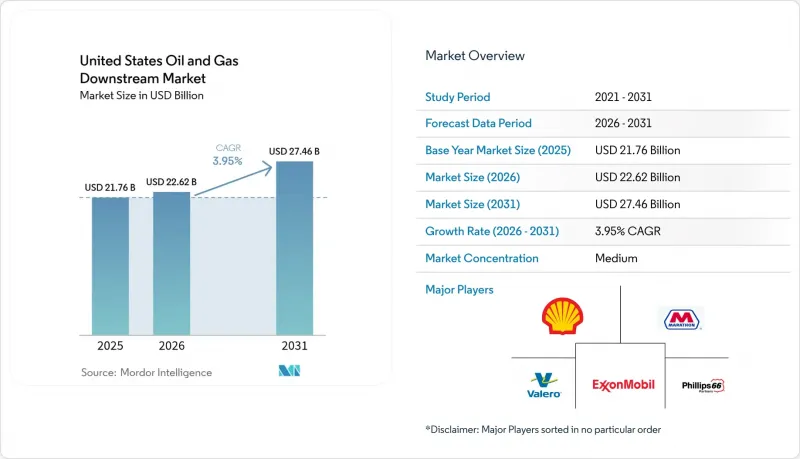
This report is Segmented by Type (Refineries and Petrochemical Plants), Product Type (Refined Petroleum Products, Petrochemicals, and Lubricants), and Distribution Channel (Direct Sales/Wholesale, Distributors/Commercial, and Retail). The Market Sizes and Forecasts are Provided in Terms of Value (USD).
United States Oil And Gas Downstream Market Trends and Insights
Rising Gasoline Demand from Sustained VMT Growth
U.S. VMT reached 3.26 trillion miles in 2023, a 2.1% year-over-year increase, and this momentum anchors the baseline transportation fuel demand even as EV penetration accelerates. E-commerce fulfillment and last-mile logistics are lifting diesel and gasoline consumption at a pace that counterbalances slower passenger-car volumes. Sun Belt states lead with annual VMT increases above 3%, propelled by population inflows and construction activity. The U.S. Department of Transportation projects that commercial-vehicle mileage will grow at double the pace of passenger travel through 2027, providing refiners with a reliable user base for gasoline, diesel, and jet fuel production. The predictable demand profile aids capacity-planning decisions and undergirds the 4.00% CAGR outlook for the United States oil and gas downstream market.
Planned Refinery Modernization & Capacity Additions
More than USD 15 billion in announced projects are revamping U.S. plants, with the Gulf Coast absorbing the largest share. ExxonMobil's USD 2 billion Beaumont expansion adds 250,000 barrels per day (b/d) of throughput, while Chevron's USD 475 million Pasadena revamp lifts capacity by 15% and equips the site to process heavier crudes. Marathon Petroleum's USD 2.5 billion renewable-diesel build-out exemplifies the dual path of investing in both legacy and low-carbon fuel lines. New hydrocrackers and fluid catalytic crackers raise middle-distillate yields, improve energy efficiency by up to 8%, and future-proof plants for shifting crude slates. The modernization cycle expands the installed base that feeds the United States oil and gas downstream market while nudging average operating costs downward.
Accelerating EV Adoption Curbing Gasoline Demand
Electric-vehicle (EV) sales crossed 1.4 million units in 2023, taking 9.1% of total U.S. light-duty registrations. California leads with a 25% share, while Washington and Oregon account for over 15%, creating localized dips in gasoline demand. The USD 7.5 billion national charging-network rollout under the Infrastructure Investment and Jobs Act compresses adoption timelines, and purchase credits valid through 2032 keep consumer interest high. Fleet operators in dense urban corridors are electrifying vans and step-trucks to capture lifecycle savings, reducing diesel demand on specific routes.
Other drivers and restraints analyzed in the detailed report include:
- Surging Petrochemical Feedstock Demand
- Expansion of Renewable Diesel & SAF Projects
- Federal & State Decarbonization Compliance Costs
For complete list of drivers and restraints, kindly check the Table Of Contents.
Segment Analysis
Plants classified as refineries generated 56.75% of 2025 revenue inside the United States oil and gas downstream market, but petrochemical facilities are expected to advance at a 4.12% CAGR to 2031, the fastest pace among asset types. ExxonMobil's USD 2 billion Baytown investment underscores the strategic migration toward integrated footprints that share utilities, lower feedstock transport costs, and unlock high-margin chemical streams.
Integrated complexes can divert naphtha, butane, and ethane toward ethylene or propylene production when crack spreads narrow, cushioning cash flow. Historical data indicate that petrochemical plants are expected to grow at a rate of 2.8% annually from 2019 to 2024; the acceleration to 4.12% is attributed to the advantages of North American natural-gas liquids and expanding exports to Asia. Independent refineries must decide whether to pursue similar upgrades or risk compressing profitability in fuel-only models. The shift bolsters the long-term competitiveness of diversified operators and enhances the depth of the United States' oil and gas downstream market.
Complete Report Scope:
- By Type
- Refineries
- Petrochemical Plants
- By Product Type
- Refined Petroleum Products
- Petrochemicals
- Lubricants
- By Distribution Channel
- Direct Sales/Wholesale
- Distributors/Commercial
- Retail
List of Companies Covered in this Report:
- Marathon Petroleum Corporation
- Valero Energy Corporation
- Phillips 66
- Exxon Mobil Corporation
- Chevron Corporation
- Shell plc
- PBF Energy Inc.
- HF Sinclair Corporation
- CITGO Petroleum Corporation
- HollyFrontier Cheyenne Refining (HF Sinclair)
- Delek US Holdings
- Koch Industries - Flint Hills Resources
- LyondellBasell (Houston Refining)
- Calumet Specialty Product Partners
- Monroe Energy (Delta Air Lines)
- Hunt Refining Company
- U.S. Oil & Refining Co.
- Par Pacific Holdings
- Chalmette Refining (PBF/Torres)
- Delta's Trainer Refinery (Monroe)
Additional Benefits:
- The market estimate (ME) sheet in Excel format
- 3 months of analyst support
TABLE OF CONTENTS
1 Introduction
- 1.1 Study Assumptions & Market Definition
- 1.2 Scope of the Study
2 Research Methodology
3 Executive Summary
4 Market Landscape
- 4.1 Market Overview
- 4.2 Market Drivers
- 4.2.1 Rising gasoline demand from sustained VMT growth
- 4.2.2 Planned refinery modernization & capacity additions
- 4.2.3 Surging petrochemical feed-stock demand
- 4.2.4 Expansion of renewable diesel & SAF projects
- 4.2.5 Carbon capture tax credit driven projects
- 4.2.6 AI-based refinery optimization & margin gains
- 4.3 Market Restraints
- 4.3.1 Accelerating EV adoption curbing gasoline demand
- 4.3.2 Federal & state decarbonization compliance costs
- 4.3.3 Water-stress-driven effluent restrictions at refineries
- 4.3.4 Skilled labor shortages for turn-arounds & projects
- 4.4 Supply-Chain Analysis
- 4.5 Regulatory Landscape
- 4.6 Technological Outlook
- 4.7 Refining Capacity Analysis
- 4.8 Porters Five Forces
- 4.8.1 Threat of New Entrants
- 4.8.2 Bargaining Power of Suppliers
- 4.8.3 Bargaining Power of Buyers
- 4.8.4 Threat of Substitutes
- 4.8.5 Competitive Rivalry
- 4.9 PESTLE Analysis
5 Market Size & Growth Forecasts
- 5.1 By Type
- 5.1.1 Refineries
- 5.1.2 Petrochemical Plants
- 5.2 By Product Type
- 5.2.1 Refined Petroleum Products
- 5.2.2 Petrochemicals
- 5.2.3 Lubricants
- 5.3 By Distribution Channel
- 5.3.1 Direct Sales/Wholesale
- 5.3.2 Distributors/Commercial
- 5.3.3 Retail
6 Competitive Landscape
- 6.1 Market Concentration
- 6.2 Strategic Moves (M&A, Partnerships, PPAs)
- 6.3 Market Share Analysis (Market Rank/Share for key companies)
- 6.4 Company Profiles (includes Global level Overview, Market level overview, Core Segments, Financials as available, Strategic Information, Products & Services, and Recent Developments)
- 6.4.1 Marathon Petroleum Corporation
- 6.4.2 Valero Energy Corporation
- 6.4.3 Phillips 66
- 6.4.4 Exxon Mobil Corporation
- 6.4.5 Chevron Corporation
- 6.4.6 Shell plc
- 6.4.7 PBF Energy Inc.
- 6.4.8 HF Sinclair Corporation
- 6.4.9 CITGO Petroleum Corporation
- 6.4.10 HollyFrontier Cheyenne Refining (HF Sinclair)
- 6.4.11 Delek US Holdings
- 6.4.12 Koch Industries - Flint Hills Resources
- 6.4.13 LyondellBasell (Houston Refining)
- 6.4.14 Calumet Specialty Product Partners
- 6.4.15 Monroe Energy (Delta Air Lines)
- 6.4.16 Hunt Refining Company
- 6.4.17 U.S. Oil & Refining Co.
- 6.4.18 Par Pacific Holdings
- 6.4.19 Chalmette Refining (PBF/Torres)
- 6.4.20 Delta's Trainer Refinery (Monroe)
7 Market Opportunities & Future Outlook
- 7.1 White-space & Unmet-Need Assessment

