PUBLISHER: Mordor Intelligence | PRODUCT CODE: 2121956

PUBLISHER: Mordor Intelligence | PRODUCT CODE: 2121956
Data Center Networks - Market Share Analysis, Industry Trends & Statistics, Growth Forecasts (2026 - 2032)
According to Mordor Intelligence, the data center networks market size is expected to grow from USD 30.78 billion in 2025 to USD 36.17 billion in 2026 and is forecast to reach USD 95.34 billion by 2032 at 17.52% CAGR over 2026-2032.
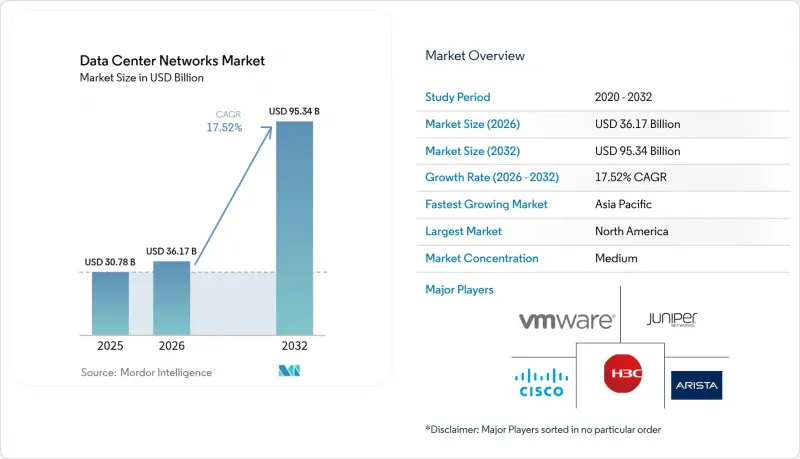
This report is Segmented by Product (Ethernet Switches and More), Network Architecture (Spine-Leaf, SDN Overlay, and More), Deployment Model ( On-Premises/Enterprise DC and More), End-User Industry (covering IT and Telecom, BFSI, and More), and Geography (North America, Asia-Pacific, and More). Market Forecasts are Provided in Terms of Value (USD).
Global Data Center Networks Market Trends and Insights
Increasing Utilization of Cloud Storage
Hybrid and multi-cloud strategies are reshaping traffic flows inside and between facilities. Operators now twin spine-leaf fabrics with 25G and 100G uplinks to meet parallel object-storage I/O requirements. Lumen Technologies doubled intercity fiber to back AI-driven demand, underscoring the link between cloud storage growth and network upgrades. Continuous scaling pressures are tilting designs toward leaf-spine topologies that minimize oversubscription and keep latency predictable.
Surge in Global IP Traffic from IoT and Video
Industrial IoT sensors, medical devices, and smart-city endpoints now stream data that must be ingested at edge nodes for real-time analytics. At the same time, high-definition video accounts for the majority of consumer traffic. Lumentum's 300 X 300-port optical switch highlights the scale of interconnect density being adopted to keep pace with this surge. Intelligent traffic-management systems are therefore becoming mandatory for bandwidth arbitration across mixed workload profiles.
Shortage of Skilled Network Professionals
AI-native fabrics require expertise spanning silicon photonics, intent-based policy, and multi-cloud orchestration. Juniper's Apstra shows that automated intent engines can reduce provisioning cycles by 85%, highlighting automation as a direct response to talent gaps. Training investments and low-code operational tools continue to grow as enterprises try to mitigate staffing risk.
Other drivers and restraints analyzed in the detailed report include:
- Growth in Retail and E-Commerce Data Traffic
- Rapid Adoption of 400G/800G Optics Lowers USD/bit
- High Capex for Next-Gen Switching Fabric
For complete list of drivers and restraints, kindly check the Table Of Contents.
Segment Analysis
Ethernet switches contributed 43.82% revenue in 2025, reflecting their status as the backbone of GPU training clusters. Several 102.4 Tb/s devices entered volume production this year, elevating port density without expanding rack footprint. Optical interconnect and cabling is the fastest riser with an 18.32% CAGR through 2032, powered by co-packaged optics that deliver 3.5 X power efficiency improvements. Integration of switching, routing, and firewall functions inside unified appliances is also emerging, enabling zero-trust enforcement at line rate.
Continuous ASIC innovation is reshaping vendor hierarchies. NVIDIA's Spectrum-X made its commercial debut in March 2025, merging photonics and Ethernet switching in a single platform. These dynamics are narrowing differentiation based purely on throughput and shifting focus toward software feature sets and energy efficiency. The data center networks market continues to reward suppliers that can couple hardware advances with cloud-based operational tooling.
Spine-leaf held 48.25% market share in 2025 owing to predictable latency and linear scale characteristics. The architecture eliminates single-tier choke points by creating equal-cost paths between every leaf and spine, which aligns with microservices traffic patterns that dominate east-west directions. SDN overlays post the fastest growth at 18.64% CAGR as enterprises centralize control across multi-vendor underlays.
Three-tier designs remain in brownfield installations where refurbishment budgets are constrained. Mesh or hyper-scale custom topologies serve niche AI factories demanding sub-microsecond hop latency. Intent-based provisioning is being layered on top of all designs, reducing manual errors and fostering compliance. The data center networks market size for SDN overlays is poised to benefit as organizations prioritize agility over fixed-function hardware investments.
Complete Report Scope:
- By Product
- Ethernet Switches
- Routers
- Storage-Area-Network (SAN) Equipment
- Optical Interconnect and Cabling
- Network Security Appliances
- By Network Architecture
- Spine-Leaf
- 3-Tier (Core/Agg/Access)
- Mesh / Hyper-scale Custom
- Software-Defined Networking (SDN) Overlay
- By Deployment Model
- Colocation Facilities
- Hyper-scale/Self-built Facilities
- On-Premises Enterprise /Edge / Micro-Data-Centers
- By End-User Industry
- IT and Telecom
- BFSI
- Healthcare
- Retail and E-commerce
- Government and Defense
- Energy and Utilities
- Other End User
- Geography
- North America
- United States
- Canada
- Mexico
- Europe
- Germany
- United Kingdom
- Rest of Europe
- Asia-Pacific
- China
- India
- Rest of Asia-Pacific
- South America
- Middle East and Africa
- North America
Geography Analysis
North America leads the data center networks market due to the presence of Amazon Web Services, Microsoft Azure, and Google Cloud. Meta committed USD 65 billion for new AI-ready campuses and Equinix secured USD 15 billion for AI-optimized facilities, accelerating domestic demand. Canada is capitalizing on abundant renewable energy, making several provinces attractive for new hyperscale sites.
Europe follows with Germany at the forefront. Energy-efficiency legislation compels operators to adopt power-lean optical fabrics, boosting upgrade cycles. The United Kingdom focuses on sub-millisecond trading networks that require deterministic switching and granular telemetry.
Asia-Pacific is the fastest mover as China, India, and Indonesia channel sovereign-cloud incentives into new builds. Edge computing hotspots are emerging in populous metros to support 5G and IoT services. South America plus Middle East and Africa are nascent yet rising; internet-penetration gains and digital-transformation projects set the groundwork for double-digit regional growth rates.
- Cisco Systems Inc.
- Juniper Networks Inc.
- Arista Networks Inc.
- Huawei Technologies Co. Ltd.
- Dell Technologies Inc.
- Hewlett Packard Enterprise Co. (HPE)
- Extreme Networks Inc.
- NVIDIA Corporation (NVIDIA Networking)
- Broadcom Inc.
- VMware Inc.
- Lenovo Group Ltd.
- NEC Corporation
- Pluribus Networks
- Edgecore Networks Corporation
- Super Micro Computer Inc. (Supermicro)
- Quanta Cloud Technology (QCT)
- Fortinet Inc.
- Cumulus Networks (NVIDIA)
- Chelsio Communications Inc.
- H3C Holding Limited
- Inspur Group Co. Ltd.
Additional Benefits:
- The market estimate (ME) sheet in Excel format
- 3 months of analyst support
TABLE OF CONTENTS
1 INTRODUCTION
- 1.1 Study Assumptions and Market Definition
- 1.2 Scope of the Study
2 RESEARCH METHODOLOGY
3 EXECUTIVE SUMMARY
4 MARKET LANDSCAPE
- 4.1 Market Overview
- 4.2 Market Drivers
- 4.2.1 Increasing utilization of cloud storage
- 4.2.2 Rising need for data back-up and restoration
- 4.2.3 Growth in retail and e-commerce data traffic
- 4.2.4 Surge in global IP traffic from IoT and video
- 4.2.5 Rapid adoption of 400G/800G optics lowers usd/bit (under-reported)
- 4.2.6 Edge-data-center build-outs for low-latency apps (under-reported)
- 4.3 Market Restraints
- 4.3.1 Shortage of skilled network professionals
- 4.3.2 High capex for next-gen switching fabric
- 4.3.3 Security and compliance risks in SDN overlays
- 4.3.4 Advanced-chip supply-chain volatility (under-reported)
- 4.4 Value / Supply-Chain Analysis
- 4.5 Regulatory Landscape
- 4.6 Technological Outlook
5 MARKET SIZE AND GROWTH FORECASTS (VALUE, USD BILLION)
- 5.1 By Product
- 5.1.1 Ethernet Switches
- 5.1.2 Routers
- 5.1.3 Storage-Area-Network (SAN) Equipment
- 5.1.4 Optical Interconnect and Cabling
- 5.1.5 Network Security Appliances
- 5.2 By Network Architecture
- 5.2.1 Spine-Leaf
- 5.2.2 3-Tier (Core/Agg/Access)
- 5.2.3 Mesh / Hyper-scale Custom
- 5.2.4 Software-Defined Networking (SDN) Overlay
- 5.3 By Deployment Model
- 5.3.1 Colocation Facilities
- 5.3.2 Hyper-scale/Self-built Facilities
- 5.3.3 On-Premises Enterprise /Edge / Micro-Data-Centers
- 5.4 By End-User Industry
- 5.4.1 IT and Telecom
- 5.4.2 BFSI
- 5.4.3 Healthcare
- 5.4.4 Retail and E-commerce
- 5.4.5 Government and Defense
- 5.4.6 Energy and Utilities
- 5.4.7 Other End User
- 5.5 Geography
- 5.5.1 North America
- 5.5.1.1 United States
- 5.5.1.2 Canada
- 5.5.1.3 Mexico
- 5.5.2 Europe
- 5.5.2.1 Germany
- 5.5.2.2 United Kingdom
- 5.5.2.3 Rest of Europe
- 5.5.3 Asia-Pacific
- 5.5.3.1 China
- 5.5.3.2 India
- 5.5.3.3 Rest of Asia-Pacific
- 5.5.4 South America
- 5.5.5 Middle East and Africa
- 5.5.1 North America
6 COMPETITIVE LANDSCAPE
- 6.1 Market Share Analysis
- 6.2 Company Profiles (includes Global level Overview, Market level overview, Core Segments, Financials as available, Strategic Information, Market Rank/Share for key companies, Products and Services, and Recent Developments)
- 6.2.1 Cisco Systems Inc.
- 6.2.2 Juniper Networks Inc.
- 6.2.3 Arista Networks Inc.
- 6.2.4 Huawei Technologies Co. Ltd.
- 6.2.5 Dell Technologies Inc.
- 6.2.6 Hewlett Packard Enterprise Co. (HPE)
- 6.2.7 Extreme Networks Inc.
- 6.2.8 NVIDIA Corporation (NVIDIA Networking)
- 6.2.9 Broadcom Inc.
- 6.2.10 VMware Inc.
- 6.2.11 Lenovo Group Ltd.
- 6.2.12 NEC Corporation
- 6.2.13 Pluribus Networks
- 6.2.14 Edgecore Networks Corporation
- 6.2.15 Super Micro Computer Inc. (Supermicro)
- 6.2.16 Quanta Cloud Technology (QCT)
- 6.2.17 Fortinet Inc.
- 6.2.18 Cumulus Networks (NVIDIA)
- 6.2.19 Chelsio Communications Inc.
- 6.2.20 H3C Holding Limited
- 6.2.21 Inspur Group Co. Ltd.
7 INVESTMENT ANALYSIS
8 MARKET OPPORTUNITIES AND FUTURE OUTLOOK

