PUBLISHER: Mordor Intelligence | PRODUCT CODE: 2122886

PUBLISHER: Mordor Intelligence | PRODUCT CODE: 2122886
Office Furniture - Market Share Analysis, Industry Trends & Statistics, Growth Forecasts (2026 - 2031)
According to Mordor Intelligence, the office furniture market size is projected to expand from USD 78.10 billion in 2025 and USD 82.60 billion in 2026 to USD 116.80 billion by 2031, registering a CAGR of 7.15% between 2026 to 2031.
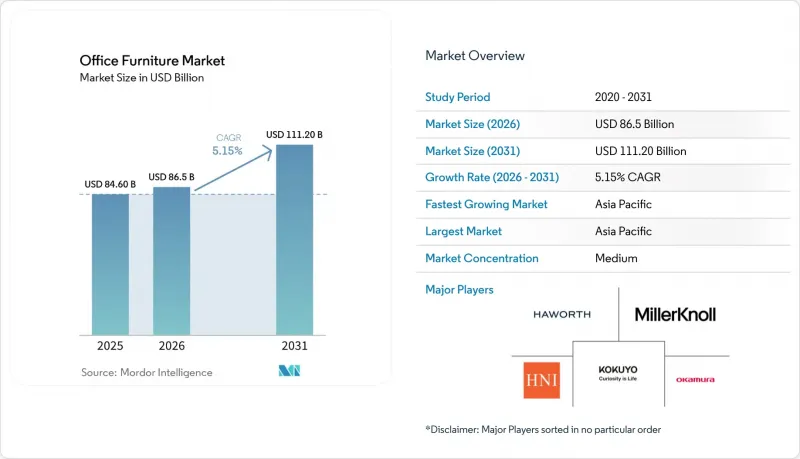
This report is Segmented by Furniture Type (Seating, Tables, and More), Distribution Channel (B2B, B2C and More), and Geography (North America, South America, Europe, Asia-Pacific, Middle East and Africa). The Market Forecasts are Provided in Terms of Value (USD).
Global Office Furniture Market Trends and Insights
Expansion of Co-Working Spaces And Hybrid Work Models
Hybrid work has stabilized headcount distributions across headquarters, regional hubs, and third spaces, so buyers favour flexible systems that mix density with privacy and can shift between team sessions and focused work. The office furniture market benefits as operators and employers configure more enclosed micro environments, standardized ergonomic seating fleets, and modular storage that can be redeployed across sites. Corporate portfolios now include memberships or satellite spaces to reduce commute friction, which spreads procurement beyond core CBDs into suburban nodes that value scalable logistics. Manufacturers are responding with localized showrooms and digital tools to enable specification at speed, as seen in MillerKnoll's 2025 China showroom launch and a broader retail footprint strategy aimed at capturing hybrid-driven refresh cycles. Product breadth is expanding to support multi-use rooms, adding mobile tables, stackable seating, and adaptable work booths, with acquisitions such as Okamura's Boss Design purchase strengthening lounge and loose furniture lines used in flex environments.
Commercial Real Estate Expansion Increasing Office Fit-Out Requirements
New office stock and active renovation pipelines translate directly into orders for desks, seating, storage, and partitions, with the effect strongest in the Asia Pacific. India's 2026 demand outlook builds off 2025 project momentum, where 65 to 70 million square feet of new office space was projected, and local leaders have committed fresh capital to ergonomic portfolios to serve that pipeline. Gulf programs in the UAE and Saudi Arabia are likewise boosting institutional procurement across government and education sectors, favouring durable, standards-compliant products specified in bulk. The office furniture market skews toward whole-site packages for these projects, rewarding suppliers that offer integrated lines across task seating, systems, and communal areas. International players are also partnering or acquiring to bolster regional fit-out positioning, widening developers' and facility managers' choices while keeping delivery lead times competitive.
Corporate Real-Estate Footprint Consolidation Reducing Workstation Density
As hybrid work policies gain traction, many large employers are reducing their overall floor space. This reduction directly translates to fewer workstations needing furnishing. Headquarters that previously accommodated every employee are now adjusting to plan for a peak occupancy of only 60-70%. This shift not only reduces bulk-order volumes but also extends replacement cycles. Facilities teams are now channeling budgets toward collaboration zones rather than individual desks, leading to a disparity in demand across product categories. Manufacturers focusing on task desks and basic chairs are facing the brunt of this volume risk. In contrast, those providing modular lounge systems are finding ways to mitigate some of these losses. Experts predict that this transitional phase will impact top-line growth for the next two to three years, until hybrid occupancy patterns find their footing.
Other drivers and restraints analyzed in the detailed report include:
- Adoption of Sustainable And Eco-Friendly Furniture Aligned With ESG Objectives
- Focus on Workplace Ergonomics and Employee Well-Being
- Macroeconomic Uncertainty and High Interest Rates Prompting Deferral of Office Fit-Out Capital Expenditure
For complete list of drivers and restraints, kindly check the Table Of Contents.
Segment Analysis
Chairs led the category with 31.40% market share in 2025 and are projected to grow at an 8.30% CAGR through 2031, reflecting employer focus on healthy posture, adjustability, and durability across task seating fleets. Task chairs remain the anchor of workplace setups, with specifications that emphasize lumbar support, arm adjustability, and reliable mechanisms that withstand daily use in hybrid attendance patterns. Wellness positioning drives investment-level purchases, and premium seating anchors upgrades in offices that are repositioning to attract employees back on site. Several vendors are advancing designs that blend ergonomic support with responsive movement and sensor-driven feedback for posture and comfort. Product roadmaps from leading brands introduce new task and guest seating that fit both open collaboration and enclosed focus rooms, supporting a balanced space-planning strategy in the global office furniture market.
Tables and desking systems keep evolving toward mobility and power integration, with sit-stand platforms embedded as a standard rather than a niche option. Conference tables now require hidden power, cable management, and finishes that endure frequent cleaning without visible wear. Privacy solutions from phone booths to modular dividers are gaining share where teams add focus spaces to counteract open plan noise. Manufacturers highlight acoustic, privacy, and modular systems to reconfigure zones for team standups, client meetings, and solo work within the same footprint. New systems enable tool-less reconfiguration, which reduces facility downtime and labor costs during changeovers. Adoption of these formats supports a multi-year replacement cycle that aligns with hybrid work and the broader office furniture market.
Wood retained 45.20% of the office furniture market share in 2025 and remains the preferred finish in executive and client-facing spaces where warmth and visual quality influence selection. As the office furniture market scales, modular systems, wood veneers, and laminates complement metal structures to deliver both aesthetics and performance. Sustainability commitments are shaping wood sourcing, with certifications and renewable energy adoption integrated into corporate goals. Buyers in regulated sectors also request product-level disclosures and supplier transparency on material origins, elevating the bar for documentation in bids. Metal frames are accelerating at a 7.60% CAGR on the back of sit-stand desking, modular benching, and partition systems that must withstand frequent reconfiguration without service calls.
Metal-oriented platforms benefit from footprint rationalization and component standardization, which improve cost leverage and lead-time reliability. Tariff policy continues to affect imported metal costs and reinforces the value of nearshoring for North American deliveries. Companies that combine domestic transformation with cross-brand component strategies are better positioned to weather inbound price shocks. Circular material practices are also advancing, with closed-loop plastics and targeted disassembly designs reducing waste for seating and panels. These practices align with corporate reporting needs and the long-term direction of enterprise purchasing requirements.
Complete Report Scope:
- By Product
- Chairs
- Employee Chairs
- Meeting Chairs
- Guest Chairs
- Tables
- Conference Tables
- Desks
- Other Tables
- Storage Units
- Filing Cabinets
- Bookcases & Shelving
- Sofas/Soft Seating
- Booths and Office Dividers
- Other Office Furniture (Stools, Reception Area Furniture, Accessories, Others)
- Chairs
- By Material
- Wood
- Metal
- Plastic & Polymer
- Other Materials
- By Price Range
- Economy
- Mid-range
- Premium
- By End-user
- Corporate Offices
- Healthcare Offices
- Educational Institutions
- Government & Public Offices
- Hospitality & Retail Back-office
- Others
- By Distribution Channel
- B2C/Retail
- Home Centers
- Specialty Furniture Stores
- Online
- Other Distribution Channels
- B2B/Directly from Manufacturers
- B2C/Retail
- By Geography
- North America
- Canada
- United States
- Mexico
- South America
- Brazil
- Peru
- Chile
- Argentina
- Rest of South America
- Europe
- United Kingdom
- Germany
- France
- Spain
- Italy
- BENELUX (Belgium, Netherlands, and Luxembourg)
- NORDICS (Denmark, Finland, Iceland, Norway, and Sweden)
- Rest of Europe
- Asia Pacific
- India
- China
- Japan
- Australia
- South Korea
- South East Asia (Singapore, Malaysia, Thailand, Indonesia, Vietnam, and Philippines)
- Rest of Asia Pacific
- Middle East And Africa
- United Arab of Emirates
- Saudi Arabia
- South Africa
- Nigeria
- Rest of Middle East And Africa
- North America
Geography Analysis
Asia Pacific leads with 41.20% in 2025 and is projected to grow at a 7.20% CAGR through 2031, supported by active development and expanding service-sector employment. India's pipeline of 65 to 70 million square feet of office space in 2025 points to significant demand for workstations and seating, and local producers are investing in capacity and digital tools to capitalize on this opportunity. Regional players are expanding product portfolios and distribution footprints to integrate loose furniture and architectural elements with core task seating strengths. Global brands are also expanding showrooms and partner networks to serve enterprise specifications and to align with localized tastes, as seen in new brand spaces in major Chinese cities. Together, these moves reinforce Asia's role as both a demand center and a manufacturing hub for the office furniture market.
North America exhibits steady replacement cycles with a focus on modernizing layouts rather than adding raw square footage. Tariff policy increases the cost of metal-intensive components, which elevates the importance of regional manufacturing and multi-sourcing. Several companies are ramping up facilities in Mexico to reduce lead times, cut freight miles, and avoid specific duty exposure while maintaining North American service levels. Government accounts continue to prioritize compliant origin and performance standards, which influence vendor selection and project planning. Retail showrooms and direct channels are expanding to capture higher-margin sales from home-office and design-led buyers, complementing contract sales and strengthening brand visibility. These dynamics support a balanced outlook for the office furniture market.
Europe invests in flexible and sustainable designs while navigating energy and regulatory costs. Suppliers emphasize traceability, clean chemistry, and recyclability to align with public procurement and corporate ESG requirements. Product innovation cycles are active, with awards and showcases that emphasize craftsmanship, refined work booths, and lounge elements that support hybrid work styles. Across the wider EMEA region, sovereign-backed developments and diversified corporate expansions drive demand for compliant, globally recognized brands. Suppliers with regional showrooms and service partners are better placed to win projects that require rapid response and multi-country execution. As sustainability and flexibility become increasingly important, the office furniture market will continue to favor manufacturers that can document progress and supply at scale.
- MillerKnoll Inc.
- Haworth Inc.
- HNI Corporation
- Okamura Corporation
- KOKUYO Co., Ltd.
- Teknion Corporation
- Kimball International
- Global Furniture Group
- ACTIU Berbegal y Formas S.A.
- Godrej Interio
- Nowy Styl Group
- KI (Krueger International)
- Vitra International AG
- Sedus Stoll AG
- Wilkhahn
- Bene GmbH
- AIS, Inc.
- Workrite Ergonomics
- Geeken Seating Collection Private Limited
- Humanscale
Additional Benefits:
- The market estimate (ME) sheet in Excel format
- 3 months of analyst support
TABLE OF CONTENTS
1 Introduction
- 1.1 Study Assumptions & Market Definition
- 1.2 Scope of the Study
2 Research Methodology
3 Executive Summary
4 Market Landscape
- 4.1 Market Overview
- 4.2 Market Drivers
- 4.2.1 Co-Working Networks & Hybrid Work Models
- 4.2.2 Rising Employment Rates Increasing Furniture Needs
- 4.2.3 Commercial Real Estate Growth Driving Fit-Out Demand
- 4.2.4 Growing Preference For Eco-Friendly Furniture Due to Sustainability & ESG Goals
- 4.2.5 Focus on Workplace Ergonomics & Employee Wellness
- 4.2.6 Digital Procurement Expanding Market Reach & Accessibility
- 4.3 Market Restraints
- 4.3.1 Corporate real-estate footprint consolidation reducing workstation density
- 4.3.2 Intense price competition and margin compression among mid-tier and regional manufacturers
- 4.3.3 Macroeconomic uncertainty and high interest rates prompting deferral of office fit-out capital expenditure
- 4.3.4 Extended product replacement cycles driven by durable materials and refurbished furniture programs
- 4.4 Industry Value Chain Analysis
- 4.5 Porter's Five Forces Analysis
- 4.5.1 Threat of New Entrants
- 4.5.2 Bargaining Power of Suppliers
- 4.5.3 Bargaining Power of Buyers
- 4.5.4 Threat of Substitutes
- 4.5.5 Competitive Rivalry
- 4.6 Insights into the Latest Trends and Innovations in the Market
- 4.7 Insights on Recent Developments (New Product Launches, Strategic Initiatives, Investments, Partnerships, JVs, Expansion, M&As, etc.) in the Market
- 4.8 Insights on Regulatory Framework and Industry Standards for Office Furniture
5 Market Size & Growth Forecasts (Value)
- 5.1 By Product
- 5.1.1 Chairs
- 5.1.1.1 Employee Chairs
- 5.1.1.2 Meeting Chairs
- 5.1.1.3 Guest Chairs
- 5.1.2 Tables
- 5.1.2.1 Conference Tables
- 5.1.2.2 Desks
- 5.1.2.3 Other Tables
- 5.1.3 Storage Units
- 5.1.3.1 Filing Cabinets
- 5.1.3.2 Bookcases & Shelving
- 5.1.4 Sofas/Soft Seating
- 5.1.5 Booths and Office Dividers
- 5.1.6 Other Office Furniture (Stools, Reception Area Furniture, Accessories, Others)
- 5.1.1 Chairs
- 5.2 By Material
- 5.2.1 Wood
- 5.2.2 Metal
- 5.2.3 Plastic & Polymer
- 5.2.4 Other Materials
- 5.3 By Price Range
- 5.3.1 Economy
- 5.3.2 Mid-range
- 5.3.3 Premium
- 5.4 By End-user
- 5.4.1 Corporate Offices
- 5.4.2 Healthcare Offices
- 5.4.3 Educational Institutions
- 5.4.4 Government & Public Offices
- 5.4.5 Hospitality & Retail Back-office
- 5.4.6 Others
- 5.5 By Distribution Channel
- 5.5.1 B2C/Retail
- 5.5.1.1 Home Centers
- 5.5.1.2 Specialty Furniture Stores
- 5.5.1.3 Online
- 5.5.1.4 Other Distribution Channels
- 5.5.2 B2B/Directly from Manufacturers
- 5.5.1 B2C/Retail
- 5.6 By Geography
- 5.6.1 North America
- 5.6.1.1 Canada
- 5.6.1.2 United States
- 5.6.1.3 Mexico
- 5.6.2 South America
- 5.6.2.1 Brazil
- 5.6.2.2 Peru
- 5.6.2.3 Chile
- 5.6.2.4 Argentina
- 5.6.2.5 Rest of South America
- 5.6.3 Europe
- 5.6.3.1 United Kingdom
- 5.6.3.2 Germany
- 5.6.3.3 France
- 5.6.3.4 Spain
- 5.6.3.5 Italy
- 5.6.3.6 BENELUX (Belgium, Netherlands, and Luxembourg)
- 5.6.3.7 NORDICS (Denmark, Finland, Iceland, Norway, and Sweden)
- 5.6.3.8 Rest of Europe
- 5.6.4 Asia Pacific
- 5.6.4.1 India
- 5.6.4.2 China
- 5.6.4.3 Japan
- 5.6.4.4 Australia
- 5.6.4.5 South Korea
- 5.6.4.6 South East Asia (Singapore, Malaysia, Thailand, Indonesia, Vietnam, and Philippines)
- 5.6.4.7 Rest of Asia Pacific
- 5.6.5 Middle East And Africa
- 5.6.5.1 United Arab of Emirates
- 5.6.5.2 Saudi Arabia
- 5.6.5.3 South Africa
- 5.6.5.4 Nigeria
- 5.6.5.5 Rest of Middle East And Africa
- 5.6.1 North America
6 Competitive Landscape
- 6.1 Market Concentration
- 6.2 Strategic Moves
- 6.3 Market Share Analysis
- 6.4 Company Profiles (includes Global level Overview, Market level overview, Core Segments, Financials as available, Strategic Information, Market Rank/Share for key companies, Products & Services, and Recent Developments)
- 6.4.1 MillerKnoll Inc.
- 6.4.2 Haworth Inc.
- 6.4.3 HNI Corporation
- 6.4.4 Okamura Corporation
- 6.4.5 KOKUYO Co., Ltd.
- 6.4.6 Teknion Corporation
- 6.4.7 Kimball International
- 6.4.8 Global Furniture Group
- 6.4.9 ACTIU Berbegal y Formas S.A.
- 6.4.10 Godrej Interio
- 6.4.11 Nowy Styl Group
- 6.4.12 KI (Krueger International)
- 6.4.13 Vitra International AG
- 6.4.14 Sedus Stoll AG
- 6.4.15 Wilkhahn
- 6.4.16 Bene GmbH
- 6.4.17 AIS, Inc.
- 6.4.18 Workrite Ergonomics
- 6.4.19 Geeken Seating Collection Private Limited
- 6.4.20 Humanscale
7 Market Opportunities & Future Outlook
- 7.1 Technology-enabled, sustainable office furniture solutions
- 7.2 Customizable, privacy-oriented furniture designs for evolving office layouts

