PUBLISHER: Mordor Intelligence | PRODUCT CODE: 2123325

PUBLISHER: Mordor Intelligence | PRODUCT CODE: 2123325
GCC Managed Services - Market Share Analysis, Industry Trends & Statistics, Growth Forecasts (2026 - 2031)
According to Mordor Intelligence, the GCC managed services market size in 2026 is estimated at USD 12.35 billion, growing from 2025 value of USD 11.35 billion with 2031 projections showing USD 18.87 billion, growing at 8.84% CAGR over 2026-2031.
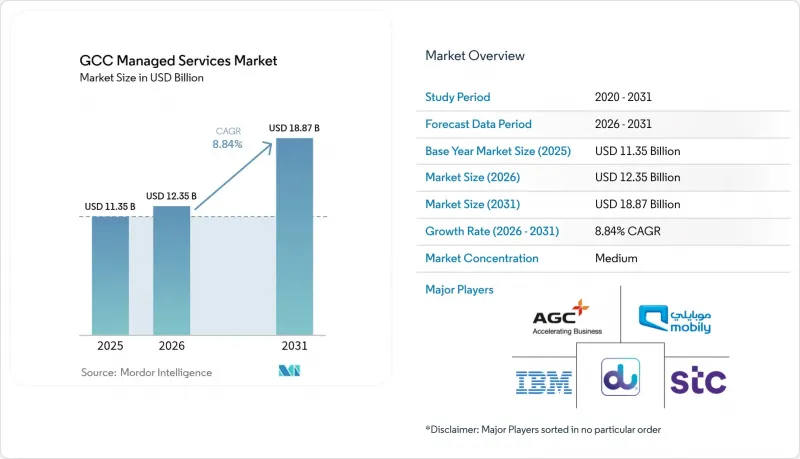
This report is Segmented by Managed Service Type (Managed Infrastructure Services, and More), End-User Support Services, End-User Vertical (IT and Telecom, BFSI, and More), Service Delivery Model (Remote/Off-site, and More), Organization Size (Large Enterprises, Smes), Deployment Environment (On-Premise, Public Cloud, and More), and Geography. The Market Forecasts are Provided in Terms of Value (USD).
GCC Managed Services Market Trends and Insights
Surge in hyperscale cloud-region launches across GCC
Microsoft's Project MGX targets 14 hyperscale campuses, while Oracle has opened its second Riyadh cloud region under a USD 1.5 billion program. The region's data-center capacity is on track to surpass 1 GW by 2026, prompting enterprises to seek managed partners for low-latency, AI-ready workloads. A USD 5 billion KKR-Gulf Data Hub venture underscores long-term capital inflows that sustain demand for operations, security, and compliance services. As hyperscalers localize infrastructure to satisfy sovereignty mandates, the GCC managed services market must deliver both global-grade tooling and in-country expertise.
Mandatory in-country data-residency and sovereignty rules
Saudi Arabia's Personal Data Protection Law and the UAE's banking directives require customer records to remain inside national borders, forcing enterprises to change hosting architectures. Microsoft, Oracle, and AWS have all launched "sovereign cloud" offerings that rely on local partners for monitoring and incident response, because certification schemes differ by state, multi-jurisdiction organizations depend on managed service providers (MSPs) to coordinate audits and maintain continuous compliance across six distinct GCC frameworks. Elevated non-compliance fines in free-zone jurisdictions add urgency to outsource governance workloads.
Persistent shortage of Arabic-speaking Tier-3 engineers
The GCC faces a critical talent gap in Arabic-speaking technical professionals, with Korn Ferry projecting nearly USD 40 billion in talent shortage costs across the UAE and Saudi Arabia, including USD 2.4 billion in wage premiums for the technology, media, and telecom sectors in Saudi Arabia alone. Saudi Arabia's requirement for 51% of IT organizations to address skills gaps as their primary challenge creates structural constraints on managed services delivery, particularly for complex technical support requiring local language capabilities. The shortage becomes more acute in Tier-3 support roles where cultural understanding and Arabic fluency are essential for effective client interaction, forcing managed service providers to invest heavily in training programs or accept higher operational costs through premium compensation packages. European tech professionals are increasingly attracted to GCC markets, with network engineers earning an average of USD 74,900 in the Middle East compared to USD 31,000 in European markets, but language barriers limit their effectiveness in client-facing roles. Oracle's commitment to train 350,000 people in AI and advanced digital technologies across the Middle East represents industry recognition of the skills gap, but the timeline for developing Arabic-speaking technical expertise extends the constraint's impact. The World Economic Forum's prediction of 945,000 new jobs requiring digital skills in the region by 2025 indicates the scale of talent development needed to address this constraint.
Other drivers and restraints analyzed in the detailed report include:
- Outsourcing push from Vision 2030 and other national agendas
- AI-enabled service automation cutting total cost of ownership
- Government "Saudization/Emiratization" hiring quotas
For complete list of drivers and restraints, kindly check the Table Of Contents.
Segment Analysis
Managed Security Services contributed USD 2.91 billion, equal to 25.62% of the GCC managed services market share in 2025, underlining demand for 24/7 threat monitoring and incident response. Rising attack volumes-from 50,000 attempted breaches daily in the UAE alone-drive enterprises to outsource advanced security operations. Managed Cloud Services, while representing a smaller revenue base, are growing at 13.65% CAGR as hyperscale expansions require governance, optimization, and FinOps expertise. The segment benefits from sovereign-cloud rollouts and low-latency AI workload requirements.
Infrastructure, network, and disaster-recovery offerings remain essential for legacy modernization and regulatory compliance. 5G rollouts by e& and stc fuel managed network demand, while national continuity regulations boost uptake of disaster-recovery-as-a-service. Emerging managed IoT and edge compute packages support smart-city projects such as Abu Dhabi's Aion Sentia, widening the addressable scope. Collectively, these patterns reinforce a diversified revenue mix that protects the GCC managed services market against cyclicality.
The BFSI segment generated USD 2.43 billion, equivalent to 21.45% of the total GCC managed services market size in 2025, reflecting stringent governance standards and real-time transaction-processing needs. Banks contract MSPs for secure core-banking, anti-fraud analytics, and open-banking API management. Healthcare grows fastest at 13.36% CAGR as electronic health records and telemedicine platforms necessitate HIPAA-style data protection alongside AI-enabled diagnostics. Government agencies and energy majors continue to outsource specialized workloads, while retail and manufacturing leverage cloud-native MSPs for omnichannel and supply-chain optimization.
Managed-service penetration remains uneven across verticals, but AI automation and cyber-insurance mandates create cross-sector tailwinds. As sectoral requirements converge on compliance, uptime, and security, providers with verticalized blueprints gain pricing power. These dynamic supports sustained double-digit expansion across the GCC managed services industry.
Complete Report Scope:
- By Managed Service Type
- Managed Infrastructure Services
- Managed Hosting Services
- Managed Security Services
- Managed Cloud Services
- Disaster Recovery and Business Continuity
- Network and Communication Services
- End-user Support Services
- Managed IoT Services
- By End-user Vertical
- IT and Telecom
- BFSI
- Oil and Gas
- Healthcare
- Government
- Retail and E-commerce
- Education
- Manufacturing
- Energy and Utilities
- By Service Delivery Model
- Remote / Off-site Managed Services
- On-site / Field Managed Services
- Hybrid Model
- Co-managed Services
- By Organization Size
- Large Enterprises
- Small and Medium-sized Enterprises (SMEs)
- By Deployment Environment
- On-premise
- Public Cloud
- Private Cloud
- Hybrid Cloud
- By Geography
- Saudi Arabia
- United Arab Emirates
- Qatar
- Kuwait
- Oman
- Bahrain
List of Companies Covered in this Report:
- Etihad Etisalat Co. (Mobily)
- Emitac Enterprise Solutions LLC
- Saudi Telecom Company (stc)
- Hewlett Packard Enterprise Company
- ACS Group
- International Business Machines Corporation
- Diyar United Company
- Ooredoo Q.P.S.C.
- Wipro Limited
- AGC Networks Limited
- MEEZA QSTP-LLC
- Emirates Integrated Telecommunications Company PJSC (du)
- Injazat Data Systems LLC
- Gulf Business Machines (GBM)
- Fujitsu Ltd.
- Oracle Corporation
- SAP SE
- Tata Consultancy Services Limited
- Cognizant Technology Solutions Corporation
- Accenture plc
- Capgemini SE
Additional Benefits:
- The market estimate (ME) sheet in Excel format
- 3 months of analyst support
TABLE OF CONTENTS
1 INTRODUCTION
- 1.1 Study Assumptions and Market Definition
- 1.2 Scope of the Study
2 RESEARCH METHODOLOGY
3 EXECUTIVE SUMMARY
4 MARKET LANDSCAPE
- 4.1 Market Overview
- 4.2 Market Drivers
- 4.2.1 Surge in hyperscale cloud-region launches across GCC
- 4.2.2 Mandatory in-country data-residency and sovereignty rules
- 4.2.3 Outsourcing push from Vision 2030 and other national agendas
- 4.2.4 Rising cyber-insurance requirements driving managed security uptake
- 4.2.5 AI-enabled service automation cutting total cost of ownership
- 4.2.6 ESG-linked OPEX shifting CAPEX workloads to MSPs
- 4.3 Market Restraints
- 4.3.1 Persistent shortage of Arabic-speaking Tier-3 engineers
- 4.3.2 Government "Saudization/Emiratization" hiring quotas
- 4.3.3 High energy-pricing volatility for data-center operations
- 4.3.4 Fragmented regulatory certifications across GCC states
- 4.4 Value / Supply-Chain Analysis
- 4.5 Regulatory Landscape
- 4.6 Technological Outlook
- 4.7 Porter's Five Forces Analysis
- 4.7.1 Threat of New Entrants
- 4.7.2 Bargaining Power of Buyers
- 4.7.3 Bargaining Power of Suppliers
- 4.7.4 Threat of Substitutes
- 4.7.5 Intensity of Competitive Rivalry
- 4.8 Impact of Macro Trends
- 4.9 Key Market Considerations and Emerging Use-Cases
5 MARKET SIZE AND GROWTH FORECASTS (VALUE)
- 5.1 By Managed Service Type
- 5.1.1 Managed Infrastructure Services
- 5.1.2 Managed Hosting Services
- 5.1.3 Managed Security Services
- 5.1.4 Managed Cloud Services
- 5.1.5 Disaster Recovery and Business Continuity
- 5.1.6 Network and Communication Services
- 5.1.7 End-user Support Services
- 5.1.8 Managed IoT Services
- 5.2 By End-user Vertical
- 5.2.1 IT and Telecom
- 5.2.2 BFSI
- 5.2.3 Oil and Gas
- 5.2.4 Healthcare
- 5.2.5 Government
- 5.2.6 Retail and E-commerce
- 5.2.7 Education
- 5.2.8 Manufacturing
- 5.2.9 Energy and Utilities
- 5.3 By Service Delivery Model
- 5.3.1 Remote / Off-site Managed Services
- 5.3.2 On-site / Field Managed Services
- 5.3.3 Hybrid Model
- 5.3.4 Co-managed Services
- 5.4 By Organization Size
- 5.4.1 Large Enterprises
- 5.4.2 Small and Medium-sized Enterprises (SMEs)
- 5.5 By Deployment Environment
- 5.5.1 On-premise
- 5.5.2 Public Cloud
- 5.5.3 Private Cloud
- 5.5.4 Hybrid Cloud
- 5.6 By Geography
- 5.6.1 Saudi Arabia
- 5.6.2 United Arab Emirates
- 5.6.3 Qatar
- 5.6.4 Kuwait
- 5.6.5 Oman
- 5.6.6 Bahrain
6 COMPETITIVE LANDSCAPE
- 6.1 Market Concentration Analysis
- 6.2 Strategic Moves (M&A, Partnerships, Launches)
- 6.3 Market Share Analysis (Top-15, 2024)
- 6.4 Company Profiles (includes Global Level Overview, Market Level Overview, Core Segments, Financials as available, Strategic Information, Market Rank/Share, Products and Services, Recent Developments)
- 6.4.1 Etihad Etisalat Co. (Mobily)
- 6.4.2 Emitac Enterprise Solutions LLC
- 6.4.3 Saudi Telecom Company (stc)
- 6.4.4 Hewlett Packard Enterprise Company
- 6.4.5 ACS Group
- 6.4.6 International Business Machines Corporation
- 6.4.7 Diyar United Company
- 6.4.8 Ooredoo Q.P.S.C.
- 6.4.9 Wipro Limited
- 6.4.10 AGC Networks Limited
- 6.4.11 MEEZA QSTP-LLC
- 6.4.12 Emirates Integrated Telecommunications Company PJSC (du)
- 6.4.13 Injazat Data Systems LLC
- 6.4.14 Gulf Business Machines (GBM)
- 6.4.15 Fujitsu Ltd.
- 6.4.16 Oracle Corporation
- 6.4.17 SAP SE
- 6.4.18 Tata Consultancy Services Limited
- 6.4.19 Cognizant Technology Solutions Corporation
- 6.4.20 Accenture plc
- 6.4.21 Capgemini SE
7 MARKET OPPORTUNITIES AND FUTURE TRENDS
- 7.1 White-space and Unmet-Need Assessment

