PUBLISHER: Mordor Intelligence | PRODUCT CODE: 2124748

PUBLISHER: Mordor Intelligence | PRODUCT CODE: 2124748
North America Managed Services - Market Share Analysis, Industry Trends & Statistics, Growth Forecasts (2026 - 2031)
According to Mordor Intelligence, the North America managed services market size is expected to grow from USD 73.57 billion in 2025 to USD 80.89 billion in 2026 and is forecast to reach USD 130.06 billion by 2031 at 9.96% CAGR over 2026-2031.
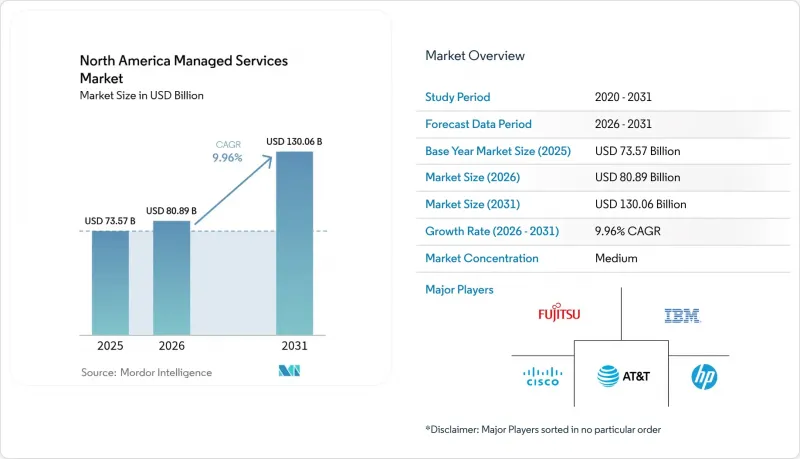
This report is Segmented by Deployment (On-Premises, and More), Service Type (Managed Data Centre, Managed Security, and More), Enterprise Size (Small and Medium Enterprises and Large Enterprises), End-User Vertical (BFSI, IT and Telecom, Healthcare and Life Sciences, and More), and Country. The Market Forecasts are Provided in Terms of Value (USD).
North America Managed Services Market Trends and Insights
Enterprises Shifting to Hybrid and Multi-Cloud Architectures
Roughly 75% of regional organizations now distribute workloads across multiple public clouds and on-premises infrastructure, which intensifies demand for managed orchestration and governance services. Vendor pricing actions that raise licensing costs are accelerating repatriation assessments and hybrid adoption strategies. Enterprises are standardizing on container platforms to limit lock-in and simplify portability, yet they still require outside expertise for policy enforcement, FinOps optimization, and workload migration. Managed service providers are capitalizing by bundling discovery, migration, and ongoing cost-control services into outcome-based contracts that tie fees to savings delivered. These factors collectively sustain the North America managed services market as a critical channel for multicloud operational excellence.
Rising Cyber-Threat Landscape Driving Managed Security Adoption
Threat actors now deploy artificial intelligence to automate reconnaissance and build polymorphic malware, which overwhelms internal security operations centers. New U.S. Securities and Exchange Commission incident-reporting rules obligate public companies to disclose material breaches within four business days, pushing boards to demand 24 X 7 detection and response coverage. Managed detection and response services fill the gap because enterprises often lack staff trained in threat hunting, forensics, and cloud-native security controls. Providers are investing in AI correlation engines that shrink dwell time and meet the stringent reporting windows. As cyber insurance underwriters impose higher premiums for organizations without third-party monitoring, managed security becomes both a technical requirement and a financial hedge.
Data-Sovereignty and Legacy-Integration Complexity
Fourteen U.S. states now enforce comprehensive privacy statutes with varied residency and processing obligations, which complicates cross-border data architectures and lengthens implementation cycles. Many large enterprises retain decades-old proprietary systems that cannot move to public clouds without costly refactoring, forcing providers to blend on-premises support with cloud-native tooling. Compliance frameworks such as NIST SP 800-171 and sector-specific mandates in healthcare or finance require granular audit trails, adding overhead for managed service providers. These factors slow project kickoffs and in certain cases limit the revenue capture potential that otherwise fuels the North America managed services market.
Other drivers and restraints analyzed in the detailed report include:
- IT Talent Shortages and Need for Cost Optimization
- Accelerated Digital Transformation in SMEs
- Vendor Lock-in and Perceived Loss of Control
For complete list of drivers and restraints, kindly check the Table Of Contents.
Segment Analysis
Cloud-hosted deployments generated 58.22% of North America managed services market revenue in 2025, while hybrid environments are forecast for an 11.03% CAGR through 2031. The surge reflects hyperscaler resilience, generous partner rebates, and marketplace procurement that simplify subscription terms. Hybrid adoption gains momentum as strict data-residency rules and edge-compute latency targets push certain workloads closer to users. Industrial firms use private 5G networks to link factories, then anchor data analytics in regional clouds managed by MSPs. As a result, providers rebound from purely lift-and-shift work to ongoing optimization engagements that balance cost, performance, and compliance across diverse infrastructures. The North America managed services market frequently embeds container management add-ons that deliver automated patching and policy enforcement for distributed clusters. Service catalogs now include FinOps dashboards that visualize chargeback and governance metrics, further cementing MSP involvement in cost stewardship.
Managed security accounted for 24.05% of 2025 revenue, underscoring board-level urgency to harden defenses against AI-driven attacks. Managed cloud and application services claim the fastest forecast CAGR at 10.61%, propelled by enterprises that shift custom development into serverless and container environments yet still require external oversight. Legacy data-center services remain relevant for regulated workloads that must stay on-premises, but providers increasingly wrap them in automation and remote-management layers to improve margin profile. Unified communications, SD-WAN, and managed networks support hybrid work patterns that persist in 2025. Across categories, AI-based orchestration engines reduce manual effort, freeing engineers to move into consulting roles that drive higher bill rates. This pivot helps sustain profitability even as price competition intensifies across the North America managed services market.
Complete Report Scope:
- By Deployment
- On-premises
- Cloud-hosted
- Hybrid
- By Service Type
- Managed Data Centre
- Managed Security
- Managed Communications (UCaaS)
- Managed Network (LAN/WAN, SD-WAN)
- Managed Infrastructure and Platform
- Managed Mobility and Workplace
- Managed Application and DevOps
- By Enterprise Size
- Small and Medium Enterprises
- Large Enterprises
- By End-user Vertical
- BFSI
- IT and Telecom
- Healthcare and Life Sciences
- Media and Entertainment
- Retail and E-commerce
- Manufacturing and Industrial
- Government and Public Sector
- Energy and Utilities
- Other End-user Verticals
- By Country
- United States
- Canada
- Mexico
List of Companies Covered in this Report:
- Accenture plc
- AT&T Inc.
- Capgemini SE
- CDW Corporation
- Cisco Systems, Inc.
- Citrix Systems, Inc.
- Cognizant Technology Solutions Corp.
- Dell Technologies Inc.
- DXC Technology Company
- Fujitsu Limited
- Hewlett Packard Enterprise Company
- International Business Machines Corporation
- Infosys Limited
- Kyndryl Holdings, Inc.
- Lumen Technologies, Inc.
- Microsoft Corporation
- NTT DATA Corporation
- Rackspace Technology, Inc.
- Softchoice Corporation
- Tata Consultancy Services Ltd.
- Verizon Communications Inc.
- Wipro Limited
Additional Benefits:
- The market estimate (ME) sheet in Excel format
- 3 months of analyst support
TABLE OF CONTENTS
1 INTRODUCTION
- 1.1 Study Assumptions and Market Definition
- 1.2 Scope of the Study
2 RESEARCH METHODOLOGY
3 EXECUTIVE SUMMARY
4 MARKET LANDSCAPE
- 4.1 Market Overview
- 4.2 Market Drivers
- 4.2.1 Enterprises shifting to hybrid and multi-cloud architectures
- 4.2.2 Rising cyber-threat landscape driving managed security adoption
- 4.2.3 IT skill shortages and need for cost optimisation
- 4.2.4 Accelerated digital transformation in SMEs
- 4.2.5 State-level privacy laws spurring compliance-led outsourcing
- 4.2.6 Edge-compute managed services for 5G private networks and Industry 4.0
- 4.3 Market Restraints
- 4.3.1 Data-sovereignty and legacy-integration complexity
- 4.3.2 Vendor lock-in and perceived loss of control
- 4.3.3 Inflation-driven wage pressure eroding MSP margins
- 4.3.4 Sustainability-reporting costs for service providers
- 4.4 Regulatory Landscape
- 4.5 Technological Outlook
- 4.6 Porter's Five Forces Analysis
- 4.6.1 Bargaining Power of Suppliers
- 4.6.2 Bargaining Power of Buyers
- 4.6.3 Threat of New Entrants
- 4.6.4 Threat of Substitutes
- 4.6.5 Intensity of Competitive Rivalry
- 4.7 Impact of Macroeconomic Trends on the Market
5 MARKET SIZE AND GROWTH FORECASTS (VALUE)
- 5.1 By Deployment
- 5.1.1 On-premises
- 5.1.2 Cloud-hosted
- 5.1.3 Hybrid
- 5.2 By Service Type
- 5.2.1 Managed Data Centre
- 5.2.2 Managed Security
- 5.2.3 Managed Communications (UCaaS)
- 5.2.4 Managed Network (LAN/WAN, SD-WAN)
- 5.2.5 Managed Infrastructure and Platform
- 5.2.6 Managed Mobility and Workplace
- 5.2.7 Managed Application and DevOps
- 5.3 By Enterprise Size
- 5.3.1 Small and Medium Enterprises
- 5.3.2 Large Enterprises
- 5.4 By End-user Vertical
- 5.4.1 BFSI
- 5.4.2 IT and Telecom
- 5.4.3 Healthcare and Life Sciences
- 5.4.4 Media and Entertainment
- 5.4.5 Retail and E-commerce
- 5.4.6 Manufacturing and Industrial
- 5.4.7 Government and Public Sector
- 5.4.8 Energy and Utilities
- 5.4.9 Other End-user Verticals
- 5.5 By Country
- 5.5.1 United States
- 5.5.2 Canada
- 5.5.3 Mexico
6 COMPETITIVE LANDSCAPE
- 6.1 Market Concentration
- 6.2 Strategic Moves
- 6.3 Market Share Analysis
- 6.4 Company Profiles (includes Global-level Overview, Market-level Overview, Core Segments, Financials as available, Strategic Information, Market Rank/Share, Products and Services, Recent Developments)
- 6.4.1 Accenture plc
- 6.4.2 AT&T Inc.
- 6.4.3 Capgemini SE
- 6.4.4 CDW Corporation
- 6.4.5 Cisco Systems, Inc.
- 6.4.6 Citrix Systems, Inc.
- 6.4.7 Cognizant Technology Solutions Corp.
- 6.4.8 Dell Technologies Inc.
- 6.4.9 DXC Technology Company
- 6.4.10 Fujitsu Limited
- 6.4.11 Hewlett Packard Enterprise Company
- 6.4.12 International Business Machines Corporation
- 6.4.13 Infosys Limited
- 6.4.14 Kyndryl Holdings, Inc.
- 6.4.15 Lumen Technologies, Inc.
- 6.4.16 Microsoft Corporation
- 6.4.17 NTT DATA Corporation
- 6.4.18 Rackspace Technology, Inc.
- 6.4.19 Softchoice Corporation
- 6.4.20 Tata Consultancy Services Ltd.
- 6.4.21 Verizon Communications Inc.
- 6.4.22 Wipro Limited
7 MARKET OPPORTUNITIES AND FUTURE OUTLOOK
- 7.1 White-space and Unmet-Need Assessment

