PUBLISHER: Mordor Intelligence | PRODUCT CODE: 2124469

PUBLISHER: Mordor Intelligence | PRODUCT CODE: 2124469
United States Managed Services - Market Share Analysis, Industry Trends & Statistics, Growth Forecasts (2026 - 2031)
According to Mordor Intelligence, the United States managed services market size is projected to expand from USD 62.91 billion in 2025 and USD 71.14 billion in 2026 to USD 119.92 billion by 2031, registering a CAGR of 11.01% between 2026 to 2031.
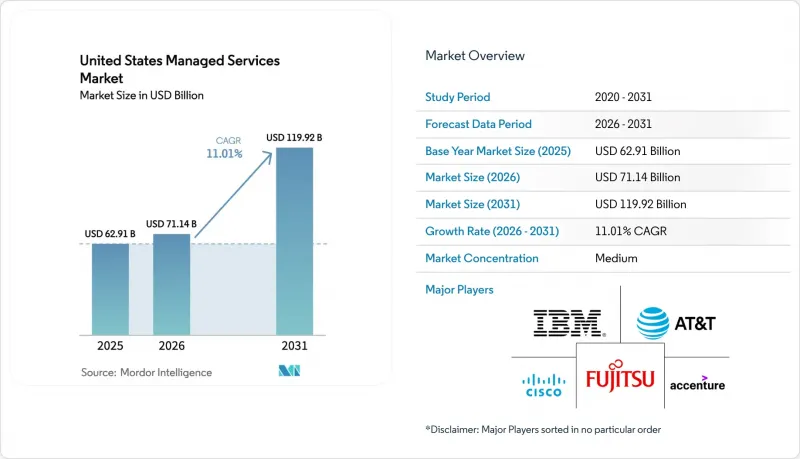
This report is Segmented by Deployment (On-Premise, and Cloud), Service Type (Managed Data Center, Managed Security, Managed Communications, Managed Network, and More), Enterprise Size (Small and Medium Enterprises, and Large Enterprises), and End-User Vertical (IT and Telecom, Healthcare, Entertainment and Media, Retail, and More). The Market Forecasts are Provided in Terms of Value (USD).
United States Managed Services Market Trends and Insights
Growing Enterprise Shift Toward Hybrid-Cloud Management
U.S. enterprises run hybrid architectures that blend on-premise data centers, multiple public clouds, and edge locations, yet fewer than one-third possess in-house expertise to optimize costs and security. Configuration drift rises 40-60% in such estates, creating vulnerabilities that managed service providers (MSPs) monetize by offering unified policy enforcement and automated workload placement. Banks lead adoption because OCC guidance requires resilience testing across all critical third-party dependencies. MSPs that consolidate monitoring and failover orchestration, therefore, win multiyear contracts that bundle infrastructure with security services.
Surge in Multi-Cloud Complexity Driving Demand for Centralized MSPs
The average enterprise now operates 3.2 public cloud platforms, up from 2.1 in 2022. Fragmented identity and access management increase the attack surface; Verizon attributed 34% of 2024 cloud breaches to misconfigured permissions. Centralized MSPs deploy cloud security posture management tools that scan AWS, Azure, and Google Cloud for deviations from the Center for Internet Security Benchmarks. Retailers and healthcare providers feel pressure because customer-facing apps are shifting to the cloud while payment and EHR systems still reside on-premises. Outsourcing becomes rational when specialist salaries in each hyperscaler's proprietary stack top USD 180,000, well above SME budgets.
Skills Shortage Inflates U.S. MSP Labor Costs
CyberSeek recorded 450,000 unfilled cybersecurity roles in 2025. Median compensation for cloud security architects climbed 22% since 2023, compressing margins for labor-intensive service lines such as managed network operations. Providers must either invest in AI-Ops to improve engineer-to-device ratios or accept lower profitability. Large MSPs with proprietary automation gain cost advantages, while smaller firms face consolidation pressure.
Other drivers and restraints analyzed in the detailed report include:
- Rapid Escalation of Cyber-Insurance Prerequisites
- SME Preference for OPEX-Based IT
- Rising Compliance Burden From SEC Cybersecurity Rules
For complete list of drivers and restraints, kindly check the Table Of Contents.
Segment Analysis
Cloud-based services commanded 63.41% of the United States managed services market share in 2025 and are projected to grow at an 11.49% CAGR through 2031. Committed-use discounts from hyperscalers reduced multiyear cloud costs to parity with depreciated on-premises hardware, erasing capital-expenditure advantages. The United States managed services market for cloud deployments is therefore positioned to surpass USD 75 billion by 2031, while on-premises growth remains muted at single-digit rates. On-premises solutions persist in defense contracting, high-frequency trading, and medical imaging, yet even these verticals are adopting hybrid models, shifting latency-tolerant workloads to public cloud while retaining data-sovereignty-sensitive applications in local environments.
Performance differentials reinforce the cloud trend. Azure-based managed services detect ransomware on average 14 hours faster than on-premises equivalents. CFOs increasingly quantify the opportunity cost of delayed detection, concluding that migration savings outweigh sunk hardware costs. As threat telemetry pooled across thousands of tenants improves machine-learning models, the cloud advantage compounds, locking more enterprises into consumption-based contracts.
Managed security services are projected to grow at a 12.13% CAGR through 2031, outpacing the broader United States managed services market. Breach costs averaging USD 4.54 million motivate boards to treat continuous monitoring as business continuity rather than discretionary spend. Managed data center services held a 24.68% share in 2025 but face pricing pressure as hyperscalers automate provisioning. The United States managed services market for security offerings is forecast to eclipse USD 40 billion by 2031, while data center services are forecast to plateau near current levels.
Ransomware-as-a-service lowered barriers to attack, with 68% of incidents in 2024 deleting backups, up from 42% in 2022. A yearly fee of USD 150,000 for 24/7 managed detection compares favorably to potential breach losses, driving uptake among mid-market firms. Compliance catalysts, regulatory requirements such as SEC disclosure rules, and insurer audits are playing a significant role in firmly integrating security outsourcing into the operational budgets of organizations.
Complete Report Scope:
- By Deployment
- On-Premise
- Cloud
- By Service Type
- Managed Data Center
- Managed Security
- Managed Communications
- Managed Network
- Other Service Types
- By Enterprise Size
- Small and Medium Enterprises
- Large Enterprises
- By End-User Vertical
- Banking, financial services and insurance (BFSI)
- IT and Telecom
- Healthcare
- Entertainment and Media
- Retail
- Other End-User Verticals
List of Companies Covered in this Report:
- Accenture plc
- AT&T Inc.
- CDW Corporation
- Cisco Systems Inc.
- Cognizant Technology Solutions
- Dell Technologies Inc.
- Fujitsu Limited
- HCL Technologies Ltd.
- Hewlett Packard Enterprise Company
- IBM Corporation
- Infosys Ltd.
- Kyndryl Holdings Inc.
- Lumen Technologies Inc.
- Microsoft Corporation
- NTT DATA Services
- Rackspace Technology Inc.
- Tata Consultancy Services Ltd.
- Unisys Corporation
- Verizon Communications Inc.
- Wipro Limited
Additional Benefits:
- The market estimate (ME) sheet in Excel format
- 3 months of analyst support
TABLE OF CONTENTS
1 INTRODUCTION
- 1.1 Study Assumptions and Market Definition
- 1.2 Scope of the Study
2 RESEARCH METHODOLOGY
3 EXECUTIVE SUMMARY
4 MARKET LANDSCAPE
- 4.1 Market Overview
- 4.2 Market Drivers
- 4.2.1 Growing Enterprise Shift Toward Hybrid-Cloud Management
- 4.2.2 Surge in Multi-Cloud Complexity Driving Demand for Centralized MSPs
- 4.2.3 Rapid Escalation of Cyber-Insurance Prerequisites
- 4.2.4 SME Preference for OPEX-Based IT
- 4.2.5 Edge-Computing Rollouts in U.S. Manufacturing Hubs
- 4.2.6 AI-Ops Automation Boosting MSP Margins
- 4.3 Market Restraints
- 4.3.1 Skills Shortage Inflates U.S. MSP Labor Costs
- 4.3.2 Vendor Lock-In Fears Among Regulated Industries
- 4.3.3 Rising Compliance Burden From SEC Cybersecurity Rules
- 4.3.4 Data-Sovereignty Pushback on Offshore NOC Models
- 4.4 Industry Value Chain Analysis
- 4.5 Technological Outlook
- 4.6 Regulatory Landscape
- 4.7 Porter's Five Forces Analysis
- 4.7.1 Bargaining Power of Suppliers
- 4.7.2 Bargaining Power of Buyers
- 4.7.3 Threat of New Entrants
- 4.7.4 Threat of Substitutes
- 4.7.5 Intensity of Competitive Rivalry
- 4.8 Impact of Macroeconomic Factors on the Market
5 MARKET SIZE AND GROWTH FORECASTS (VALUE)
- 5.1 By Deployment
- 5.1.1 On-Premise
- 5.1.2 Cloud
- 5.2 By Service Type
- 5.2.1 Managed Data Center
- 5.2.2 Managed Security
- 5.2.3 Managed Communications
- 5.2.4 Managed Network
- 5.2.5 Other Service Types
- 5.3 By Enterprise Size
- 5.3.1 Small and Medium Enterprises
- 5.3.2 Large Enterprises
- 5.4 By End-User Vertical
- 5.4.1 Banking, financial services and insurance (BFSI)
- 5.4.2 IT and Telecom
- 5.4.3 Healthcare
- 5.4.4 Entertainment and Media
- 5.4.5 Retail
- 5.4.6 Other End-User Verticals
6 COMPETITIVE LANDSCAPE
- 6.1 Market Concentration
- 6.2 Strategic Moves
- 6.3 Market Share Analysis
- 6.4 Company Profiles (includes Global Level Overview, Market Level Overview, Core Segments, Financials As Available, Strategic Information, Market Rank/Share For Key Companies, Products and Services, and Recent Developments)
- 6.4.1 Accenture plc
- 6.4.2 AT&T Inc.
- 6.4.3 CDW Corporation
- 6.4.4 Cisco Systems Inc.
- 6.4.5 Cognizant Technology Solutions
- 6.4.6 Dell Technologies Inc.
- 6.4.7 Fujitsu Limited
- 6.4.8 HCL Technologies Ltd.
- 6.4.9 Hewlett Packard Enterprise Company
- 6.4.10 IBM Corporation
- 6.4.11 Infosys Ltd.
- 6.4.12 Kyndryl Holdings Inc.
- 6.4.13 Lumen Technologies Inc.
- 6.4.14 Microsoft Corporation
- 6.4.15 NTT DATA Services
- 6.4.16 Rackspace Technology Inc.
- 6.4.17 Tata Consultancy Services Ltd.
- 6.4.18 Unisys Corporation
- 6.4.19 Verizon Communications Inc.
- 6.4.20 Wipro Limited
7 MARKET OPPORTUNITIES AND FUTURE OUTLOOK
- 7.1 White-Space and Unmet-Need Assessment

