PUBLISHER: Mordor Intelligence | PRODUCT CODE: 2124494

PUBLISHER: Mordor Intelligence | PRODUCT CODE: 2124494
Africa Managed Services - Market Share Analysis, Industry Trends & Statistics, Growth Forecasts (2026 - 2031)
According to Mordor Intelligence, the Africa managed services market size was valued at USD 4.95 billion in 2025 and estimated to grow from USD 5.53 billion in 2026 to reach USD 9.62 billion by 2031, at a CAGR of 11.72% during the forecast period (2026-2031).
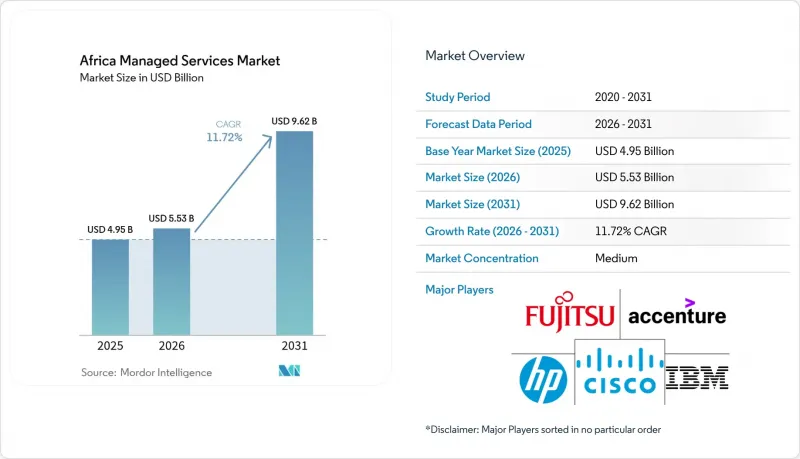
This report is Segmented by Service Type (Managed Network Services, Managed Security Services, Managed Mobility Services, and More), Deployment Model (Private Cloud, Public Cloud, Hybrid Cloud), Organization Size (Large Enterprises, Smes), End-User Industry (IT and Telecom, BFSI, Healthcare, and More), and by Country. The Market Forecasts are Provided in Terms of Value (USD).
Africa Managed Services Market Trends and Insights
SME-led Surge in Managed Cloud Adoption
Small and medium enterprises increasingly anchor the Africa managed services market as currency depreciation makes on-premises hardware unaffordable. Nigerian SMEs now choose naira-denominated cloud bundles that avoid foreign-exchange shocks, lowering total cost of ownership by up to 40%. Similar shifts appear in Ghana where a stronger cedi lets firms channel savings into subscription-based analytics platforms. Providers such as Nebula and Nobus use volume pricing to profitably serve thousands of small customers, fuelling predictable recurring revenue across the Africa managed services market. Scalable multi-tenant architectures let these MSPs maintain margins even as average contract value falls. Over the next two years, SME demand remains the most immediate growth catalyst for providers that can automate onboarding and support functions.
National Data-sovereignty Policies Driving Local MSP Demand
Domestic data-residency laws in Egypt, Nigeria, South Africa and Kenya have re-ordered procurement priorities. Egypt's 120-petabyte Government Data and Cloud Computing Center anchors local workload hosting mandates and draws hyperscaler partnerships that reinforce the Africa managed services market.Financial institutions in Nigeria similarly divert workloads to local operators to comply with 2024 data-protection rules, granting indigenous MSPs strategic advantage. Liquid Intelligent Technologies posted 10.3% revenue growth after packaging compliance-ready cloud, connectivity and security services for regulated clients. As more governments formalise localisation, in-country capacity becomes a non-negotiable tender criterion, reshaping vendor shortlists and underwriting mid-term market expansion.
Chronic Power-supply Instability Increasing OPEX
Frequent outages mean Nigerian data centres operate diesel generators 8-12 hours daily, driving energy bills 60-80% higher than grid-reliant peers and compressing margins across the Africa managed services market. South Africa's scheduled load-shedding still forces dual-feed designs that raise capital outlays. Providers deploy battery storage and micro-grid solutions yet capital intensity limits entry for smaller firms. Clients also bear hidden costs through higher connectivity pricing as operators amortise redundancy investments. Although renewable deployments promise relief, unreliable power remains the single largest operational expense headwind through 2027.
Other drivers and restraints analyzed in the detailed report include:
- Rise of Pan-African Fibre Networks Lowering Latency
- Mining and Resource Sector's OT-IT Convergence Needs
- Depreciating Local Currencies Squeezing ICT Budgets
For complete list of drivers and restraints, kindly check the Table Of Contents.
Segment Analysis
Managed data-centre and hosting services retained the largest 37.02% revenue slice in 2025, underscoring infrastructure's foundational role. Managed security solutions, however, are growing at 12.28% CAGR, elevating their importance within the Africa managed services market. Heightened attack frequency against banks and telcos drives continuous monitoring, incident response and zero-trust architecture demand. The Africa managed services industry also benefits from chronic cybersecurity talent shortages, prompting enterprises to outsource advanced protection stacks.
Increasing ransomware claims spur regulatory scrutiny, bolstering spend on compliance-aligned managed detection and response. At the same time, multi-tenant SOC platforms allow providers to amortise tooling across dozens of clients, lifting margins. As African boards attach financial penalties to breaches, security retainer contracts lengthen from annual renewals to multi-year-plus extensions, embedding steady cash flow into the Africa managed services market.
Public cloud captured 76.65% of 2025 revenues and is projected to climb with a 12.75% CAGR, yet data-sovereignty rules catalyse a pivot toward hybrid frameworks. Nigerian firms now blend hyperscale compute with local nodes to comply with residency mandates without sacrificing elasticity. Providers integrate edge devices and regional availability zones to maintain sub-50 ms latency for consumer applications, demonstrating the Africa managed services market's agility.
Private cloud persists in heavily regulated banking and government workloads where direct control remains paramount. Hybrid orchestration tools from Microsoft and VMware thus experience rising adoption, indicating that deployment decisions are becoming workload-specific rather than binary. Over time, hybrid models are likely to narrow the public-cloud share even as absolute volumes expand, reshaping architecture design principles within the Africa managed services market.
Complete Report Scope:
- By Service Type
- Managed Network Services
- Managed Security Services
- Managed Mobility Services
- Managed Cloud Services
- Managed Data-centre and Hosting Services
- Other Services
- By Deployment Model
- Private Cloud
- Public Cloud
- Hybrid Cloud
- By Organization Size
- Large Enterprises
- Small and Medium-sized Enterprises (SMEs)
- By End-user Industry
- IT and Telecom
- BFSI
- Retail and E-commerce
- Healthcare
- Government and Public Sector
- Manufacturing
- Other Industries
- By Country
- South Africa
- Kenya
- Nigeria
- Egypt
- Rest of Africa
List of Companies Covered in this Report:
- Accenture PLC
- BCX (Telkom SA SOC)
- Castlerock Managed IT Services
- Cisco Systems Inc.
- CMC Networks
- Dimension Data (NTT Ltd.)
- Ericsson AB
- Fujitsu Ltd.
- Hewlett Packard Enterprise (HPE)
- Huawei Technologies Co.
- IBM Corporation
- Internet Solutions (IS)
- LanDynamix
- Liquid Intelligent Technologies
- MTN Business
- NEC Corporation
- Orange Business Services
- SEACOM Ltd.
- T-Systems South Africa
- Vodacom Business
Additional Benefits:
- The market estimate (ME) sheet in Excel format
- 3 months of analyst support
TABLE OF CONTENTS
1 INTRODUCTION
- 1.1 Study Assumptions and Market Definition
- 1.2 Scope of the Study
2 RESEARCH METHODOLOGY
3 EXECUTIVE SUMMARY
4 MARKET LANDSCAPE
- 4.1 Market Overview
- 4.2 Market Drivers
- 4.2.1 Favorable trends in big data and analytics and growing ICT spend
- 4.2.2 SME-led surge in managed cloud adoption
- 4.2.3 Rise of pan-African fibre networks lowering latency
- 4.2.4 National data-sovereignty policies driving local MSP demand
- 4.2.5 Mining and resource sector's OT-IT convergence needs
- 4.2.6 Greenfield smart-city projects (e.g., Konza, Eko Atlantic) requiring outsourced IT
- 4.3 Market Restraints
- 4.3.1 Chronic power-supply instability increasing OPEX
- 4.3.2 Data-privacy and cybersecurity skill gaps
- 4.3.3 Slow cross-border bandwidth upgrades in Central Africa
- 4.3.4 Depreciating local currencies squeezing ICT budgets
- 4.4 Supply-Chain Analysis
- 4.5 Regulatory Landscape
- 4.6 Technological Outlook (AI-ops, SASE, Edge)
- 4.7 Porter's Five Forces
- 4.7.1 Threat of New Entrants
- 4.7.2 Bargaining Power of Buyers
- 4.7.3 Bargaining Power of Suppliers
- 4.7.4 Threat of Substitutes
- 4.7.5 Intensity of Competitive Rivalry
- 4.8 Assesment of Macroeconomic Factors on the market
5 MARKET SIZE AND GROWTH FORECASTS (VALUE)
- 5.1 By Service Type
- 5.1.1 Managed Network Services
- 5.1.2 Managed Security Services
- 5.1.3 Managed Mobility Services
- 5.1.4 Managed Cloud Services
- 5.1.5 Managed Data-centre and Hosting Services
- 5.1.6 Other Services
- 5.2 By Deployment Model
- 5.2.1 Private Cloud
- 5.2.2 Public Cloud
- 5.2.3 Hybrid Cloud
- 5.3 By Organization Size
- 5.3.1 Large Enterprises
- 5.3.2 Small and Medium-sized Enterprises (SMEs)
- 5.4 By End-user Industry
- 5.4.1 IT and Telecom
- 5.4.2 BFSI
- 5.4.3 Retail and E-commerce
- 5.4.4 Healthcare
- 5.4.5 Government and Public Sector
- 5.4.6 Manufacturing
- 5.4.7 Other Industries
- 5.5 By Country
- 5.5.1 South Africa
- 5.5.2 Kenya
- 5.5.3 Nigeria
- 5.5.4 Egypt
- 5.5.5 Rest of Africa
6 COMPETITIVE LANDSCAPE
- 6.1 Market Concentration
- 6.2 Strategic Moves (MandA, Partnerships)
- 6.3 Market Share Analysis
- 6.4 Company Profiles {(includes Global level Overview, Market level overview, Core Segments, Financials as available, Strategic Information, Market Rank/Share for key companies, Products and Services, and Recent Developments)}
- 6.4.1 Accenture PLC
- 6.4.2 BCX (Telkom SA SOC)
- 6.4.3 Castlerock Managed IT Services
- 6.4.4 Cisco Systems Inc.
- 6.4.5 CMC Networks
- 6.4.6 Dimension Data (NTT Ltd.)
- 6.4.7 Ericsson AB
- 6.4.8 Fujitsu Ltd.
- 6.4.9 Hewlett Packard Enterprise (HPE)
- 6.4.10 Huawei Technologies Co.
- 6.4.11 IBM Corporation
- 6.4.12 Internet Solutions (IS)
- 6.4.13 LanDynamix
- 6.4.14 Liquid Intelligent Technologies
- 6.4.15 MTN Business
- 6.4.16 NEC Corporation
- 6.4.17 Orange Business Services
- 6.4.18 SEACOM Ltd.
- 6.4.19 T-Systems South Africa
- 6.4.20 Vodacom Business
7 MARKET OPPORTUNITIES AND FUTURE OUTLOOK
- 7.1 White-space and Unmet-Need Assessment

