PUBLISHER: Mordor Intelligence | PRODUCT CODE: 2123347

PUBLISHER: Mordor Intelligence | PRODUCT CODE: 2123347
Asia-Pacific Self Storage - Market Share Analysis, Industry Trends & Statistics, Growth Forecasts (2026 - 2031)
According to Mordor Intelligence, the Asia-Pacific self storage market size is expected to grow from 32.86 million square feet in 2025 to 35.28 million square feet in 2026 and is forecast to reach 47.63 million square feet by 2031 at 6.19% CAGR over 2026-2031.
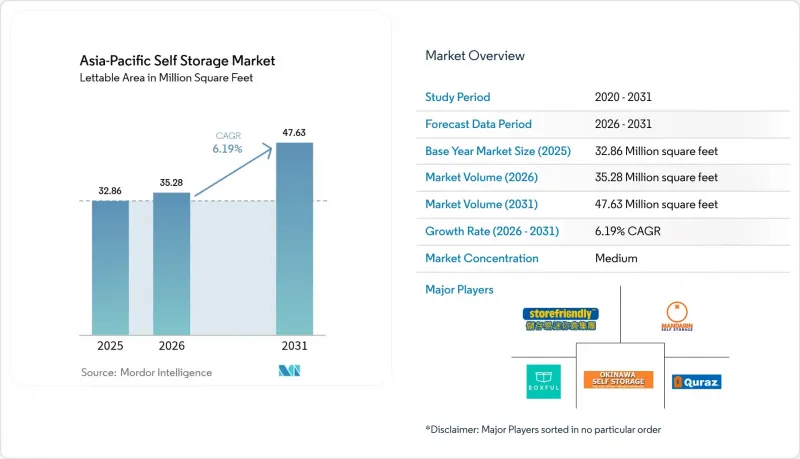
This report is Segmented by End-User (Personal, and Business), Storage Size (Small and Medium Units (Less Than 40 Sq Ft), Large Units (Above 40 Sq Ft), and More), Storage Type (Climate-Controlled, and Non-Climate-Controlled), Ownership Pattern (Owned, and Leased). The Market Forecasts are Provided in Terms of Volume (Million Sq Ft).
Asia-Pacific Self Storage Market Trends and Insights
Densifying Urban Housing and Shrinking Apartment Sizes
Median floor areas in major Asia-Pacific cities have fallen by 10-15% over the past decade, while price-to-income multiples reached 25 in Hong Kong and 32 in Shenzhen in 2024, leaving residents with little choice but to rent off-site lockers to regain livable space. Planning agencies continue to favor high-density towers that maximize unit counts rather than unit sizes, locking in a long-run mismatch between household belongings and apartment capacity. Developers in Tokyo and Singapore now integrate storage basements into new condominiums, banking on higher sale prices for units with bundled storage rights. As personal living quarters shrink further, demand for external lockers scales almost one-for-one, which keeps occupancy high even as new facilities open. This structural trend contributes the single largest uplift to long-term growth in the Asia-Pacific self storage market.
Explosive Growth of SME Cross-Border E-Commerce Fulfillment
Southeast Asia's online sales reached USD 300 billion in 2025, and merchants using localized fulfillment sold up to 14 times more during flash-sales because one-day delivery boosts conversion rates. Small enterprises cannot justify multi-year warehouse leases, so they choose modular storage units with 24-hour access that scale with promotional cycles. In Vietnam, 40% of business tenants in premium facilities are cross-border sellers holding buffer stock to manage upstream volatility. Operators respond with loading docks, parcel pick-and-pack zones, and business-hour concierge services, deepening wallet share from these clients. The segment's outperformance adds meaningful lift to the Asia-Pacific self storage market during the medium term.
Scarcity and Escalating Price of Suitable Urban Land Parcels
Singapore's industrial space ran 89% full in 2024, leaving bidders to pay record premiums for the few blocks that can still convert to storage, a reality that compresses rental yields below institutional return targets. Hong Kong mirrors the squeeze: three storage-suitable plots came to auction in 2024, and the winning price exceeded HKD 15,000 (USD 1,920) per square foot, a level that only breakevens when facilities hold more than 95% occupancy at rents 30% above today's averages. Tokyo's inner wards ban most new self-storage on residential lots, so operators chase secondary cities, but longer drive times undercut the convenience premium that anchors the Asia-Pacific self storage market. China offers larger land banks yet local planners grant priority to manufacturing parks, leaving self-storage applicants waiting months for discretionary approvals. Tighter site supply slows unit roll-outs in the priciest metros, subtracting 1.1 percentage points from baseline growth even while demand remains firm.
Other drivers and restraints analyzed in the detailed report include:
- Institutional Capital Flooding into Industrial-to-Storage Conversions
- Rise of Flexible Work and Hybrid Home-Office Setups
- Patchwork Zoning, Fire-Safety and Hazardous Goods Regulations
For complete list of drivers and restraints, kindly check the Table Of Contents.
Segment Analysis
The segment captured 62.41% of total square footage from personal users in 2025, yet business tenants are expanding at a 6.72% compound clip to 2031, outpacing households. This pivot lifts the Asia-Pacific self storage market size because cross-border sellers, field-service contractors and micro-brands now treat storage nodes as variable logistics rather than capital expenditure. Small enterprises in Vietnam cut last-mile costs by up to 20% after shifting buffer inventory into multiple lockers located within urban delivery zones. Operators segment facilities accordingly, reserving loading-dock floors for businesses and upper levels for personal users, a mix that supports stable occupancy even during retail down-cycles.
Personal customers are also evolving. Retirees moving from suburban homes into smaller condominiums now sign multi-year contracts, lengthening average tenancy and reducing churn. Younger professionals, meanwhile, treat storage as episodic capacity during job relocations or overseas study, so operators offer discount bundles that combine moving services with three-month locker rentals. Dynamic pricing tools let chains nudge tariffs higher for business users during festival-driven sales peaks while softening rates for households in lull periods. This dual-track strategy deepens revenue per square foot, sustaining the Asia-Pacific self storage market share of operators that balance both demand pools.
Large rooms above 40 square feet commanded 48.37% of 2025 take-up, yet small and medium modules are growing faster at 6.43% a year as e-commerce merchants and gig workers favour agile footprints. Small lockers yield 40-50% higher rent per square foot than jumbo rooms, so operators subdivide legacy facilities to amplify revenue density. Box-in-box retrofits inside Hong Kong warehouses can raise total unit count by 25% without altering the external shell, an attractive tactic where land prices eclipse USD 1,900 per square foot.
E-retailers in Manila and Ho Chi Minh City report that 60% of stock turns inside 30 days, so they prefer several 20-square-foot lockers scattered near courier depots instead of one big central store. Work+Store's 5-square-foot option in Singapore, priced at SGD 80 (USD 60) a month, now runs 90% full among downtown finance professionals who store compliance files off-site. The granular mix tempers vacancy risk because tenants can scale space up or down without total move-outs, locking in stickier cash flows that reinforce the Asia-Pacific self storage market.
Complete Report Scope:
- By End-User
- Personal
- Business
- By Storage Size
- Small and Medium Units (Less Than 40 Sq Ft)
- Large Units (Above 40 Sq Ft)
- Other Storage Sizes (Lockers / Double-Stacked)
- By Storage Type
- Climate-Controlled
- Non-Climate-Controlled
- By Ownership Pattern
- Owned
- Leased
- By Geography
- Japan
- Hong Kong
- Taiwan
- Singapore
- China
- Malaysia
- Rest of Asia Pacific
List of Companies Covered in this Report:
- StorHub Group Pte. Ltd.
- Extra Space Asia Management Pte. Ltd.
- Boxful Holdings Limited
- Mandarin Self Storage Pte. Ltd.
- Storage King Pty Ltd
- Quraz Co., Ltd.
- Okinawa Self Storage Co., Ltd.
- UD Self Storage Co., Ltd.
- Far East Organization - Store-Y Self Storage
- Store Friendly Self Storage Group Limited
- National Storage Holdings Ltd. (REIT)
- Kennards Self Storage Pty Limited
- Keep-It-Safe Self Storage Sdn. Bhd.
- Cube Self Storage Limited
- SC Storage (Holdings) Limited
- Lock+Store Pte. Ltd.
- UrbanSpace Self Storage Ltd.
- Spacebox Self Storage Co., Ltd.
- My Storage Vietnam Co., Ltd.
Additional Benefits:
- The market estimate (ME) sheet in Excel format
- 3 months of analyst support
TABLE OF CONTENTS
1 INTRODUCTION
- 1.1 Study Assumptions and Market Definition
- 1.2 Scope of the Study
2 RESEARCH METHODOLOGY
3 EXECUTIVE SUMMARY
4 MARKET LANDSCAPE
- 4.1 Market Overview
- 4.2 Market Drivers
- 4.2.1 Densifying Urban Housing and Shrinking Apartment Sizes
- 4.2.2 Explosive Growth of SME Cross-Border E-Commerce Fulfillment
- 4.2.3 Institutional Capital Flooding into Industrial-to-Self-Storage Conversions
- 4.2.4 Rise of Flexible Work and Hybrid Home-Office Setups
- 4.2.5 Government Incentives for Adaptive Reuse of Aging Industrial Stock
- 4.2.6 Growing Demand for Climate-Controlled Specialty Storage
- 4.3 Market Restraints
- 4.3.1 Scarcity and Escalating Price of Suitable Urban Land Parcels
- 4.3.2 Patchwork Zoning, Fire-Safety and Hazardous Goods Regulations
- 4.3.3 Low Consumer Awareness and Cultural Reluctance in Emerging Markets
- 4.3.4 Increasing Competition from On-Demand Mobile Storage and Home-Organization Tech
- 4.4 Industry Value Chain Analysis
- 4.5 Regulatory Landscape
- 4.6 Impact of Macroeconomic Factors
- 4.7 Porter's Five Forces Analysis
- 4.7.1 Bargaining Power of Suppliers
- 4.7.2 Bargaining Power of Buyers
- 4.7.3 Threat of New Entrants
- 4.7.4 Threat of Substitutes
- 4.7.5 Intensity of Competitive Rivalry
- 4.8 Investment Analysis
- 4.9 PESTEL Analysis
- 4.10 Key Considerations of Consumers While Selecting a Self-Storage Facility
- 4.11 Market Dynamics in Hong Kong
- 4.11.1 Analysis of Occupancy Rates
- 4.11.2 Average Rental Trends
- 4.11.3 Profitability Analysis
- 4.11.4 Average Facility Size
5 MARKET SIZE AND GROWTH FORECASTS (UNIT)
- 5.1 By End-User
- 5.1.1 Personal
- 5.1.2 Business
- 5.2 By Storage Size
- 5.2.1 Small and Medium Units (Less Than 40 Sq Ft)
- 5.2.2 Large Units (Above 40 Sq Ft)
- 5.2.3 Other Storage Sizes (Lockers / Double-Stacked)
- 5.3 By Storage Type
- 5.3.1 Climate-Controlled
- 5.3.2 Non-Climate-Controlled
- 5.4 By Ownership Pattern
- 5.4.1 Owned
- 5.4.2 Leased
- 5.5 By Geography
- 5.5.1 Japan
- 5.5.2 Hong Kong
- 5.5.3 Taiwan
- 5.5.4 Singapore
- 5.5.5 China
- 5.5.6 Malaysia
- 5.5.7 Rest of Asia Pacific
6 COMPETITIVE LANDSCAPE
- 6.1 Market Concentration
- 6.2 Strategic Moves
- 6.3 Market Share Analysis
- 6.4 Company Profiles (includes Global Level Overview, Market Level Overview, Core Segments, Financials as available, Strategic Information, Market Rank/Share, Products and Services, Recent Developments)
- 6.4.1 StorHub Group Pte. Ltd.
- 6.4.2 Extra Space Asia Management Pte. Ltd.
- 6.4.3 Boxful Holdings Limited
- 6.4.4 Mandarin Self Storage Pte. Ltd.
- 6.4.5 Storage King Pty Ltd
- 6.4.6 Quraz Co., Ltd.
- 6.4.7 Okinawa Self Storage Co., Ltd.
- 6.4.8 UD Self Storage Co., Ltd.
- 6.4.9 Far East Organization - Store-Y Self Storage
- 6.4.10 Store Friendly Self Storage Group Limited
- 6.4.11 National Storage Holdings Ltd. (REIT)
- 6.4.12 Kennards Self Storage Pty Limited
- 6.4.13 Keep-It-Safe Self Storage Sdn. Bhd.
- 6.4.14 Cube Self Storage Limited
- 6.4.15 SC Storage (Holdings) Limited
- 6.4.16 Lock+Store Pte. Ltd.
- 6.4.17 UrbanSpace Self Storage Ltd.
- 6.4.18 Spacebox Self Storage Co., Ltd.
- 6.4.19 My Storage Vietnam Co., Ltd.
7 MARKET OPPORTUNITIES AND FUTURE OUTLOOK
- 7.1 White-Space and Unmet-Need Assessment

