PUBLISHER: Mordor Intelligence | PRODUCT CODE: 2124539

PUBLISHER: Mordor Intelligence | PRODUCT CODE: 2124539
Scandinavia Self-Storage - Market Share Analysis, Industry Trends & Statistics, Growth Forecasts (2026 - 2031)
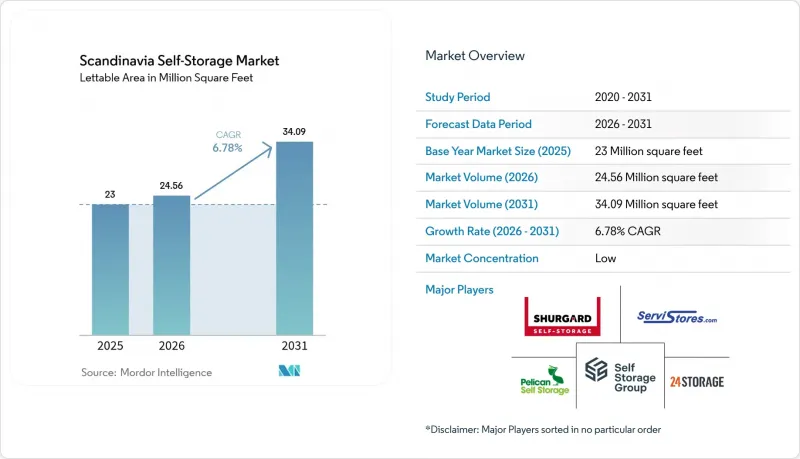
According to Mordor Intelligence, Scandinavia self-Storage market size in 2026 is estimated at 24.56 million sq ft, growing from 2025 value of 23 million sq ft with 2031 projections showing 34.09 million sq ft, growing at 6.78% CAGR over 2026-2031.
This report is Segmented by End-User (Personal and Business), Storage Size (Small and Medium Units Less Than 40 Sq Ft, Large Units Above 40 Sq Ft, and More), Storage Type (Climate-Controlled and Non-Climate-Controlled), Ownership Pattern (Owned Facilities and Leased Facilities). The Market Forecasts are Provided in Terms of Volume (Units).
Scandinavia Self-Storage Market Trends and Insights
Urbanization and Smaller Living Spaces
Population growth has concentrated in 30 Nordic urban areas, lifting density and shrinking average apartment sizes. Oslo recorded a 22.5% density uptick over two decades, while Stockholm followed a similar trajectory. Constrained space pushes households toward external storage, especially as Norwegian home prices rose 7.3% YoY in early 2025. Swedish construction costs outpacing land values further compress unit footprints. Denmark's 25% affordable-housing rule limits unit size, compounding demand across income levels.
High E-Commerce Penetration Driving SME Inventory Needs
Online purchasing rates of 97-99% stretch Nordic delivery networks, creating micro-fulfillment requirements for SMEs. Finnish consumers' preference for parcel lockers drives distributed storage nodes that double as last-mile hubs. PostNord's heavy parcel-box investment offers partnership paths for operators. EU-mandated 14-day returns and Norway's comparable consumer-protection rules produce predictable reverse-logistics peaks requiring overflow space. Seasonal surges in clothing, electronics, and cosmetics underline the business segment's need for flexible contracts.
Scarcity and High Cost of Zoned Urban Land
Compact-city policies prioritize residential or mixed-use projects, pushing storage developers to peripheral sites where accessibility is weaker. Prime Oslo yields widened to 4.7% amid financing cost hikes, dampening acquisition appetite. Competition from data centers and logistics centers inflates industrial-zone values, squeezing margins and prolonging timelines.
Other drivers and restraints analyzed in the detailed report include:
- Rising Housing Mobility and Rental Turnover
- Institutional Capital Seeking Yield-Stabilized Assets
- Stringent Heritage-District Building Regulations
For complete list of drivers and restraints, kindly check the Table Of Contents.
Segment Analysis
Personal customers accounted for 74.10% of the Scandinavia self-storage market size in 2025, a share rooted in high housing costs and shrinking dwelling footprints. The segment grows in tandem with frequent relocations and student moves, particularly in the capitals. Pricing models emphasize small-unit formats and month-to-month flexibility that align with consumer cash-flow patterns. Operators employ app-based access and bundled moving supplies to enhance stickiness.
Business users, although smaller, are forecast to log an 7.88% CAGR through 2031. E-commerce SMEs leverage units as micro-fulfillment nodes for returns and seasonal stock peaks. Regulatory return periods and cross-border VAT reconciliation amplify the need for local inventory buffers. Operators respond with 24/7 loading bays, integrated parcel services, and short-commitment contracts, broadening the Scandinavia self-storage market's addressable base.
Units below 40 sq ft captured 58.10% of Scandinavia self-storage market share in 2025, reflecting customer sensitivity to price per month and the prevalence of apartment living. The category is projected to post a 7.52% CAGR, buoyed by dynamic partitioning technologies that let operators adjust mix ratios in real time. Compact formats also underpin lockers designed for click-and-collect partnerships with logistics groups.
Larger units serve SME inventory and recreational-gear storage, generating higher absolute rents but lower occupancy turnover. Operators use tiered pricing, insurance upsells and ancillary services such as shelving installation to defend yields. Double-stacked designs in dense districts help extract additional lettable volume without new land take, strengthening overall profitability inside the Scandinavia self-storage market.
Complete Report Scope:
- By End-User
- Personal
- Business
- By Storage Size
- Small and Medium Units (less than 40 sq ft)
- Large Units (above 40 sq ft)
- Others (Lockers/Double-Stacked)
- By Storage Type
- Climate-Controlled
- Non-Climate-Controlled
- By Ownership Pattern
- Owned Facilities
- Leased Facilities
List of Companies Covered in this Report:
- Shurgard Self-Storage SA
- Self Storage Group ASA
- Pelican Self-Storage ApS
- 24Storage AB
- City Self-Storage AS
- Green Storage AB
- Sesam Self-Storage AB
- Servistore Oy
- YourSpace Storage AB
- Solo Minilager AS
- Lagersjefen AS
- Storage365 ApS
- Bear Storage Oy
- StorageCo AS
- CityBox AS
- Grenland Minilager AS
- 123Minilager AS
- Lagerboks AS
- Magasinera AB
- Your and Box AB
Additional Benefits:
- The market estimate (ME) sheet in Excel format
- 3 months of analyst support
TABLE OF CONTENTS
1 INTRODUCTION
- 1.1 Study Assumptions and Market Definition
- 1.2 Scope of the Study
2 RESEARCH METHODOLOGY
3 EXECUTIVE SUMMARY
4 MARKET LANDSCAPE
- 4.1 Market Overview
- 4.2 Market Drivers
- 4.2.1 Urbanisation and Smaller Living Spaces
- 4.2.2 High E-commerce Penetration Driving SME Inventory Needs
- 4.2.3 Rising Housing Mobility and Rental Turnover
- 4.2.4 Institutional Capital Seeking Yield-Stabilised Assets
- 4.2.5 Sustainability-Linked Conversions of Retail/Industrial Boxes
- 4.2.6 Municipal Incentives to Repurpose Underground Parking
- 4.3 Market Restraints
- 4.3.1 Scarcity and High Cost of Zoned Urban Land
- 4.3.2 Stringent Heritage-District Building Regulations
- 4.3.3 Escalating Construction and Fit-out Costs
- 4.3.4 Cultural Reliance on Basement/Attic Storage in Rural Areas
- 4.4 Impact of Macroeconomic Factors
- 4.5 Industry Value Chain Analysis
- 4.6 Regulatory Landscape
- 4.7 Technological Outlook
- 4.8 Porter's Five Forces Analysis
- 4.8.1 Bargaining Power of Suppliers
- 4.8.2 Bargaining Power of Buyers
- 4.8.3 Threat of New Entrants
- 4.8.4 Threat of Substitutes
- 4.8.5 Intensity of Competitive Rivalry
- 4.9 Investment Analysis
- 4.10 PESTEL Analysis
- 4.11 Key Considerations of Consumers while selecting a Self-Storage Facility
5 MARKET DYNAMICS IN SCANDINAVIA
- 5.1 Analysis of Occupancy Rates
- 5.2 Average Rental Trends
- 5.2.1 Pre-Covid and Post-Covid Market Implications
- 5.3 Profitability Analysis
- 5.3.1 Pre-Covid and Post-Covid Market Implications
- 5.4 Average Facility Size
6 MARKET SIZE AND GROWTH FORECASTS (UNITS)
- 6.1 By End-User
- 6.1.1 Personal
- 6.1.2 Business
- 6.2 By Storage Size
- 6.2.1 Small and Medium Units (less than 40 sq ft)
- 6.2.2 Large Units (above 40 sq ft)
- 6.2.3 Others (Lockers/Double-Stacked)
- 6.3 By Storage Type
- 6.3.1 Climate-Controlled
- 6.3.2 Non-Climate-Controlled
- 6.4 By Ownership Pattern
- 6.4.1 Owned Facilities
- 6.4.2 Leased Facilities
7 COMPETITIVE LANDSCAPE
- 7.1 Market Concentration
- 7.2 Strategic Moves
- 7.3 Market Share Analysis
- 7.4 Company Profiles (includes Global level Overview, Market level overview, Core Segments, Financials as available, Strategic Information, Market Rank/Share for key companies, Products and Services, Recent Developments)
- 7.4.1 Shurgard Self-Storage SA
- 7.4.2 Self Storage Group ASA
- 7.4.3 Pelican Self-Storage ApS
- 7.4.4 24Storage AB
- 7.4.5 City Self-Storage AS
- 7.4.6 Green Storage AB
- 7.4.7 Sesam Self-Storage AB
- 7.4.8 Servistore Oy
- 7.4.9 YourSpace Storage AB
- 7.4.10 Solo Minilager AS
- 7.4.11 Lagersjefen AS
- 7.4.12 Storage365 ApS
- 7.4.13 Bear Storage Oy
- 7.4.14 StorageCo AS
- 7.4.15 CityBox AS
- 7.4.16 Grenland Minilager AS
- 7.4.17 123Minilager AS
- 7.4.18 Lagerboks AS
- 7.4.19 Magasinera AB
- 7.4.20 Your and Box AB
8 MARKET SHARE OF KEY SELF-STORAGE OPERATORS
9 MARKET OPPORTUNITIES AND FUTURE OUTLOOK
- 9.1 White-space and Unmet-Need Assessment

