PUBLISHER: Mordor Intelligence | PRODUCT CODE: 2123374

PUBLISHER: Mordor Intelligence | PRODUCT CODE: 2123374
United States Self Storage - Market Share Analysis, Industry Trends & Statistics, Growth Forecasts (2026 - 2031)
According to Mordor Intelligence, the United States self storage market size is expected to grow from USD 45.34 billion in 2025 to USD 47.28 billion in 2026 and is forecast to reach USD 57.79 billion by 2031 at 4.10% CAGR over 2026-2031.
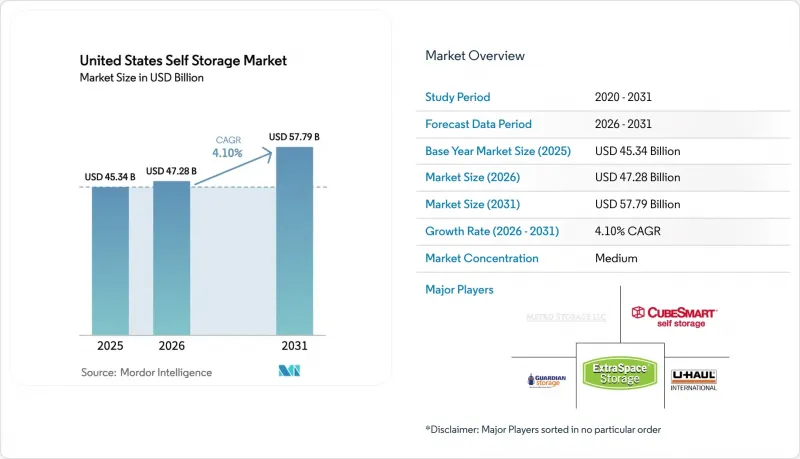
This report is Segmented by User Type (Personal, and Business), Unit Size (<= 100 Sq Ft Small, and More), Property Type (Purpose-Built Facilities, and More), Booking Channel (Offline Walk-in/Phone, and Online Aggregators and Operator Portals), and End-Use Duration (Short-Term (Less Than 6 Months), Long-Term (More Than 6 Months)). The Market Forecasts are Provided in Terms of Value (USD).
United States Self Storage Market Trends and Insights
Increased Urbanization and Shrinking Dwelling Size
Median new single-family homes measured 2,146 square feet in 2024, down from prior peaks, while apartment footprints contracted in major metros as developers maximized unit counts per parcel. A Self Storage Association study counted 16.68 million household renters in 2024, lifting penetration to 12.6% from 11.1% in 2022. Millennials account for roughly 40% of renters, and 78% value round-the-clock access, with over one-third willing to pay premium rates for extended hours. Tight zoning caps floor-area ratios in cities such as New York and San Francisco, perpetuating housing scarcity and sustaining demand for off-site storage. Collectively, these forces funnel urban households toward rental units for seasonal gear, furniture, and hobby equipment, reinforcing a steady uptake trajectory for the United States self-storage market.
Growth in E-commerce Micro-Fulfilment Demand
Prologis estimates e-commerce absorbs three times the logistics square footage of brick-and-mortar retail, with total take-up projected at 250 to 350 million square feet by 2030. Small sellers unable to secure dedicated warehouses increasingly lease climate-controlled units near urban delivery nodes to shave last-mile transit times. Business renters prioritize flexible lease terms, 24-hour entry, and loading-dock access, prompting operators to retrofit sites with wider drive aisles and roll-up doors. The business segment's 4.89% forecast CAGR signals that tailoring contracts and amenities for commercial tenants can unlock an outsized share of near-term growth within the United States self-storage market. Contractors and tradespeople storing tools between jobs further diversify revenue streams and lengthen average lease duration.
Escalating Land and Construction Costs
Land and building expenses have risen 40-50% since 2017, squeezing development yields and pushing target cap rates to 5.75-8.0% for new projects. Material shortages and labor constraints extend build times, undermining pro-forma assumptions. Many operators now favor portfolio acquisitions over ground-up developments, as illustrated by the USD 12.7 billion Extra Space-Life Storage merger that added more than 1,200 properties without construction risk. Higher interest rates further inflate financing costs, discouraging speculative projects. Collectively, these factors temper supply growth in the United States self-storage market and magnify the appeal of adaptive reuse.
Other drivers and restraints analyzed in the detailed report include:
- Adaptive Reuse of Distressed Retail or Office Assets
- Rising Residential Mobility and Migration Rates
- Zoning and Land-Use Restrictions in Urban Cores
For complete list of drivers and restraints, kindly check the Table Of Contents.
Segment Analysis
Business tenants are forecast to expand at a 4.89% CAGR from 2026 to 2031, outpacing overall market growth as e-commerce sellers, contractors, and service firms repurpose units for inventory staging and equipment storage. Personal users still anchored 77.19% of 2025 revenue, relying on facilities during moves, seasonal storage, and life events. Commercial renters value 24-hour access, loading docks, and security sensors, prompting operators to invest in IoT-enabled monitoring systems that raise capital intensity but boost retention.
The diversification toward commercial users reduces reliance on relocation cycles, lengthens average lease terms, and raises price tolerance, enhancing cash-flow stability for the United States self-storage market. Contractors parking tools and materials between job sites likewise broaden demand across economic sectors. Operators tailoring offerings such as package-receipt services or electrical outlets for device charging stand to capture a disproportionate share of the expanding business segment within the United States self-storage industry.
The 10 X 10-foot format commanded 35.57% of 2025 revenue, serving as the workhorse for household moves and seasonal needs. Yet climate-controlled lockers are projected to grow at a 5.11% CAGR through 2031 as urban renters pay premiums to protect electronics, documents, and collectibles. In April 2025 climate-controlled rents climbed across 17 of the 30 largest metros while standard rates stagnated, highlighting a bifurcated market.
Operators retrofit ambient units with dehumidifiers and LED lighting, capturing higher rents and boosting the United States self-storage market size tied to premium inventory. Smart lockers with environmental sensors let tenants track temperature via mobile apps, appealing to millennials and Gen Z customers. The shift underscores a strategic thrust toward value-added features rather than mere square footage, allowing operators to defend margins even as commodity pricing plateaus.
Complete Report Scope:
- By User Type
- Personal
- Business
- By Unit Size
- <= 100 sq ft (Small)
- 101-200 sq ft (Medium)
- More than 200 sq ft (Large/Vehicle)
- Climate-Controlled Lockers
- By Property Type
- Purpose-Built Facilities
- Converted Commercial Buildings
- Container-Based/Mobile Sites
- By Booking Channel
- Offline (Walk-in / Phone)
- Online Aggregators and Operator Portals
- By End-Use Duration
- Short-Term (Less than 6 Months)
- Long-Term (More than equal to 6 Months)
List of Companies Covered in this Report:
- Metro Storage LLC
- Guardian Storage Solutions, LLC
- CubeSmart L.P.
- Extra Space Storage Inc.
- U-Haul International, Inc.
- Life Storage, Inc.
- National Storage Affiliates Trust
- Public Storage
- StorageMart Partners, LLC
- Simply Self Storage Management LLC
- KO Storage LLC
- Global Self Storage, Inc.
- Prime Storage Group, LLC
- Storage Asset Management, LLC
- SmartStop Self Storage REIT, Inc.
- A-American Self Storage Management, LLC
- StorQuest Self Storage, LLC
- Safeguard Self Storage, Inc.
- SpareBox Storage, LLC
- Mini U Storage, LLC
Additional Benefits:
- The market estimate (ME) sheet in Excel format
- 3 months of analyst support
TABLE OF CONTENTS
1 INTRODUCTION
- 1.1 Study Assumptions and Market Definition
- 1.2 Scope of the Study
2 RESEARCH METHODOLOGY
3 EXECUTIVE SUMMARY
4 MARKET LANDSCAPE
- 4.1 Market Overview
- 4.2 Market Drivers
- 4.2.1 Increased Urbanization and Shrinking Dwelling Size
- 4.2.2 Growth in E-commerce Micro-Fulfilment Demand
- 4.2.3 Rising Residential Mobility and Migration Rates
- 4.2.4 Adaptive Reuse of Distressed Retail/Office Assets
- 4.2.5 Emergence of On-Demand Valet Storage Platforms
- 4.2.6 Weather-Related Loss-Mitigation Storage Needs
- 4.3 Market Restraints
- 4.3.1 Zoning and Land-Use Restrictions in Urban Cores
- 4.3.2 Escalating Land and Construction Costs
- 4.3.3 ESG Scrutiny on Energy-Intensive Climate Units
- 4.3.4 Margin Pressure from REIT Consolidation Wave
- 4.4 Impact of Macroeconomic Factors on the Market
- 4.5 Industry Supply-Chain Analysis
- 4.6 Regulatory Landscape
- 4.7 Technological Outlook
- 4.8 Porter's Five Forces Analysis
- 4.8.1 Bargaining Power of Suppliers
- 4.8.2 Bargaining Power of Buyers
- 4.8.3 Threat of New Entrants
- 4.8.4 Intensity of Competitive Rivalry
- 4.8.5 Threat of Substitutes
- 4.9 Pricing Analysis (Rent / sq-ft)
- 4.10 Operational Metrics Benchmarking
5 MARKET SIZE AND GROWTH FORECASTS (VALUE)
- 5.1 By User Type
- 5.1.1 Personal
- 5.1.2 Business
- 5.2 By Unit Size
- 5.2.1 <= 100 sq ft (Small)
- 5.2.2 101-200 sq ft (Medium)
- 5.2.3 More than 200 sq ft (Large/Vehicle)
- 5.2.4 Climate-Controlled Lockers
- 5.3 By Property Type
- 5.3.1 Purpose-Built Facilities
- 5.3.2 Converted Commercial Buildings
- 5.3.3 Container-Based/Mobile Sites
- 5.4 By Booking Channel
- 5.4.1 Offline (Walk-in / Phone)
- 5.4.2 Online Aggregators and Operator Portals
- 5.5 By End-Use Duration
- 5.5.1 Short-Term (Less than 6 Months)
- 5.5.2 Long-Term (More than equal to 6 Months)
6 COMPETITIVE LANDSCAPE
- 6.1 Market Concentration
- 6.2 Strategic Moves
- 6.3 Market Share Analysis
- 6.4 Company Profiles (includes Global Level Overview, Market Level Overview, Core Segments, Financials as Available, Strategic Information, Market Rank/Share for Key Companies, Products and Services, and Recent Developments)
- 6.4.1 Metro Storage LLC
- 6.4.2 Guardian Storage Solutions, LLC
- 6.4.3 CubeSmart L.P.
- 6.4.4 Extra Space Storage Inc.
- 6.4.5 U-Haul International, Inc.
- 6.4.6 Life Storage, Inc.
- 6.4.7 National Storage Affiliates Trust
- 6.4.8 Public Storage
- 6.4.9 StorageMart Partners, LLC
- 6.4.10 Simply Self Storage Management LLC
- 6.4.11 KO Storage LLC
- 6.4.12 Global Self Storage, Inc.
- 6.4.13 Prime Storage Group, LLC
- 6.4.14 Storage Asset Management, LLC
- 6.4.15 SmartStop Self Storage REIT, Inc.
- 6.4.16 A-American Self Storage Management, LLC
- 6.4.17 StorQuest Self Storage, LLC
- 6.4.18 Safeguard Self Storage, Inc.
- 6.4.19 SpareBox Storage, LLC
- 6.4.20 Mini U Storage, LLC
7 MARKET OPPORTUNITIES AND FUTURE OUTLOOK
- 7.1 White-Space and Unmet-Need Assessment

