PUBLISHER: Mordor Intelligence | PRODUCT CODE: 2124627

PUBLISHER: Mordor Intelligence | PRODUCT CODE: 2124627
United States Smart Homes - Market Share Analysis, Industry Trends & Statistics, Growth Forecasts (2026 - 2031)
According to Mordor Intelligence, the United States smart homes market size in 2026 is estimated at USD 54.53 billion, growing from 2025 value of USD 50.30 billion with 2031 projections showing USD 81.61 billion, growing at 8.4% CAGR over 2026-2031.
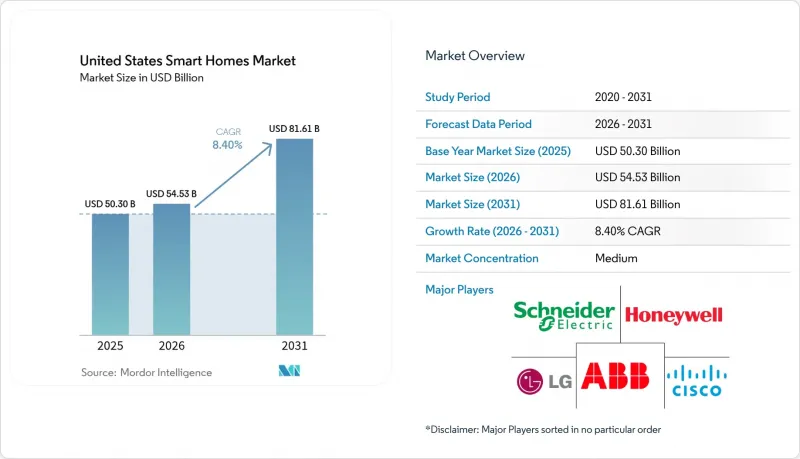
This report is Segmented by Product Type (Comfort and Lighting, Energy Management, and More), Connectivity Technology(Wi-Fi-Enabled Devices, Thread-Enabled Devices), Installation Type (DIY / Self-Installed, Professionally Installed Integrated Systems), Sales Channel (Online Retail (Amazon, Direct-To-Consumer), Telecom / Utility Bundles (5G-FWA, Demand-Response Kits)), and Component.
United States Smart Homes Market Trends and Insights
Utility-backed Energy-Efficiency Rebates and Dynamic-Pricing Programs
The Department of Energy's USD 8.8 billion Home Energy Rebates program-already live in California, Hawaii, New Mexico, and New York-has placed unprecedented purchasing power directly in homeowners' hands.New York's May 2024 roll-out set the tone for states eager to capture federal dollars for smart thermostats, heat pumps, and connected water heaters. Southern California Edison now offers USD 75 bill credits for enrolling certified thermostats in demand-response schemes, while PSEG Long Island earmarked USD 92.45 million for 2025 efficiency measures focused on connected devices. Wisconsin's USD 149 million allocation under its Focus on Energy program shows that even colder climates are leaning heavily on connected equipment to curb peak loads. Utilities then recycle the savings they achieve on peak-generation costs into broader rebate pools, thereby creating a virtuous adoption cycle.
Rapid Adoption of Matter Protocol Driving Multi-brand Device Bundles
Matter's 1.4 specification, published in November 2024, was the watershed moment when unified multi-admin control, expanded device classes, and native Thread mesh support converged. Over 670 Thread-based products had cleared certification by mid-2025, and major retailers pledged dedicated shelf space to Matter-ready gear. Apple reversed course, shifting from HomeKit exclusivity to full Matter compliance, a move that signaled ecosystem consensus. Self-healing Thread networks now allow devices from different brands to join without re-commissioning, erasing historical complexities that drove high return rates. Version 1.5, expected in late 2025, will embed grid-interactive energy APIs, positioning residences as dispatchable demand-response nodes rather than passive loads.
Persistent Data-Privacy and Surveillance Concerns
Although the FCC unveiled the Cyber Trust Mark in 2025, labeling remains voluntary, leaving device makers free to adopt tiered approaches that consumers often find opaque. California's Consumer Privacy Act requires explicit disclosure of data use, elevating public awareness about what smart cameras, speakers, and sensors collect. Voice-assistant defaults drew renewed scrutiny when Amazon introduced an opt-in voice data retention policy in March 2025, igniting social-media backlash. Professional-grade IP cameras remain outside the FCC label's scope, perpetuating concerns among security-sensitive households. Family dynamics further complicate matters: younger residents may welcome automation, while older or privacy-conscious members view 24-hour monitoring as intrusive.
Other drivers and restraints analyzed in the detailed report include:
- Aging-in-Place and "Age-Tech" Demand Accelerating Retrofit Spending
- Insurance Premium Discounts for Smart Security Installations
- High Professional-Installation Cost for Legacy Housing Stock
For complete list of drivers and restraints, kindly check the Table Of Contents.
Segment Analysis
Security systems accounted for a 29.30% share of 2025 spending within the United States smart homes market, underlining consumers' instinctive prioritization of personal safety and property protection. Early adoption often begins with cameras or video doorbells bundled into insurance discount programs, which then serve as launchpads for broader ecosystems. Smart appliances, however, are poised for the fastest lift, tracking a 14.25% CAGR on the strength of Matter-enabled cross-brand compatibility and escalating utility rebates on energy-star units. Energy-management packages-particularly smart thermostats linked to dynamic pricing schemes-continue benefiting from federal and state incentives. Home-entertainment devices, while maturing, still find incremental gains by acting as centralized automation dashboards on large-screen displays.
Consumer emphasis on unified control is closing the gap between historically siloed categories. Cameras now embed AI analytics that cooperate with lighting scenes, while refrigerators surface real-time dynamic-pricing prompts that mesh with energy-management routines. All told, hardware convergence reinforces the view that product labels will blur over the next five years as platform capabilities outpace single-function devices.
Wi-Fi controlled 60.35% of device shipments in 2025, buoyed by widespread router penetration and low incremental setup friction. Yet the Thread specification is on pace to carve out a substantial share, growing at an 18.1% CAGR to 2031. The latest 1.4 build delivers unified mesh capability, enabling multiple vendor border routers to form a single network without user intervention. Thread's low-power, IPv6-based architecture allows sensors to sustain multi-year battery life even while participating in real-time communication loops essential for security and energy management.
The convergence between Thread and Wi-Fi is now complementary: high-bandwidth applications such as streaming cameras still rely on Wi-Fi, whereas low-bandwidth door sensors, leak detectors, and buttons migrate to Thread. Apple's tvOS 26, Google's Fuchsia-based Nest hubs, and Amazon's Echo Hub firmware all ship with Thread border-router functionality, signaling mainstream endorsement. The Thread Group surpassed 670 certifications by June 2025, confirming that the ecosystem has passed a critical maturity threshold.
Complete Report Scope:
- By Product Type
- Comfort and Lighting
- Control and Connectivity
- Energy Management
- Home Entertainment
- Security
- Smart Appliances
- By Connectivity Technology
- Wi-Fi-enabled devices
- Thread-enabled devices
- By Installation Type
- DIY / Self-installed
- Professionally installed integrated systems
- By Sales Channel
- Online retail (Amazon, direct-to-consumer)
- Telecom / Utility bundles (5G-FWA, demand-response kits)
- By Component
- Hardware (devices and hubs)
- Subscription and monitoring services
List of Companies Covered in this Report:
- ABB Ltd.
- Schneider Electric SE
- Honeywell International Inc.
- Nest Labs (Google)
- Ring (Amazon)
- LG Electronics Inc.
- Cisco Systems Inc.
- Google LLC (Alphabet Inc.)
- Microsoft Corp.
- GE Appliances (Haier Group)
- Legrand SA
- Lutron Electronics Co. Inc.
- Whirlpool Corp.
- Control4 Corp.
- Savant Systems Inc. (GE Lighting)
Additional Benefits:
- The market estimate (ME) sheet in Excel format
- 3 months of analyst support
TABLE OF CONTENTS
1 INTRODUCTION
- 1.1 Study Assumptions and Market Definition
- 1.2 Scope of the Study
2 RESEARCH METHODOLOGY
3 EXECUTIVE SUMMARY
4 MARKET LANDSCAPE
- 4.1 Market Overview
- 4.2 Market Drivers
- 4.2.1 Utility-backed energy-efficiency rebates and dynamic-pricing programs
- 4.2.2 Rapid adoption of Matter protocol driving multi-brand device bundles
- 4.2.3 Aging-in-place and age-tech demand accelerating retrofit spending
- 4.2.4 Insurance premium discounts for smart security installations
- 4.2.5 5G FWA bundles from ISPs lowering entry barriers for hubs/kits
- 4.3 Market Restraints
- 4.3.1 Persistent data-privacy and surveillance concerns
- 4.3.2 High professional-installation cost for legacy housing stock
- 4.3.3 Device return-rates caused by lingering interoperability gaps
- 4.3.4 Rising cyber-compliance costs under forthcoming U.S. Cyber-Trust Mark
- 4.4 Value/Supply-Chain Analysis
- 4.5 Regulatory Landscape
- 4.6 Technological Outlook
- 4.7 Porter's Five Forces
- 4.7.1 Bargaining Power of Suppliers
- 4.7.2 Bargaining Power of Consumers
- 4.7.3 Threat of New Entrants
- 4.7.4 Threat of Substitute Products
- 4.7.5 Intensity of Competitive Rivalry
5 MARKET SIZE AND GROWTH FORECASTS (VALUE)
- 5.1 By Product Type
- 5.1.1 Comfort and Lighting
- 5.1.2 Control and Connectivity
- 5.1.3 Energy Management
- 5.1.4 Home Entertainment
- 5.1.5 Security
- 5.1.6 Smart Appliances
- 5.2 By Connectivity Technology
- 5.2.1 Wi-Fi-enabled devices
- 5.2.2 Thread-enabled devices
- 5.3 By Installation Type
- 5.3.1 DIY / Self-installed
- 5.3.2 Professionally installed integrated systems
- 5.4 By Sales Channel
- 5.4.1 Online retail (Amazon, direct-to-consumer)
- 5.4.2 Telecom / Utility bundles (5G-FWA, demand-response kits)
- 5.5 By Component
- 5.5.1 Hardware (devices and hubs)
- 5.5.2 Subscription and monitoring services
6 COMPETITIVE LANDSCAPE
- 6.1 Market Concentration
- 6.2 Strategic Moves
- 6.3 Market Share Analysis
- 6.4 Company Profiles (includes Global level Overview, Market level overview, Core Segments, Financials as available, Strategic Information, Market Rank/Share for key companies, Products and Services, and Recent Developments)
- 6.4.1 ABB Ltd.
- 6.4.2 Schneider Electric SE
- 6.4.3 Honeywell International Inc.
- 6.4.4 Nest Labs (Google)
- 6.4.5 Ring (Amazon)
- 6.4.6 LG Electronics Inc.
- 6.4.7 Cisco Systems Inc.
- 6.4.8 Google LLC (Alphabet Inc.)
- 6.4.9 Microsoft Corp.
- 6.4.10 GE Appliances (Haier Group)
- 6.4.11 Legrand SA
- 6.4.12 Lutron Electronics Co. Inc.
- 6.4.13 Whirlpool Corp.
- 6.4.14 Control4 Corp.
- 6.4.15 Savant Systems Inc. (GE Lighting)
7 MARKET OPPORTUNITIES AND FUTURE OUTLOOK
- 7.1 White-space and Unmet-need Assessment

