PUBLISHER: Mordor Intelligence | PRODUCT CODE: 2124715

PUBLISHER: Mordor Intelligence | PRODUCT CODE: 2124715
ASEAN Smart Homes - Market Share Analysis, Industry Trends & Statistics, Growth Forecasts (2026 - 2031)
According to Mordor Intelligence, the ASEAN smart homes market size is expected to grow from USD 5.29 billion in 2025 to USD 6.11 billion in 2026 and is forecast to reach USD 12.56 billion by 2031 at 15.51% CAGR over 2026-2031.
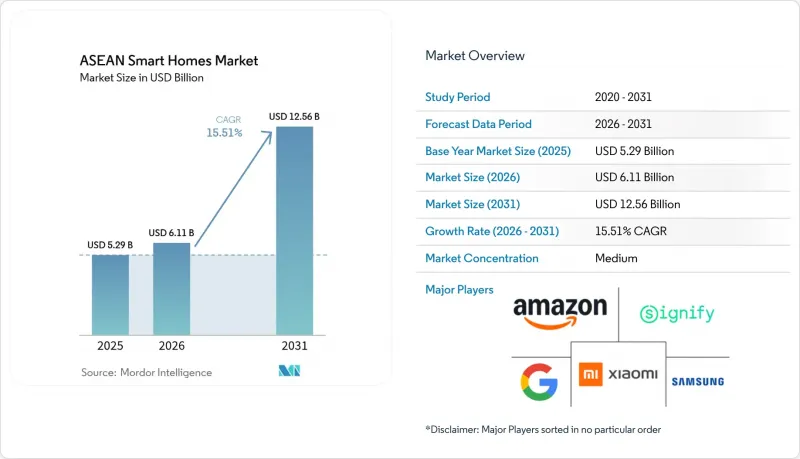
This report is Segmented by Product Type (Smart Lighting, HVAC and Energy-Management Devices, Safety, Security and Access Control, and More), Communication Protocol (Wi-Fi, Zigbee, and More), Sales Channel (Online Retail and Marketplaces, Telco/ISP Bundles, and More), Installation Type (Retrofit and New-Build Integrated), and Country. The Market Forecasts are Provided in Terms of Value (USD).
ASEAN Smart Homes Market Trends and Insights
Government-backed Energy-efficiency Incentives
Singapore's Climate-Friendly Households Programme gives every HDB household SGD 400 vouchers for energy-efficient appliances and sets an influential benchmark that neighboring markets monitor closely. Thailand's Building Energy Code and Malaysia's National Semiconductor Strategy provide similar regulatory nudges that elevate demand for connected HVAC and energy-management devices. Utilities in multiple countries have begun piloting time-of-use tariffs, rewarding homes equipped with smart thermostats and load controllers. Integration of Home Energy Management Systems into Singapore's Punggol Northshore estates demonstrates how bake-in infrastructure shortens payback periods and boosts user confidence. Collectively, these measures move smart energy devices from nice-to-have to default specifications, lifting the ASEAN smart homes market outlook for the medium term.
Rising Urban Middle-class Disposable Income
ASEAN's expanding urban middle class drives a shift from basic appliances to feature-rich, connected products. Vietnam's home-appliance spend is on course to touch USD 13 billion by 2025, growing over 10% annually. Indonesian developers now position smart homes as standard rather than premium, reinforcing consumer perception that connected living is part of modern housing. Regional firms such as Vietnam's Lumi, which operates a 6,000 m2 IoT factory and serves 70,000 customers, illustrate how localized design, language support, and climate-appropriate hardware create defensible niches against multinational brands. Rising disposable income thus unlocks multi-device purchases and subscription upgrades, increasing lifetime customer value for vendors.
High Upfront Device and Install Cost
Component inflation and tariff pressures have lifted BOM costs just as price-sensitive ASEAN consumers weigh discretionary upgrades. Manufacturers diversifying production into Malaysia and Vietnam to reduce duty exposure incur short-term capex that can raise end-user prices, slowing adoption in entry-level segments. Bulk-purchase government subsidies partially offset sticker shock, yet many households still start with single devices rather than full-suite installs. Vendors respond with stripped-down SKUs, but these pared features sometimes dilute the seamless experience that anchors recurring revenue models, tempering near-term uptake.
Other drivers and restraints analyzed in the detailed report include:
- Smartphone and Broadband Penetration Surge
- Matter Protocol Enabling Cross-brand IoT
- Ecosystem Fragmentation and Legacy Protocol Lock-in
For complete list of drivers and restraints, kindly check the Table Of Contents.
Segment Analysis
Safety, security, and access control devices accounted for 31.45% of the ASEAN smart homes market in 2025, reflecting dense urban living and rising consumer focus on personal safety. The segment enjoys strong retrofit demand, as door locks, cameras, and sensors can be installed without structural changes. HVAC and energy-management devices register the quickest pulse, expanding at 16.78% CAGR as utilities launch variable tariffs and governments tie appliance rebates to energy-star ratings. Smart lighting remains an established gateway category; Philips Hue's AI-enhanced offerings illustrate growing convergence between ambiance, security, and automation. Entertainment hubs face substitution pressure from smartphone-based control panels, yet multi-room setups still favor dedicated bridges for latency-sensitive streaming. Emerging niches such as smart water valves and leak detectors address resilience in water-stressed markets.
Philips Hue's generative-AI assistant exemplifies how legacy lighting brands extend into whole-home security, while Tuya's AI-enabled pet-health feeders highlight category blurring that keeps the ASEAN smart homes market vibrant. Competitive intensity varies: mature devices like motion sensors are commoditizing, but AI-enabled cameras and energy-optimizing HVAC controls sustain premium pricing. As user trust in cloud analytics rises, vendors that bundle software dashboards with hardware achieve higher stickiness and recurring service revenue.
Wi-Fi underpins 38.55% of connected devices in 2025, benefiting from ubiquitous router presence and straightforward user onboarding. Power consumption and congested 2.4 GHz bands, however, open space for Thread's low-energy mesh to grow at 16.55% CAGR. Zigbee maintains a foothold in cost-sensitive, multi-sensor deployments, especially for lighting. Bluetooth Low Energy powers proximity-based functions such as door unlocks, but rarely manages entire homes. Proprietary sub-GHz protocols persist in long-range security peripherals yet lose share as multi-protocol chips become mainstream. Google-MediaTek's Thread-native chipset signals the silicon ecosystem's pivot toward standardized stacks, reducing development overhead and boosting cross-vendor interoperability. Silicon Labs' support for native Matter-over-Thread smart locks further validates the protocol's viability in high-security use cases. As chipset prices fall, ASEAN manufacturers integrate dual-band Wi-Fi/Thread radios, granting end users future-proof flexibility.
Complete Report Scope:
- By Product Type
- Smart Lighting
- HVAC and Energy-Management Devices
- Safety, Security and Access Control
- Smart Appliances
- Entertainment and Connectivity Hubs
- Water and Utility-Management Devices
- By Communication Protocol
- Wi-Fi
- Zigbee
- Bluetooth/BLE
- Z-Wave
- Thread and Matter
- Proprietary/Others
- By Sales Channel
- Online Retail and Marketplaces
- Telco/ISP Bundles
- Home-Improvement and Electronics Stores
- Value-added Service Integrators
- By Installation Type
- Retrofit
- New-Build Integrated
- By Country
- Indonesia
- Thailand
- Malaysia
- Vietnam
- Singapore
- Philippines
- Others
List of Companies Covered in this Report:
- Amazon.com Inc. (Ring/Echo)
- Google LLC (Nest)
- Samsung Electronics Co. Ltd (SmartThings)
- Xiaomi Corp. (Aqara)
- Signify N.V. (Philips Hue)
- Schneider Electric SE (Wiser)
- Honeywell International Inc. (Resideo)
- Arlo Technologies Inc.
- Ecobee Inc.
- TP-Link Technologies Co. Ltd (Tapo/Kasa)
- Anker Innovations (Eufy)
- Wyze Labs Inc.
- Nanoleaf Canada Ltd.
- Belkin International Inc. (Wemo)
- Lifx Lighting (Feit Electric)
- Eve Systems GmbH
- Yale Home (ASSA ABLOY)
- SimpliSafe Inc.
- August Home Inc.
- SwitchBot Co. Ltd.
- Sengled Optoelectronics Co. Ltd.
- Fibaro (Nice S.p.A.)
- Tuya Smart Co. Ltd.
- Aqara (Lumi United)
- DoorBird (Bird Home Automation GmbH)
Additional Benefits:
- The market estimate (ME) sheet in Excel format
- 3 months of analyst support
TABLE OF CONTENTS
1 INTRODUCTION
- 1.1 Study Assumptions and Market Definition
- 1.2 Scope of the Study
2 RESEARCH METHODOLOGY
3 EXECUTIVE SUMMARY
4 MARKET LANDSCAPE
- 4.1 Market Overview
- 4.2 Market Drivers
- 4.2.1 Government?backed energy-efficiency incentives
- 4.2.2 Rising urban middle-class disposable income
- 4.2.3 Smartphone and broadband penetration surge
- 4.2.4 Security and safety concerns in dense cities
- 4.2.5 Matter protocol enabling cross-brand IoT
- 4.2.6 Telco-bundled IoT subscription models
- 4.3 Market Restraints
- 4.3.1 High upfront device and install cost
- 4.3.2 Ecosystem fragmentation and legacy protocol lock-in
- 4.3.3 Data-localisation compliance costs
- 4.3.4 Limited certified installer base beyond tier-1 cities
- 4.4 Industry Value Chain Analysis
- 4.5 Regulatory Landscape
- 4.6 Technological Outlook
- 4.7 Industry Attractiveness - Porter's Five Forces Analysis
- 4.7.1 Threat of New Entrants
- 4.7.2 Bargaining Power of Buyers
- 4.7.3 Bargaining Power of Suppliers
- 4.7.4 Threat of Substitutes
- 4.7.5 Intensity of Competitive Rivalry
- 4.8 Pricing Analysis
- 4.9 Impact of Macroeconomic Factors on the Market
5 MARKET SIZE AND GROWTH FORECASTS (VALUES)
- 5.1 By Product Type
- 5.1.1 Smart Lighting
- 5.1.2 HVAC and Energy-Management Devices
- 5.1.3 Safety, Security and Access Control
- 5.1.4 Smart Appliances
- 5.1.5 Entertainment and Connectivity Hubs
- 5.1.6 Water and Utility-Management Devices
- 5.2 By Communication Protocol
- 5.2.1 Wi-Fi
- 5.2.2 Zigbee
- 5.2.3 Bluetooth/BLE
- 5.2.4 Z-Wave
- 5.2.5 Thread and Matter
- 5.2.6 Proprietary/Others
- 5.3 By Sales Channel
- 5.3.1 Online Retail and Marketplaces
- 5.3.2 Telco/ISP Bundles
- 5.3.3 Home-Improvement and Electronics Stores
- 5.3.4 Value-added Service Integrators
- 5.4 By Installation Type
- 5.4.1 Retrofit
- 5.4.2 New-Build Integrated
- 5.5 By Country
- 5.5.1 Indonesia
- 5.5.2 Thailand
- 5.5.3 Malaysia
- 5.5.4 Vietnam
- 5.5.5 Singapore
- 5.5.6 Philippines
- 5.5.7 Others
6 COMPETITIVE LANDSCAPE
- 6.1 Market Concentration
- 6.2 Strategic Moves
- 6.3 Market Share Analysis
- 6.4 Company Profiles (includes Global level Overview, Market level overview, Core Segments, Financials as available, Strategic Information, Market Rank/Share for key companies, Products and Services, and Recent Developments)
- 6.4.1 Amazon.com Inc. (Ring/Echo)
- 6.4.2 Google LLC (Nest)
- 6.4.3 Samsung Electronics Co. Ltd (SmartThings)
- 6.4.4 Xiaomi Corp. (Aqara)
- 6.4.5 Signify N.V. (Philips Hue)
- 6.4.6 Schneider Electric SE (Wiser)
- 6.4.7 Honeywell International Inc. (Resideo)
- 6.4.8 Arlo Technologies Inc.
- 6.4.9 Ecobee Inc.
- 6.4.10 TP-Link Technologies Co. Ltd (Tapo/Kasa)
- 6.4.11 Anker Innovations (Eufy)
- 6.4.12 Wyze Labs Inc.
- 6.4.13 Nanoleaf Canada Ltd.
- 6.4.14 Belkin International Inc. (Wemo)
- 6.4.15 Lifx Lighting (Feit Electric)
- 6.4.16 Eve Systems GmbH
- 6.4.17 Yale Home (ASSA ABLOY)
- 6.4.18 SimpliSafe Inc.
- 6.4.19 August Home Inc.
- 6.4.20 SwitchBot Co. Ltd.
- 6.4.21 Sengled Optoelectronics Co. Ltd.
- 6.4.22 Fibaro (Nice S.p.A.)
- 6.4.23 Tuya Smart Co. Ltd.
- 6.4.24 Aqara (Lumi United)
- 6.4.25 DoorBird (Bird Home Automation GmbH)
7 MARKET OPPORTUNITIES AND FUTURE TRENDS
- 7.1 White-Space and Unmet-Need Assessment

