PUBLISHER: Mordor Intelligence | PRODUCT CODE: 2154725

PUBLISHER: Mordor Intelligence | PRODUCT CODE: 2154725
South America Smart Home - Market Share Analysis, Industry Trends & Statistics, Growth Forecasts (2026 - 2031)
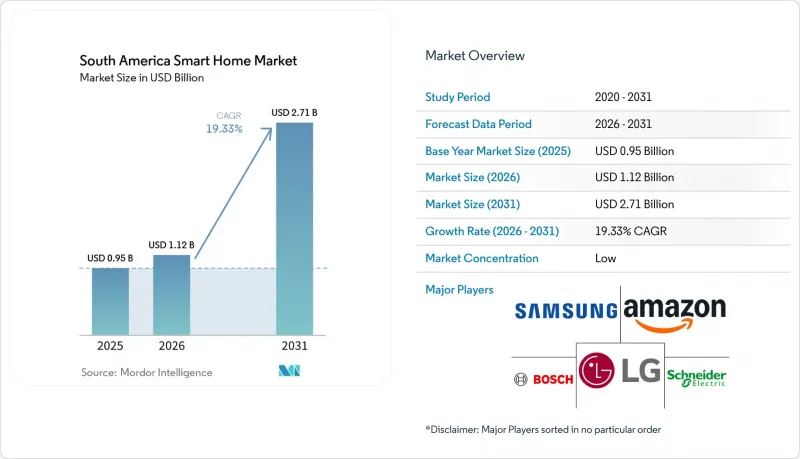
According to Mordor Intelligence, the South America smart home market size was valued at USD 0.95 billion in 2025 and estimated to grow from USD 1.12 billion in 2026 to reach USD 2.71 billion by 2031, at a CAGR of 19.33% during the forecast period (2026-2031).
South America Smart Home Market Trends and Insights
Rising Broadband, Smartphone, and Connected-Home Penetration
Household connectivity provides the South America Smart Home Market with a larger base of connected devices. Reported that 93.6% of Brazilian households had internet access in 2024, while fixed broadband reached 88.9% of connected homes. The same survey counted 13.5 million Brazilian homes with at least 1 smart device, after an increase of 1.9 million homes in 1 year. This installed base supports both first purchases and later additions such as cameras, lamps, and sensors. Better network access also makes lower-cost Wi-Fi products practical for households that do not want a complex installation.
Growing Demand for Residential Security and Remote Monitoring
Security demand remains a direct driver for the South America Smart Home Market because cameras, locks, and alarms solve visible household concerns. Brazil's electronic security sector included 33,000 companies in 2025, showing the scale of the existing distribution and installer base. Connected security products can be added gradually, which lowers the initial commitment for buyers. A camera or digital lock can also introduce a household to broader automation without requiring a full system purchase. Suppliers that pair easy installation with dependable monitoring are better placed to turn security buyers into repeat customers.
High Upfront Retrofit and Professional-Installation Costs
Retrofit work can slow the South America Smart Home Market because much of the residential stock was not designed for connected systems. Older homes may lack suitable wiring, hub locations, or compatible switch boxes. Professional installation can raise the total cost and place integrated systems beyond many middle-income households. This creates a split between premium installations and simpler do-it-yourself products. Wireless products that avoid rewiring can reduce this barrier, but they may not provide every function sought in a whole-home system.
Other drivers and restraints analyzed in the detailed report include:
- Energy-Cost Management and Distributed-Energy Integration
- Smart Appliance and Voice-Control Adoption
- Cybersecurity, Privacy, and Trust Concerns
For complete list of drivers and restraints, kindly check the Table Of Contents.
Segment Analysis
Access Control, Safety, and Security accounted for 38.12% of the South America Smart Home Market in 2025. Cameras, alarms, smart locks, smoke detectors, and monitoring devices serve a direct need for protection in private homes and shared residential spaces. The group also benefits from established security distributors and installers who can recommend products, configure systems, and provide post-installation support. Cloud-managed panels are useful to professional installers because they support monitoring and maintenance needs across multiple customer locations. Consumer Electronics, including smart speakers, home theater systems, and air purifiers, is another important component group because it brings familiar connected products into homes.
Smart-Home Healthcare is forecast to grow at a 20.41% CAGR through 2031. The category includes remote monitoring products that can support older adults and patients who require regular observation, while keeping care linked to the home. In March 2026, InCor began a 200-patient trial of a smart cardiac wristband with Arqia, and commercialization is planned for 2027. Lighting, energy management, climate controls, controllers, and hubs can grow alongside security as users add products and connect separate device categories over time. Smart kitchen products remain small in size, but developer-led housing projects can introduce them to buyers through preselected bundles.
Single-Family Dwelling held 74.23% of the South America Smart Home Market share in 2025. Detached-home owners have more flexibility to add outdoor cameras, lighting, access controls, and climate products without requiring approval from a building manager. These homes can support gradual do-it-yourself upgrades as well as professionally integrated systems, which gives vendors multiple ways to reach the same household. Security products are particularly suited to homes with exterior areas, garages, gates, and separate points of entry. The segment, therefore, remains central to near-term device volumes and to the coverage strategies used by retailers and installation companies.
Multifamily Dwelling is forecast to expand at a 21.27% CAGR through 2031. Developers can add connectivity, access control, shared cameras, and building management features before residents move in, reducing the complexity of later installations. Housi stated in January 2026 that it was targeting more than 400,000 apartments with embedded technology across 80 cities and 17 Brazilian states. This model provides a ready foundation for residents to add personal devices after occupancy, rather than starting with basic infrastructure work. Suppliers that establish developer relationships can create repeat demand across multiple residential projects and build an installed base for later upgrades.
Complete Report Scope:
- By Components
- Consumer Electronics
- Smart Speakers
- Smart Home Theater
- Smart Purifiers
- Other Consumer Electronics
- Access Control, Safety and Security Solution
- Smart Alarms
- Smart Locks
- Smart Sensors
- Smoke and Hazard Detectors
- Smart Cameras and Monitoring
- Garage-Door Operators among Other Access Control, Safety and Security Solutions
- Lighting
- Smart Lighting
- Smart Lamps and Luminaires
- Ambient Lighting
- Other Lighting Products
- Energy Management
- Lighting Energy Controllers
- Central Control Systems
- HVAC Energy Controls
- Smart HVAC and Climate Control
- Fans
- Radiators
- Thermostats
- Air Conditioners
- Controllers and Hubs
- DIY Hubs and Panels
- Professional Hubs and Panels
- Smart-Home Healthcare
- Medical-Alert Systems
- Smart Glucose Monitors
- Smart Cardiac Monitors
- Smart Kitchen
- Smart Refrigerators
- Smart Cookware and Cooktops
- Smart Dishwashers
- Smart Ovens
- Other Smart Kitchen Products
- Consumer Electronics
- By Housing Type
- Single-Family Dwelling
- Multifamily Dwelling
- By Installation Type
- New Construction
- Retrofit
- By Sales Channel
- Online
- Offline
- By Connectivity Technology
- Wi-Fi
- Zigbee and Z-Wave
- Bluetooth Low Energy
- Thread
- Powerline and PLC
- Rest of Connectivity Technology
- By Application
- Safety and Security
- Energy Management
- Comfort and Climate Control
- Entertainment and Media
- Assisted Living and Home Healthcare
- Smart Kitchen and Household Tasks
- By Geography
- Brazil
- Argentina
- Colombia
- Chile
- Rest of South America
List of Companies Covered in this Report:
- Samsung Electronics Co., Ltd.
- Alarm.com Incorporated
- Amazon.com, Inc.
- LG Electronics Inc.
- Vivint, Inc.
- Robert Bosch GmbH
- Schneider Electric SE
- Eve Systems GmbH
- Lumi United Technology Co., Ltd.
- Tuya Inc.
- Shelly Group SE
- Nice S.p.A.
- FIBARO Group S.A.
- Somfy SA
- Nuki Home Solutions GmbH
- Ajax Systems Inc.
- ELSYS Equipamentos Eletronicos Ltda.
- Flex Automation Ltda.
- Hometree Casa Inteligente LTDA
- Smart Homy SpA
- Tholz LtdA
Additional Benefits:
- The market estimate (ME) sheet in Excel format
- 3 months of analyst support
TABLE OF CONTENTS
1 INTRODUCTION
- 1.1 Study Assumptions and Market Definition
- 1.2 Scope of the Study
2 RESEARCH METHODOLOGY
3 EXECUTIVE SUMMARY
4 MARKET LANDSCAPE
- 4.1 Market Overview
- 4.2 Market Drivers
- 4.2.1 Rising Broadband, Smartphone, and Connected-Home Penetration
- 4.2.2 Growing Demand for Residential Security and Remote Monitoring
- 4.2.3 Energy-Cost Management and Distributed-Energy Integration
- 4.2.4 Smart Appliance and Voice-Control Adoption
- 4.2.5 Developer-Led Smart-Home Standardization in Premium Multifamily Projects
- 4.2.6 Spanish- and Portuguese-Language Localized Automation Experiences
- 4.3 Market Restraints
- 4.3.1 High Upfront Retrofit and Professional-Installation Costs
- 4.3.2 Cybersecurity, Privacy, and Trust Concerns
- 4.3.3 Voltage, Wiring, and Building-Stock Compatibility Constraints
- 4.3.4 Currency Volatility and Import-Dependent Device Pricing
- 4.4 Impact of Macroeconomic Factors on the Market
- 4.5 Industry Supply-Chain Analysis
- 4.6 Technology Outlook
- 4.7 Regulatory Landscape
- 4.8 Porter's Five Forces Analysis
- 4.8.1 Threat of New Entrants
- 4.8.2 Bargaining Power of Suppliers
- 4.8.3 Bargaining Power of Buyers
- 4.8.4 Threat of Substitutes
- 4.8.5 Intensity of Competitive Rivalry
5 MARKET SIZE AND GROWTH FORECASTS (VALUE)
- 5.1 By Components
- 5.1.1 Consumer Electronics
- 5.1.1.1 Smart Speakers
- 5.1.1.2 Smart Home Theater
- 5.1.1.3 Smart Purifiers
- 5.1.1.4 Other Consumer Electronics
- 5.1.2 Access Control, Safety and Security Solution
- 5.1.2.1 Smart Alarms
- 5.1.2.2 Smart Locks
- 5.1.2.3 Smart Sensors
- 5.1.2.4 Smoke and Hazard Detectors
- 5.1.2.5 Smart Cameras and Monitoring
- 5.1.2.6 Garage-Door Operators among Other Access Control, Safety and Security Solutions
- 5.1.3 Lighting
- 5.1.3.1 Smart Lighting
- 5.1.3.2 Smart Lamps and Luminaires
- 5.1.3.3 Ambient Lighting
- 5.1.3.4 Other Lighting Products
- 5.1.4 Energy Management
- 5.1.4.1 Lighting Energy Controllers
- 5.1.4.2 Central Control Systems
- 5.1.4.3 HVAC Energy Controls
- 5.1.5 Smart HVAC and Climate Control
- 5.1.5.1 Fans
- 5.1.5.2 Radiators
- 5.1.5.3 Thermostats
- 5.1.5.4 Air Conditioners
- 5.1.6 Controllers and Hubs
- 5.1.6.1 DIY Hubs and Panels
- 5.1.6.2 Professional Hubs and Panels
- 5.1.7 Smart-Home Healthcare
- 5.1.7.1 Medical-Alert Systems
- 5.1.7.2 Smart Glucose Monitors
- 5.1.7.3 Smart Cardiac Monitors
- 5.1.8 Smart Kitchen
- 5.1.8.1 Smart Refrigerators
- 5.1.8.2 Smart Cookware and Cooktops
- 5.1.8.3 Smart Dishwashers
- 5.1.8.4 Smart Ovens
- 5.1.8.5 Other Smart Kitchen Products
- 5.1.1 Consumer Electronics
- 5.2 By Housing Type
- 5.2.1 Single-Family Dwelling
- 5.2.2 Multifamily Dwelling
- 5.3 By Installation Type
- 5.3.1 New Construction
- 5.3.2 Retrofit
- 5.4 By Sales Channel
- 5.4.1 Online
- 5.4.2 Offline
- 5.5 By Connectivity Technology
- 5.5.1 Wi-Fi
- 5.5.2 Zigbee and Z-Wave
- 5.5.3 Bluetooth Low Energy
- 5.5.4 Thread
- 5.5.5 Powerline and PLC
- 5.5.6 Rest of Connectivity Technology
- 5.6 By Application
- 5.6.1 Safety and Security
- 5.6.2 Energy Management
- 5.6.3 Comfort and Climate Control
- 5.6.4 Entertainment and Media
- 5.6.5 Assisted Living and Home Healthcare
- 5.6.6 Smart Kitchen and Household Tasks
- 5.7 By Geography
- 5.7.1 Brazil
- 5.7.2 Argentina
- 5.7.3 Colombia
- 5.7.4 Chile
- 5.7.5 Rest of South America
6 COMPETITIVE LANDSCAPE
- 6.1 Market Concentration
- 6.2 Strategic Moves
- 6.3 Market Share Analysis
- 6.4 Company Profiles (includes Global Level Overview, Market Level Overview, Core Segments, Financials as available, Strategic Information, Market Rank/Share, Products and Services, Recent Developments)
- 6.4.1 Samsung Electronics Co., Ltd.
- 6.4.2 Alarm.com Incorporated
- 6.4.3 Amazon.com, Inc.
- 6.4.4 LG Electronics Inc.
- 6.4.5 Vivint, Inc.
- 6.4.6 Robert Bosch GmbH
- 6.4.7 Schneider Electric SE
- 6.4.8 Eve Systems GmbH
- 6.4.9 Lumi United Technology Co., Ltd.
- 6.4.10 Tuya Inc.
- 6.4.11 Shelly Group SE
- 6.4.12 Nice S.p.A.
- 6.4.13 FIBARO Group S.A.
- 6.4.14 Somfy SA
- 6.4.15 Nuki Home Solutions GmbH
- 6.4.16 Ajax Systems Inc.
- 6.4.17 ELSYS Equipamentos Eletronicos Ltda.
- 6.4.18 Flex Automation Ltda.
- 6.4.19 Hometree Casa Inteligente LTDA
- 6.4.20 Smart Homy SpA
- 6.4.21 Tholz LtdA
7 MARKET OPPORTUNITIES AND FUTURE OUTLOOK
- 7.1 White-Space and Unmet-Need Assessment

