PUBLISHER: Mordor Intelligence | PRODUCT CODE: 2125430

PUBLISHER: Mordor Intelligence | PRODUCT CODE: 2125430
India D2C E-commerce - Market Share Analysis, Industry Trends & Statistics, Growth Forecasts (2026 - 2031)
According to Mordor Intelligence, the India D2C e-commerce market size was valued at USD 87.5 billion in 2025 and estimated to grow from USD 108.76 billion in 2026 to reach USD 322.1 billion by 2031, at a CAGR of 24.30% during the forecast period (2026-2031).
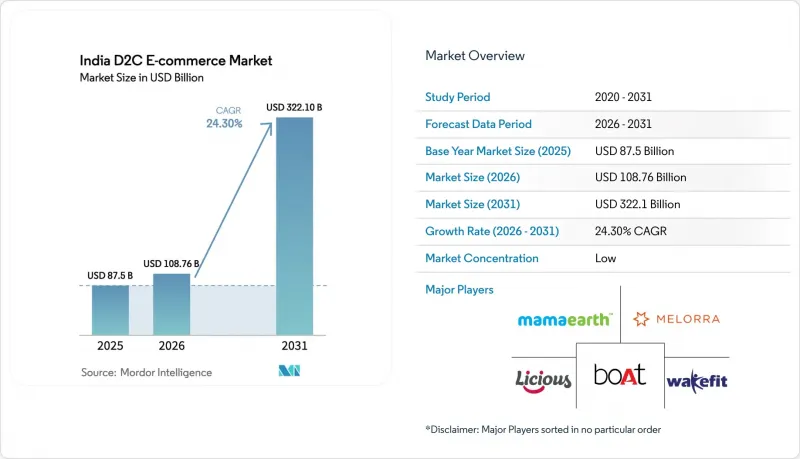
This report is Segmented by End-User Vertical (Apparel and Footwear, Grocery and Gourmet, Personal Care, Home Decor and Household Supplies, Healthcare, and Jewelry) and City (Delhi NCR, Mumbai Metropolitan Region, Bengaluru, Hyderabad, Chennai, Kolkata, and More). The Market Forecasts are Provided in Terms of Value (USD).
India D2C E-commerce Market Trends and Insights
Accelerating VC/PE funding into D2C brands
Selective capital deployment is favoring enterprises with positive contribution margins, sustained 15-20% monthly revenue growth, and proven retention economics, even though overall funding slipped to USD 757 million in 2024. Large rounds now emphasize supply-chain automation, headless commerce platforms, and AI-driven personalization, positioning funded companies such as boAt to target IPOs in 2025 at USD 300-500 million valuations. Revenue-based lenders, led by Recur Club, allocated INR 150 crore (USD 18 million) during 2024 to alleviate COD-related working-capital gaps. Consolidation is accelerating, enabling well-capitalized players to absorb niche labels and widen stock-keeping units (SKUs) without commensurate marketing-spend escalation. Capital discipline thereby converts funding scarcity into a market-share opportunity for operators with efficient cost structures.
GST-enabled nationwide logistics efficiencies
Unified GST has lowered interstate transit dwell time, trimmed logistics costs by 20-25%, and enabled 2-3-day delivery to 19,000+ pin codes through third-party carriers. Centralized fulfillment now suffices for categories like apparel, reducing inventory duplication across hubs and cutting administrative overhead by up to 18%. Small D2C entrants can scale nationally without recreating regional warehousing, while established brands re-optimize network footprints to free working capital. Harmonized e-invoicing also simplifies returns reconciliation, a critical element given COD reversal volumes. Over the long term, lower distribution frictions are expected to widen the India D2C E-commerce market by pulling underserved pin codes into viable service radii.
Escalating digital-marketing CPA inflation
Google Ads CPC rose between 30% and 100% across categories in 2024, while Facebook CPM climbed 25-40%, lifting acquisition costs to INR 800-1,200 per new customer. Apple's privacy policy shifts further erode attribution precision, swelling unoptimized spend. Brands with lower average-order values, such as personal care, must extend payback periods or optimize retention loops to preserve contribution margin. Heavier competition in auction-based media favors capital-rich players, compressing visibility for emerging labels. In response, operators allocate larger budgets to owned media, referral incentives, and loyalty tiers, emphasizing lifetime-value realization over top-of-funnel volume.
Other drivers and restraints analyzed in the detailed report include:
- Rise of ONDC and open-API commerce infrastructure
- Tier-2/3 smartphone penetration boosting online first-purchases
- Fragmented cold-chain for grocery and perishables
For complete list of drivers and restraints, kindly check the Table Of Contents.
Segment Analysis
Apparel and Footwear accounted for 25.18% of India D2C E-commerce market share in 2025, reflecting early-mover depth in catalog breadth and influencer partnerships. However, Personal Care is poised to compound at a 24.92% CAGR to 2031 as premium beauty GMV expands toward USD 3 billion on the back of AR try-ons, AI diagnostics, and 12-24 micro-collections each year. Skincare alone advances at a 14.6% trajectory, with clean-label formulations and dermat-backed claims converting skeptical first-time buyers. High lifetime value, often exceeding INR 2,000, makes Paid Social breakevens feasible despite rising CPC.
Adjacent segments mirror divergent headwinds and tailwinds. Grocery growth is tethered to cold-chain deficiencies yet feels uplift from quick-commerce models that rotate inventory within 20 minutes, a dynamic elevating demand for revenue-based financing to fund rolling stock. Home Decor benefits from the remote-work paradigm, with furniture subscriptions reducing upfront purchase inertia. Healthcare-adjacent D2C blends prescription fulfillment and teleconsults, driving adherence-based revenue stability. Jewelry leverages virtual try-on engines to bridge tactile gaps inherent in online gold and gems trading, while BIS certification complexity in electronics raises entry barriers that safeguard incumbents.
Complete Report Scope:
- By End-User Vertical
- Apparel and Footwear
- Grocery and Gourmet
- Personal Care
- Home Decor and Household Supplies
- Healthcare
- Jewelry
- By City
- Delhi NCR
- Mumbai Metropolitan Region
- Bengaluru
- Hyderabad
- Chennai
- Kolkata
- Pune
- Other Cities
List of Companies Covered in this Report:
- Honasa Consumer Limited (Mamaearth)
- Imagine Marketing Limited (boAt Lifestyle)
- Delightful Gourmet Private Limited (Licious)
- InnoVision Jewellery India Private Limited (Melorra)
- Vellvette Lifestyle Private Limited (SUGAR Cosmetics)
- Nexxbase Marketing Private Limited (Noise)
- Bewakoof Brands Private Limited
- Behemoth Agri Services Private Limited (Country Delight)
- Nykaa E-Retail Private Limited
- Wakefit Innovations Private Limited
- Body Cupid Private Limited (WOW Skin Science)
- Bluestone Jewellery and Lifestyle Private Limited
- Actoserba Active Wholesale Private Limited (Zivame)
- Urban Ladder Home Decor Solutions Limited
- Trendsutra Platform Services Private Limited (Pepperfry)
- Kieraya Furnishing Solutions Private Limited (Furlenco)
- Sleepycat Beds Private Limited
- Sanghvi Beauty and Technologies Private Limited (Good Glamm Group)
- Palred Electronics Private Limited (pTron)
- The Souled Store Private Limited
Additional Benefits:
- The market estimate (ME) sheet in Excel format
- 3 months of analyst support
TABLE OF CONTENTS
1 INTRODUCTION
- 1.1 Study Assumptions and Market Definition
- 1.2 Scope of the Study
2 RESEARCH METHODOLOGY
3 EXECUTIVE SUMMARY
4 MARKET LANDSCAPE
- 4.1 Market Overview
- 4.2 Market Drivers
- 4.2.1 Accelerating VC/PE Funding Into D2C Brands
- 4.2.2 GST-Enabled Nationwide Logistics Efficiencies
- 4.2.3 Rise of ONDC and Open-API Commerce Infrastructure
- 4.2.4 Tier-2/3 Smartphone Penetration Boosting Online First-Purchases
- 4.2.5 Social-Commerce-Led "Community Group Buying" Momentum
- 4.2.6 Gen-Z Preference for Sustainable, Native "Made-in-India" Labels
- 4.3 Market Restraints
- 4.3.1 Escalating Digital Marketing CPA Inflation
- 4.3.2 Fragmented Cold-Chain for Grocery and Perishables
- 4.3.3 Low Repeat-Purchase Rates Beyond Top 5 Metros
- 4.3.4 High Working-Capital Cycle Due to Cash-on-Delivery Returns
- 4.4 Industry Value Chain Analysis
- 4.5 Regulatory Landscape
- 4.6 Technological Outlook
- 4.7 Impact of Macroeconomic Factors on the Market
- 4.8 Porter's Five Forces Analysis
- 4.8.1 Bargaining Power of Suppliers
- 4.8.2 Bargaining Power of Buyers
- 4.8.3 Threat of New Entrants
- 4.8.4 Threat of Substitutes
- 4.8.5 Intensity of Competitive Rivalry
5 MARKET SIZE AND GROWTH FORECASTS (VALUE)
- 5.1 By End-User Vertical
- 5.1.1 Apparel and Footwear
- 5.1.2 Grocery and Gourmet
- 5.1.3 Personal Care
- 5.1.4 Home Decor and Household Supplies
- 5.1.5 Healthcare
- 5.1.6 Jewelry
- 5.2 By City
- 5.2.1 Delhi NCR
- 5.2.2 Mumbai Metropolitan Region
- 5.2.3 Bengaluru
- 5.2.4 Hyderabad
- 5.2.5 Chennai
- 5.2.6 Kolkata
- 5.2.7 Pune
- 5.2.8 Other Cities
6 COMPETITIVE LANDSCAPE
- 6.1 Market Concentration
- 6.2 Strategic Moves
- 6.3 Market Share Analysis
- 6.4 Company Profiles (includes Global level Overview, Market level overview, Core Segments, Financials as available, Strategic Information, Market Rank/Share for key companies, Products and Services, and Recent Developments)
- 6.4.1 Honasa Consumer Limited (Mamaearth)
- 6.4.2 Imagine Marketing Limited (boAt Lifestyle)
- 6.4.3 Delightful Gourmet Private Limited (Licious)
- 6.4.4 InnoVision Jewellery India Private Limited (Melorra)
- 6.4.5 Vellvette Lifestyle Private Limited (SUGAR Cosmetics)
- 6.4.6 Nexxbase Marketing Private Limited (Noise)
- 6.4.7 Bewakoof Brands Private Limited
- 6.4.8 Behemoth Agri Services Private Limited (Country Delight)
- 6.4.9 Nykaa E-Retail Private Limited
- 6.4.10 Wakefit Innovations Private Limited
- 6.4.11 Body Cupid Private Limited (WOW Skin Science)
- 6.4.12 Bluestone Jewellery and Lifestyle Private Limited
- 6.4.13 Actoserba Active Wholesale Private Limited (Zivame)
- 6.4.14 Urban Ladder Home Decor Solutions Limited
- 6.4.15 Trendsutra Platform Services Private Limited (Pepperfry)
- 6.4.16 Kieraya Furnishing Solutions Private Limited (Furlenco)
- 6.4.17 Sleepycat Beds Private Limited
- 6.4.18 Sanghvi Beauty and Technologies Private Limited (Good Glamm Group)
- 6.4.19 Palred Electronics Private Limited (pTron)
- 6.4.20 The Souled Store Private Limited
7 MARKET OPPORTUNITIES AND FUTURE OUTLOOK
- 7.1 White-space and Unmet-Need Assessment

