PUBLISHER: Mordor Intelligence | PRODUCT CODE: 2125444

PUBLISHER: Mordor Intelligence | PRODUCT CODE: 2125444
North America B2B E-commerce - Market Share Analysis, Industry Trends & Statistics, Growth Forecasts (2026 - 2031)
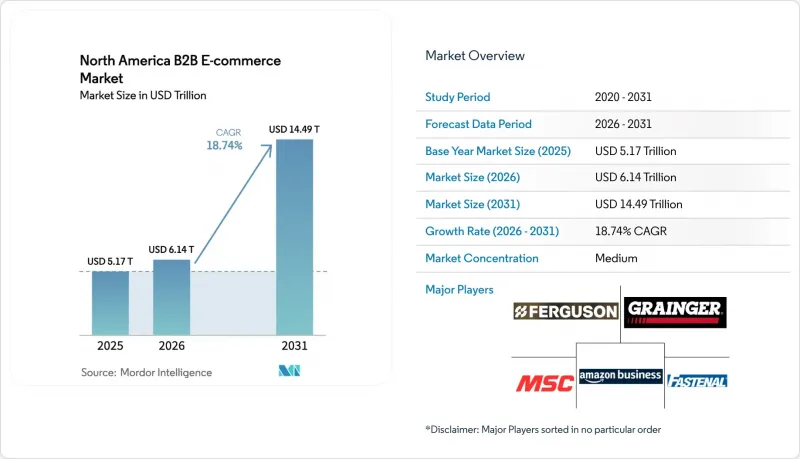
According to Mordor Intelligence, North America B2B e-commerce market size in 2026 is estimated at USD 6.14 trillion, growing from 2025 value of USD 5.17 trillion with 2031 projections showing USD 14.49 trillion, growing at 18.74% CAGR over 2026-2031.
This report is Segmented by Channel (Direct Sales, Marketplace Sales), Transaction Model (Domestic, Cross-Border), Payment Method (Bank Transfers and ACH, Credit and Debit Cards, and More), Industry Vertical (Manufacturing, Retail and Wholesale, Healthcare and Life Sciences, Automotive, and More), and Country (United States, Canada, Mexico). The Market Forecasts are Provided in Terms of Value (USD).
North America B2B E-commerce Market Trends and Insights
Omnichannel Fulfillment Preference
Omnichannel models now define purchasing expectations as 94% of decision-makers view unified buying experiences as productive for their organizations. Integrated inventory visibility and centralized order orchestration lift order accuracy by up to 20% and trim processing times by nearly one-quarter. Industrial distributors observe that buyers often start online, consult a representative, and complete pickup at a branch, blending physical and digital hand-offs within the same transaction. Accelerated digital payment adoption accompanies this shift, with 73% of companies transitioning to electronic settlement methods to support real-time reconciliation. As omnichannel fulfillment matures, platform operators differentiate on inventory depth, last-mile reliability, and payment flexibility, giving rise to ecosystem partnerships between carriers, ERP vendors, and embedded-finance providers. The North America B2B e-commerce market, therefore, tilts towards players that can synchronize data across every interaction node without introducing process friction.
Migration from EDI and Fax to Self-Service Portals
Legacy EDI links and fax orders are giving way to modern portals as 62% of buyers prefer to self-educate online before engaging sales staff. Portal functionality has evolved to include role-based permissions, contract pricing, and tailored catalogs, mirroring complex approval hierarchies inside large enterprises. Millennial procurement professionals, now driving 73% of buying decisions, expect consumer-grade speed and transparency, accelerating portal adoption. Organizations that deploy robust portals report double-digit cuts in administrative overhead and measurable decreases in Maverick spend. Short implementation timelines, often under six months when leveraging composable commerce, further catalyze upgrade cycles. Strong early traction in the United States and Canada suggests near-term upside for solution providers able to integrate portal workflows directly into ERP and inventory systems.
Cyber-attacks and Data-Sovereignty Litigation
Business email compromise schemes, ransomware, and supply-chain intrusions add material risk to digital channels, with annual losses measured in billions. Heightened regulatory scrutiny, especially around health and financial data, elevates compliance costs as firms must localize sensitive records to satisfy jurisdictional rules. Security budgets are climbing 15-20% each year, yet mid-market players often lack the scale to absorb such expense, delaying platform upgrades. Class-action litigation surrounding breaches causes further hesitation among regulated industries. The policy environment, therefore, represents a meaningful drag on overall adoption, even though security-first architectures promise long-term risk mitigation.
Other drivers and restraints analyzed in the detailed report include:
- Surge in Marketplace Adoption by Mid-Market Firms
- Procurement-Cost Reduction Mandates
- Fragmented Payment Rails for Net-30/60 Terms
For complete list of drivers and restraints, kindly check the Table Of Contents.
Segment Analysis
Marketplace momentum is reshaping the North America B2B e-commerce market. Direct channels retained a 62.40% share in 2025, underpinned by bespoke pricing agreements in regulated environments. Marketplaces, however, are forecast to log a 20.95% CAGR, outpacing the overall North America B2B e-commerce market size. Demand for broad assortments and rapid vendor onboarding fuels migration, particularly among mid-size manufacturers seeking scale without heavy technology investment.
Intensifying rivalry pushes legacy distributors to augment digital storefronts and explore marketplace partnerships. Many pursue a dual-track approach, selling through proprietary portals while listing commodity SKUs on leading marketplaces. As customers blend channels, 85% of firms now report multi-channel engagement strategies. The North America B2B e-commerce market therefore evolves into a hybrid network where channel choice hinges on product complexity, service expectations, and total landed cost.
Domestic orders represented 64.30% of the North America B2B e-commerce market share in 2025, yet cross-border flows are projected to advance at 19.88% CAGR, narrowing the gap. USMCA provisions that lift de minimis thresholds lower customs friction, promoting smaller, higher-frequency shipments. Automated duty calculation and digital customs documentation further remove process hurdles.
Tariff announcements in February 2025 added a 25% levy on select goods from Canada and Mexico, prompting supply-chain re-routing and localized stockholding tactics. Platform providers integrating duty estimation and alternative routing tools stand to gain as firms navigate cost volatility. Over the forecast horizon, the North America B2B e-commerce market size in cross-border trade will hinge on policy stability, logistics modernization, and harmonized data standards.
Complete Report Scope:
- By Channel
- Direct Sales
- Marketplace Sales
- By Transaction Model
- Domestic
- Cross-border
- By Payment Method
- Bank Transfers and ACH
- Credit and Debit Cards
- Other Payment Methods
- By Industry Vertical
- Manufacturing
- Retail and Wholesale
- Healthcare and Life Sciences
- Automotive
- Construction and Building Materials
- Other Industry Verticals
- By Geography
- United States
- Canada
- Mexico
List of Companies Covered in this Report:
- Amazon.com Inc. (Amazon Business)
- W.W. Grainger Inc.
- Fastenal Company
- MSC Industrial Supply Co.
- Ferguson plc
- Staples Inc. (Staples Business Advantage)
- Office Depot Inc. (ODP Business Solutions)
- Walmart Inc. (Walmart Business)
- Home Depot USA Inc. (Home Depot Pro)
- Uline Inc.
- Global Industrial Company
- Thomas Publishing Company (Thomasnet)
- Alibaba Group Holding Ltd. (Alibaba.com)
- eBay Inc. (eBay Business Supply)
- Veritiv Corporation
- Parts Town LLC
- Henry Schein Inc.
- Sysco Corporation (Sysco Shop)
- C.H. Robinson Worldwide Inc. (Freightquote)
- Newegg Commerce Inc. (Newegg Business)
Additional Benefits:
- The market estimate (ME) sheet in Excel format
- 3 months of analyst support
TABLE OF CONTENTS
1 INTRODUCTION
- 1.1 Study Assumptions and Market Definition
- 1.2 Scope of the Study
2 RESEARCH METHODOLOGY
3 EXECUTIVE SUMMARY
4 MARKET LANDSCAPE
- 4.1 Market Overview
- 4.2 Market Drivers
- 4.2.1 Omnichannel fulfilment preference
- 4.2.2 Migration from EDI and fax to self-service portals
- 4.2.3 Surge in marketplace adoption by mid-market firms
- 4.2.4 Procurement-cost reduction mandates
- 4.2.5 Embedded-finance APIs unlocking high-ticket check-out
- 4.2.6 Cross-border (US-MX-CA) USMCA duty-free thresholds
- 4.3 Market Restraints
- 4.3.1 Cyber-attacks and data-sovereignty litigation
- 4.3.2 Fragmented payment rails for Net-30/60 terms
- 4.3.3 Growing seller resistance to marketplace fee inflation
- 4.3.4 Warehouse-capacity crunch at inland ports
- 4.4 Value Chain Analysis
- 4.5 Regulatory Landscape
- 4.6 Technological Outlook (AI, headless and composable commerce)
- 4.7 Porter's Five Forces Analysis
- 4.7.1 Threat of New Entrants
- 4.7.2 Bargaining Power of Suppliers
- 4.7.3 Bargaining Power of Buyers
- 4.7.4 Threat of Substitutes
- 4.7.5 Intensity of Competitive Rivalry
5 MARKET SIZE AND GROWTH FORECASTS (VALUES)
- 5.1 By Channel
- 5.1.1 Direct Sales
- 5.1.2 Marketplace Sales
- 5.2 By Transaction Model
- 5.2.1 Domestic
- 5.2.2 Cross-border
- 5.3 By Payment Method
- 5.3.1 Bank Transfers and ACH
- 5.3.2 Credit and Debit Cards
- 5.3.3 Other Payment Methods
- 5.4 By Industry Vertical
- 5.4.1 Manufacturing
- 5.4.2 Retail and Wholesale
- 5.4.3 Healthcare and Life Sciences
- 5.4.4 Automotive
- 5.4.5 Construction and Building Materials
- 5.4.6 Other Industry Verticals
- 5.5 By Geography
- 5.5.1 United States
- 5.5.2 Canada
- 5.5.3 Mexico
6 COMPETITIVE LANDSCAPE
- 6.1 Market Concentration
- 6.2 Strategic Moves
- 6.3 Market Share Analysis
- 6.4 Company Profiles (includes Global level Overview, Market level overview, Core Segments, Financials, Strategic Information, Market Rank/Share, Products and Services, Recent Developments)
- 6.4.1 Amazon.com Inc. (Amazon Business)
- 6.4.2 W.W. Grainger Inc.
- 6.4.3 Fastenal Company
- 6.4.4 MSC Industrial Supply Co.
- 6.4.5 Ferguson plc
- 6.4.6 Staples Inc. (Staples Business Advantage)
- 6.4.7 Office Depot Inc. (ODP Business Solutions)
- 6.4.8 Walmart Inc. (Walmart Business)
- 6.4.9 Home Depot USA Inc. (Home Depot Pro)
- 6.4.10 Uline Inc.
- 6.4.11 Global Industrial Company
- 6.4.12 Thomas Publishing Company (Thomasnet)
- 6.4.13 Alibaba Group Holding Ltd. (Alibaba.com)
- 6.4.14 eBay Inc. (eBay Business Supply)
- 6.4.15 Veritiv Corporation
- 6.4.16 Parts Town LLC
- 6.4.17 Henry Schein Inc.
- 6.4.18 Sysco Corporation (Sysco Shop)
- 6.4.19 C.H. Robinson Worldwide Inc. (Freightquote)
- 6.4.20 Newegg Commerce Inc. (Newegg Business)
7 MARKET OPPORTUNITIES AND FUTURE OUTLOOK
- 7.1 White-space and Unmet-need Assessment

