PUBLISHER: Mordor Intelligence | PRODUCT CODE: 2125510

PUBLISHER: Mordor Intelligence | PRODUCT CODE: 2125510
India Q-Commerce - Market Share Analysis, Industry Trends & Statistics, Growth Forecasts (2026 - 2031)
According to Mordor Intelligence, the India quick commerce market size stands at USD 3.65 billion in 2026, and it is forecast to reach USD 6.64 billion by 2031 at a 12.74% CAGR.
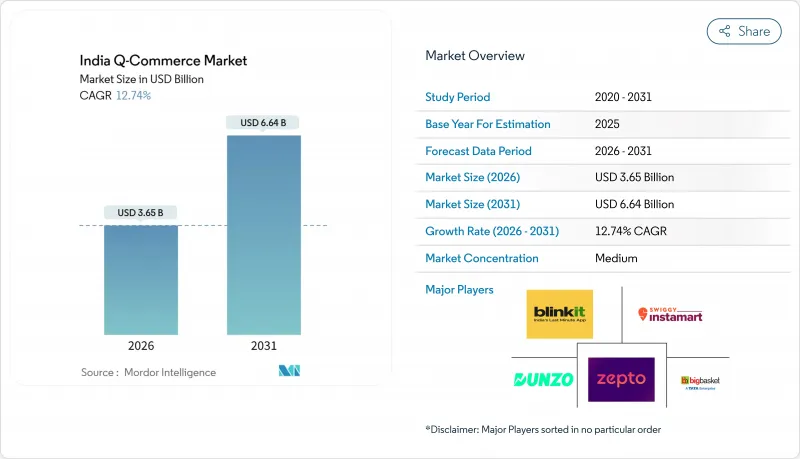
This report is Segmented by Product Category (Grocery & Staples, Fresh Produce & Dairy, Snacks & Beverages, Personal Care & OTC Pharma, Home & Cleaning Supplies, and More), Delivery Time Promise (<=10 Minutes, 11-30 Minutes, and 31-60 Minutes), City Tier (Tier I Metros, Tier II Cities, and Tier III & Below), and Geography. Market Forecasts are Provided in Terms of Value (USD).
India Q-Commerce Market Trends and Insights
Rapid Urbanization and Lifestyle Changes
High population density in India's major metropolitan areas enables shorter delivery coverage for dark stores, resulting in higher order volumes per store and more efficient, predictable inventory replenishment cycles. The concentration of affluent households in core neighborhoods lifts basket values and supports premium convenience categories for the India quick commerce market. The number of online shoppers crossed the 250 million mark by 2025, which extends the addressable base for app-driven instant delivery formats in high-penetration corridors. Dual-income households and time-pressed professionals sustain recurring demand for essentials, fresh foods, and ready-to-consume items that fit within micro-warehouse assortments. Tier II consumption centers are also maturing, and they provide density pockets near campuses and affluent districts that accommodate dark store clusters. This structural shift establishes dependable catchments for the India quick commerce market and underpins near-term growth visibility in major micro-markets.
Growing Demand for Instant Delivery
Consumer expectations for speed have reshaped service-level norms, which makes sub-30-minute fulfillment a baseline in large metros and important Tier II cities. Platforms responded with network densification and process improvements that reduced national average delivery times across key operators. Swiggy Instamart reduced average delivery time from 17 minutes to 13 minutes during fiscal 2025 as route optimization and dark store density improved order processing cycles. Blinkit demonstrated extreme-speed runs under three minutes in select instances during 2025, which shows the role of near-inventory and low-latency dispatch models in the India quick commerce market. During festive 2025, instant delivery formats gained share within overall e-commerce spending as consumer adoption surged in top-city corridors with high on-time performance. This shift supports ongoing frequency and habit formation, which reinforces demand predictability for the India quick commerce market in dense urban catchments.
High Last-Mile Delivery Costs
Last-mile costs remain a large share of fulfillment expense because the model prioritizes speed, reliability, and tight delivery radii. Blinkit reduced delivery cost per order by 14% year-on-year to USD 0.64 (INR 55) by the fourth quarter of fiscal 2025, which highlights operational efficiency gains from network density and dispatch optimization. City-level rider availability and payout changes created friction in some markets during late 2025, which added volatility to service reliability in a few corridors. Policymakers advanced work on platform worker protections that may widen social coverage in 2026, which could alter unit-level cost structures depending on final provisions. Store throughput outside the top-city clusters can fall short of breakeven benchmarks, which pressures economics in lower-density markets where average orders per node remain constrained. These conditions weigh on near-term margins, yet operators continue to refine routing, shift planning, and assortment depth to stabilize unit economics in the India quick commerce market.
Other drivers and restraints analyzed in the detailed report include:
- Expansion of Dark Stores and Micro-Fulfillment Centers
- Increasing Smartphone and Internet Penetration
- Limited Profit Margins Due to Deep Discounts
For complete list of drivers and restraints, kindly check the Table Of Contents.
Segment Analysis
Grocery & Staples dominated the category mix with a 61.33% share in 2025, which reflects the format's roots in daily-needs replenishment at frequent purchase intervals. Electronics & Accessories is projected to grow at a 17.78% CAGR through 2031 as platforms leverage inventory-led models and partnerships to expand beyond essentials in the India quick commerce market. Large platforms disclosed tie-ups with premium resellers and brand partners to accelerate instant delivery of high-demand launches in top-city catchments. Fresh Produce & Dairy and Snacks & Beverages support high-frequency orders and stable throughput per store because daily-use items sustain household-level recurrence for the India quick commerce market. Personal Care and over-the-counter pharmacy use cases gained traction through 2025, and leaders partnered with licensed e-pharmacies while complying with pharmacist oversight and valid prescription rules for regulated items.
Non-grocery categories, including pet care and gifting, contributed a larger slice of gross sales by late 2025 as catalogs widened in select cities with higher average order values. Flipkart disclosed that the fast expansion of Minutes increased assortment breadth and supported faster delivery promises in core metros, which pushed usage beyond essential-only baskets. As category depth increased, assortment localization at the pin code level became a core operating practice that aligns stock with neighborhood-specific demand patterns in the India quick commerce industry. Food safety authorities mandated license display and warehouse hygiene standards, which raised compliance expectations across the grocery-linked flow for instant delivery. These shifts support a broader mix while keeping quality and safety guardrails intact across increasingly complex assortments within the India quick commerce market.
Complete Report Scope:
- By Product Category
- Grocery & Staples
- Fresh Produce & Dairy
- Snacks & Beverages
- Personal Care & OTC Pharma
- Home & Cleaning Supplies
- Electronics & Accessories
- Pet Care
- Flowers & Gifts
- By Delivery Time Promise
- <= 10 Minutes
- 11-30 Minutes
- 31-60 Minutes
- By City Tier
- Tier I Metros
- Tier II Cities
- Tier III & Below
- By Region
- North India
- South India
- West India
- East India
- Central
List of Companies Covered in this Report:
- Blinkit (Blink Commerce Private Limited)
- Swiggy Limited
- Zepto Marketplace Private Limited
- bigbasket.com (Supermarket Grocery Supplies Pvt Ltd)
- Amazon' Fresh (Amazon.com, Inc.)
- Flipkart Minutes (Flipkart.com)
- JioMart (Reliance Retail Ltd.)
- Milkbasket
- Nature's Basket
- Jiffy (Spencers)
- Freshtohome
- Licious (Delightful Gourmet Pvt Ltd.)
- Tata 1mg
- Apollo 24|7
- PharmEasy
Additional Benefits:
- The market estimate (ME) sheet in Excel format
- 3 months of analyst support
TABLE OF CONTENTS
1 Introduction
- 1.1 Study Assumptions & Market Definition
- 1.2 Scope of the Study
2 Research Methodology
3 Executive Summary
4 Market Landscape
- 4.1 Market Overview
- 4.2 Market Drivers
- 4.2.1 Rapid Urbanization and Lifestyle Changes
- 4.2.2 Growing Demand for Instant Delivery
- 4.2.3 Expansion of Dark Stores and Micro-Fulfilment Centers
- 4.2.4 Increasing Smartphone and Internet Penetration
- 4.2.5 Rising Investment from E-commerce Giants and Start-ups
- 4.3 Market Restraints
- 4.3.1 High Last-Mile Delivery Costs
- 4.3.2 Limited Profit Margins Due to Deep Discounts
- 4.3.3 Operational Challenges in Tier-2 & Tier-3 Cities
- 4.3.4 Infrastructure and Traffic Congestion Issues
- 4.3.5 Consumer Retention and Loyalty Challenges
- 4.4 Value / Supply-Chain Analysis
- 4.5 Regulatory Outlook
- 4.6 Technological Outlook
- 4.7 Porter's Five Forces
- 4.7.1 Threat of New Entrants
- 4.7.2 Bargaining Power of Suppliers
- 4.7.3 Bargaining Power of Buyers
- 4.7.4 Threat of Substitutes
- 4.7.5 Industry Rivalry
5 Market Size & Growth Forecasts (Value)
- 5.1 By Product Category
- 5.1.1 Grocery & Staples
- 5.1.2 Fresh Produce & Dairy
- 5.1.3 Snacks & Beverages
- 5.1.4 Personal Care & OTC Pharma
- 5.1.5 Home & Cleaning Supplies
- 5.1.6 Electronics & Accessories
- 5.1.7 Pet Care
- 5.1.8 Flowers & Gifts
- 5.2 By Delivery Time Promise
- 5.2.1 <= 10 Minutes
- 5.2.2 11-30 Minutes
- 5.2.3 31-60 Minutes
- 5.3 By City Tier
- 5.3.1 Tier I Metros
- 5.3.2 Tier II Cities
- 5.3.3 Tier III & Below
- 5.4 By Region
- 5.4.1 North India
- 5.4.2 South India
- 5.4.3 West India
- 5.4.4 East India
- 5.4.5 Central
6 Competitive Landscape
- 6.1 Market Concentration
- 6.2 Strategic Moves
- 6.3 Market Share Analysis
- 6.4 Company Profiles (includes Global level Overview, Market level overview, Core Segments, Financials as available, Strategic Information, Market Rank/Share for key companies, Products & Services, and Recent Developments)
- 6.4.1 Blinkit (Blink Commerce Private Limited)
- 6.4.2 Swiggy Limited
- 6.4.3 Zepto Marketplace Private Limited
- 6.4.4 bigbasket.com (Supermarket Grocery Supplies Pvt Ltd)
- 6.4.5 Amazon' Fresh (Amazon.com, Inc.)
- 6.4.6 Flipkart Minutes (Flipkart.com)
- 6.4.7 JioMart (Reliance Retail Ltd.)
- 6.4.8 Milkbasket
- 6.4.9 Nature's Basket
- 6.4.10 Jiffy (Spencers)
- 6.4.11 Freshtohome
- 6.4.12 Licious (Delightful Gourmet Pvt Ltd.)
- 6.4.13 Tata 1mg
- 6.4.14 Apollo 24|7
- 6.4.15 PharmEasy
7 Market Opportunities & Future Outlook
- 7.1 White-Space & Unmet-Need Assessment

